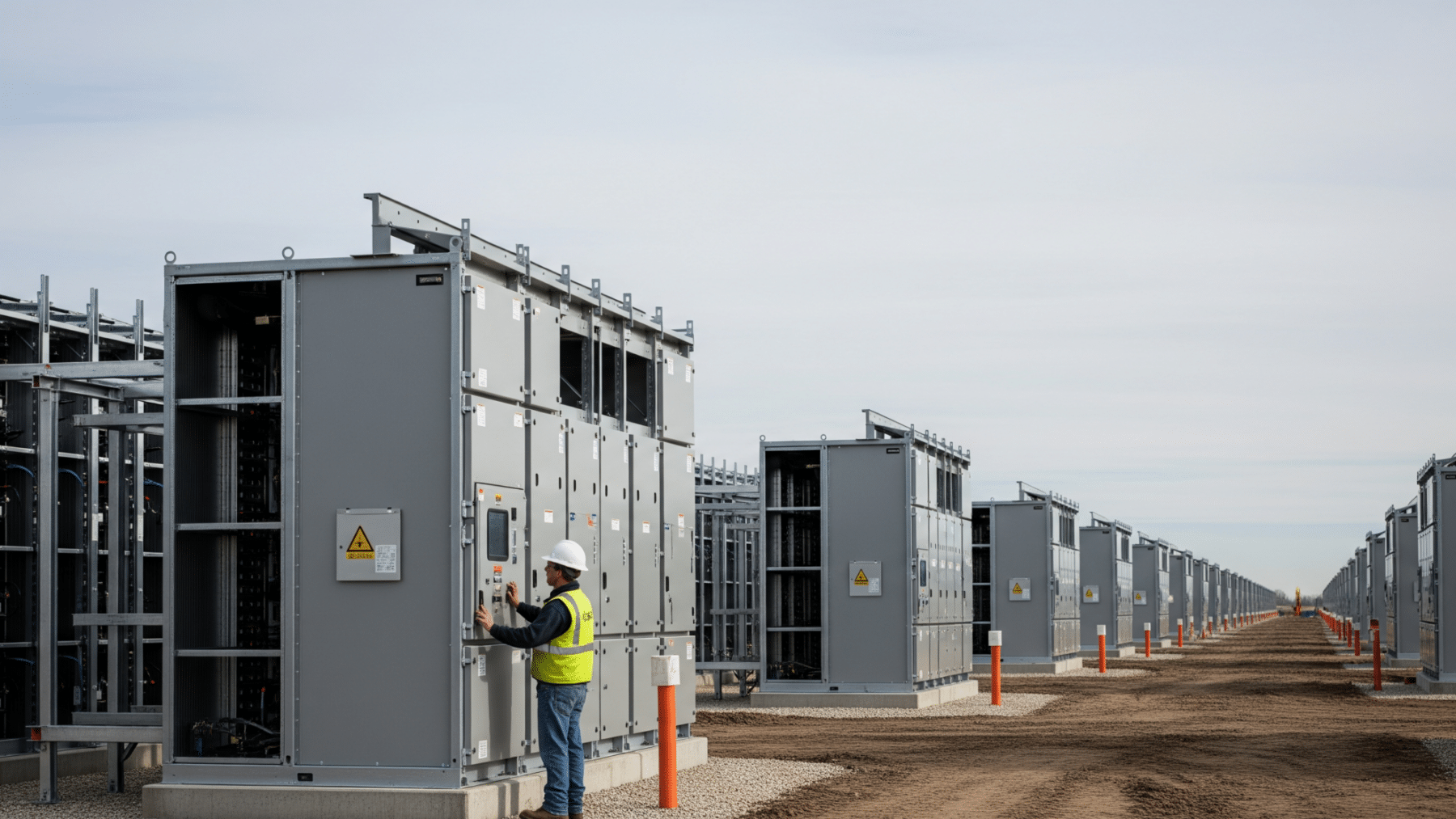
Something unusual is rising out of the flat fields just northeast of Columbus, Ohio.
It is not a factory, not a warehouse, and not a power plant in any traditional sense.
It is row after row of large grey steel cabinets, and what they are designed to do to the eastern American power grid changes a record that has stood unchallenged since battery storage first arrived at utility scale.
A corridor that already hums around the clock
The land around New Albany, Ohio, does not look like the center of anything from the road.
Lush fields give way to enormous white boxes that emit a low, constant hum.
Just northeast of Columbus, the leafy Main Street of New Albany gives way to fields and ponds, but the countryside soon transitions into mile after mile of enormous white boxes, a patch of former farmland that has become one of the densest clusters of computing infrastructure in the nation.
That corridor was recently joined by Intel, which is constructing a $28 billion computer-chip factory campus at the northern end of the industrial bloc.
Every one of those computing boxes runs around the clock, pulling power from a grid that was never designed for this kind of relentless, concentrated load.
The grid that covers 13 states and why it is under pressure
The power market that covers this part of Ohio is called PJM Interconnection.
It is the largest grid operator in the United States, stretching across 13 states and the District of Columbia, serving 67 million people.
The resulting power price spikes have drawn the ire of both Republican and Democratic governors, who are demanding that PJM and tech giants figure out how to stop data centers from driving up costs for everybody around them.
Those rising costs have a direct line to household bills.
If you have noticed your own transmission charges creeping upward over the past decade, the pressure building inside PJM is a big part of why.
The grid needed something fast and flexible enough to absorb the surge. Batteries are the answer the market keeps reaching for.
What 1 gigawatt-hour actually means in everyday terms
A gigawatt-hour is an abstract number until you translate it into something a household can picture.
A typical American home uses roughly 30 kilowatt-hours of electricity per day.
One gigawatt-hour is one million kilowatt-hours, enough, at that rate, to power more than 33,000 homes for a full day, drawn entirely from stored energy.
Now consider that this project can deliver 200 megawatts of that stored power for more than five hours in a row, injecting it directly into the substation that feeds the computing corridor whenever the grid needs relief.
That is not a backup generator.
That is a fast-response power plant that charges itself silently and releases electricity on demand in milliseconds.
The record that just fell in Ohio
On July 29, 2026, developer Eolian announced that the Flint Grid project had officially broken ground in Jersey Township, Licking County, Ohio.
The Flint Grid Project is the first large-scale battery energy storage system to qualify for the PJM capacity market and the largest battery storage system to clear the 2027/28 Residual Capacity Auction, representing more than 50 percent of all new battery storage capacity in that capacity year.
The project is also the first grid-scale battery energy storage system permitted by the Ohio Power Siting Board and the largest battery energy storage system built to date in Ohio and the PJM footprint, establishing an important precedent for future energy storage development across the state.
With 1 gigawatt-hour of storage capacity, Flint Grid will be the biggest battery on the 13-state PJM market and the biggest battery east of the Mississippi.
That is a title no battery project had ever held before, and it sits inside the grid region that covers the most densely populated stretch of the country.
The project is confirmed in Eolian’s official press release, dated July 29, 2026.
Why this one project could reshape what gets built next
The Flint Grid precedent matters well beyond Ohio.
Flint Grid is expected to enter commercial operation in advance of the 2027 to 2028 PJM capacity year.
Qualifying for the PJM capacity market is the key unlock. It means the battery is paid not just for the electricity it delivers but for the reliability guarantee it provides, a revenue stream that makes the economics of future projects far more predictable.
Spurred by tax-code changes that benefit energy storage systems with more U.S.-sourced content, domestic battery manufacturing is ramping up to meet expected demand across the country.
That supply-chain shift, combined with a cleared path through state permitting boards and the PJM capacity auction, gives the next developer a proven template to follow rather than a blank page.
For anyone watching what shows up on their electric bill, more flexible storage inside an overloaded grid is the clearest tool available to keep hidden transmission costs from climbing further. Flint Grid just proved it can be done at record scale, right in the heart of the grid that needs it most.
