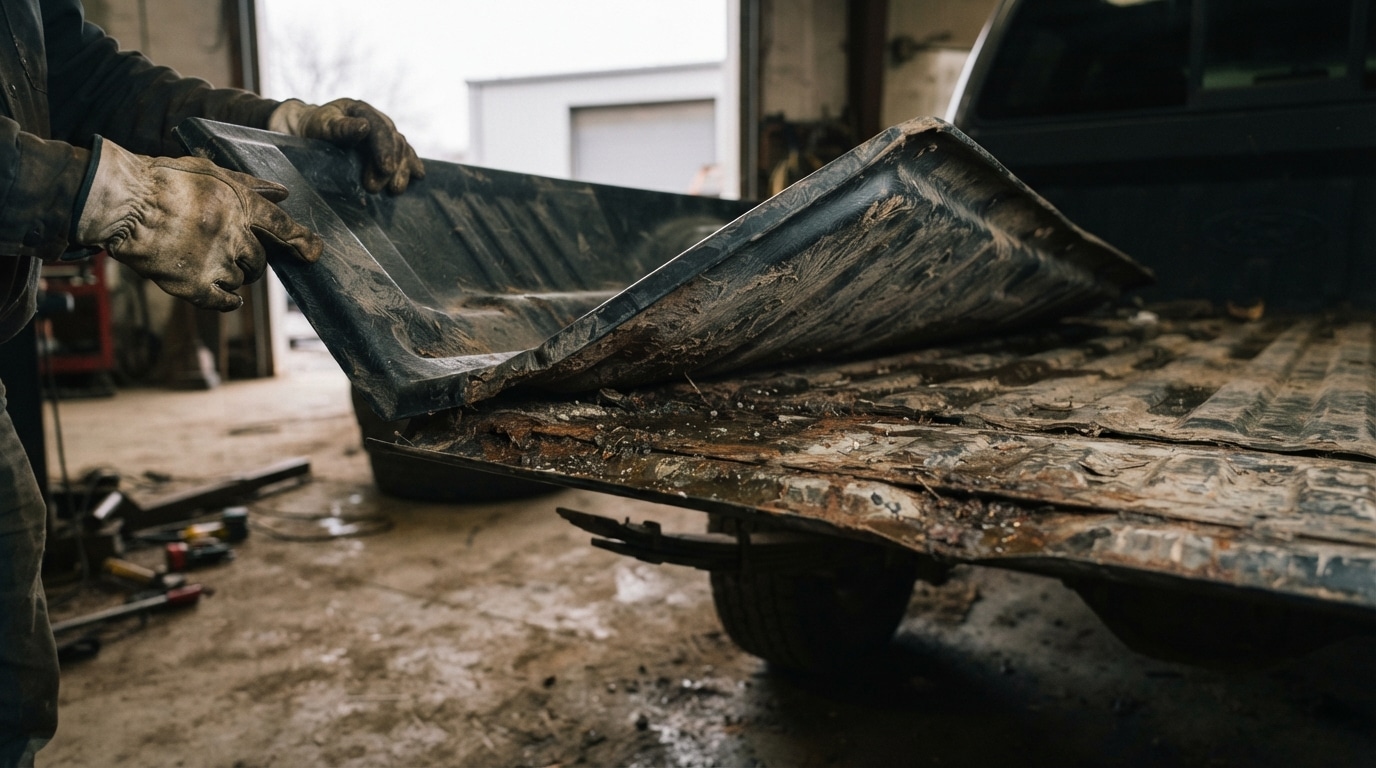
A piece of hard black plastic, resting in the bed of a brand-new truck.
It costs around $250 at any dealer or big-box store. It looks tough. It feels protective.
And for millions of pickup owners across the country, it is quietly doing the opposite of its job.
The question worth asking before the next resale: what is actually living underneath it?
How a “protective” shell becomes a moisture trap that grinds away factory paint
A drop-in bed liner is simply a piece of hard plastic that sits on top of the truck bed’s painted finish, held in place by clips or its own weight. That loose fit is where the damage starts. The shell is free to slide around with every load shift, and the constant movement rubs away at the factory paint job.
Water, sand, and grit collect between the plastic shell and the bed floor. If the shell is not periodically pulled out for cleaning, trapped moisture grinds at the paint every time the bed flexes.
In states that salt the roads, this is exactly how hidden rust gets started under a shell that looks fine on top. The liner appears intact from above. The metal below tells a completely different story.
What the bed looks like when the liner finally comes out
When truck owners lift a drop-in liner, they often find rust and damage the black plastic had been concealing for years. The surprise catches most owners off guard, because the shell on top was showing no obvious wear. Hidden corrosion beneath a perfectly intact-looking liner is the rule, not the exception.
Truck beds are exposed to water, salt, chemicals, and debris, all of which eat at paint over time. Rust starts small but spreads quickly, especially where moisture gets trapped against bare metal.
Drop-in liners also loosen and shift with use, leaving owners with damage they never noticed until the liner comes out and the full extent becomes visible. In regions with harsh winters, road salt makes everything worse. Industry installers confirm that drop-in liners trap moisture and debris underneath, leading to hidden wear, paint damage, and rust over time. By the time most owners look, rust has often worked well past the surface coat.
The repair bills and resale hit that dealers rarely mention at point of sale
Drop-in plastic liners cost $200 to $400 up front, but their five-to-seven-year lifespan and the rust repairs they can trigger make the true cost significantly higher. A drop-in at $250 plus a body-shop rust repair five years later costs more than a spray-in liner did on day one, and the spray-in is still going.
Hidden rust can reduce a truck’s resale value by $2,000 to $5,000 compared to a rust-free example. That is a steep price for a product promoted as protection.
The used-truck market already punishes rust-damaged beds hard. With used truck prices up more than 35 percent since 2019, buyers at trade-in are scrutinizing beds far more carefully than they did a decade ago. A truck with a healthy spray-in coating can ask $500 to $1,000 more than the same truck with a scratched or rusted bare bed. Drop-in shells add less because buyers know to look underneath for hidden corrosion.
Where the drop-in liner’s design limits make the problem unavoidable
The plastic shell’s rigid geometry means it never fully conforms to the bed, leaving consistent air gaps along the edges and corners where water pools soonest. Blocked drainage holes turn the truck bed into a water trap, and once corrosion gets going, repair costs escalate fast, sometimes reaching into the thousands depending on severity.
A drop-in liner sitting over a blocked drain hole is effectively a bathtub with a lid on it.
Factory spray-in liners carry their own adhesion risks if prep work is skipped. Some factory-applied coatings fail because the bed is not properly sanded prior to installation. Aftermarket installers who sand everything first achieve far better adhesion and longevity. Experienced installers consistently point to surface preparation, not the coating itself, as the single biggest factor in long-term liner performance.
What pickup owners can do now, and what the market is offering instead
The most immediate fix costs nothing. Pulling the liner once a year, hosing the bed, drying it completely, and reinstalling it can break the moisture-and-grit cycle before rust gets a foothold. Most owners skip this entirely because the liner looks clean from above and the inspection feels unnecessary.
Professional spray-in coatings bond directly to the metal rather than resting on top of it, which eliminates the gap where water and grit accumulate. Standard applications typically run $500 to $800, with premium systems reaching $1,000 to $1,500. These coatings often outlast the truck itself and can increase resale value by $1,500 to $3,000 or more.
That math matters more today than it did when trucks were cheaper to replace. As used pickups under $20,000 have nearly vanished, every point of resale value at trade-in is real money. A $250 liner that costs thousands at resale is no longer a minor miscalculation. The good news is that the fix is simple, the inspection takes ten minutes, and the window for catching hidden rust early stays open for as long as the liner comes off at least once a year.
