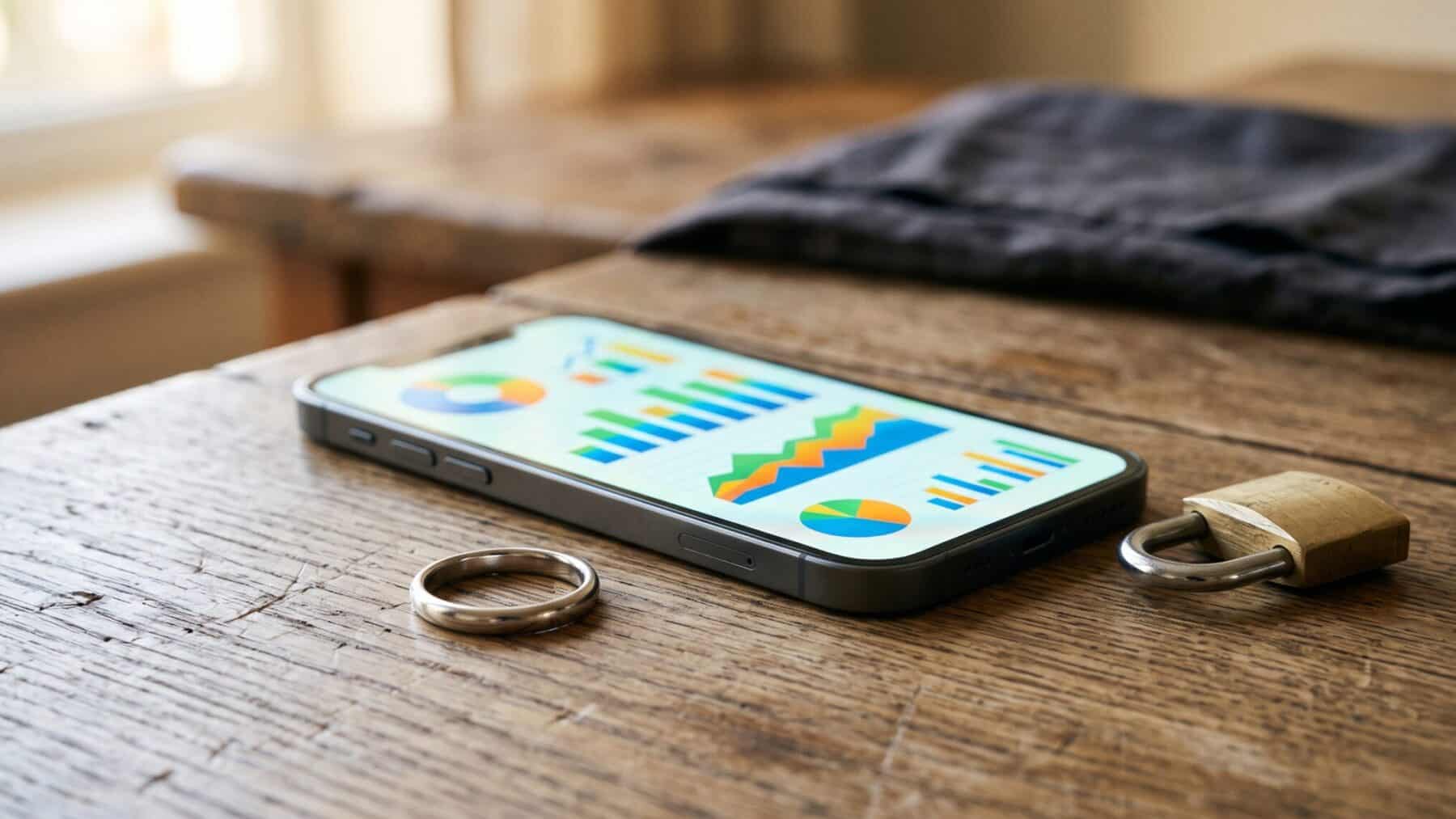
It slides onto your finger like a plain band of titanium.
There is no screen, no strap, no magnetic charging puck for a wrist. The pitch is elegant: wear it around the clock, gather over 50 health signals while you sleep and move, and read the results in an app each morning. For many buyers, the $399 price tag feels like the whole deal. It is not.
How the sensor data gets held at arm’s length once you own the hardware
Smart rings like the Oura Ring 5 are built around an array of optical sensors, an accelerometer, and a skin-temperature reader packed into the inner surface of the band. Those sensors run continuously, capturing raw signals from your pulse, your movement patterns, and the tiny fluctuations in skin temperature that track your body’s recovery state overnight.
But raw signals are not the product. The interpretation is: the readiness score, the detailed sleep-stage breakdown, the stress and recovery trend lines that tell you whether yesterday’s run actually helped. Without a subscription, the ring still surfaces three daily scores, Sleep, Readiness, and Activity, but trends, detailed HRV, temperature deviations, and the AI features stay locked. The hardware keeps recording. The software simply stops translating it for you.
That distinction, between sensing and interpreting, is the entire business model. The ring is the entry fee, and the monthly invoice is the real product.
What the checkout screen shows and what the receipt looks like two years later
When the Oura Ring 5 began shipping this past June, the headline number was clear: the Black and Silver variants retail for $399, while the rest cost $499. That figure is the one that appears in every ad, every unboxing video, and every gift-guide headline.
The ring requires a membership subscription at $5.99 a month, or $69.99 annually, to unlock more than 50 health metrics, including sleep staging, heart health, stress, and metabolic data. A buyer who picks the base ring and pays monthly is looking at roughly $72 a year on top of the purchase price. That is easy to absorb in year one.
Year two changes the arithmetic fast. The total cost approaches $540 on the annual plan after only two years, and a five-year owner pays at least $750. The subscription clock runs regardless of whether the hardware wears out.
The numbers that confirm how the market actually works
Oura is not alone in this structure, but it is the most prominent example in the fast-growing smart ring category. Subscription-free rivals like RingConn and Ultrahuman have increased the pressure to innovate, which partly explains why Oura launched a new ring just a year and a half after the Ring 4, compared with the roughly three-year gap between the Ring 3 and Ring 4.
The broader wearables market is having the same argument in public. Many buyers argue that detailed sleep-stage analysis, which the device has the sensors to perform, should not cost extra simply because the manufacturer chose to run the analysis on a server. That frustration has a name in the industry: “hostageware.”
Interest in wristband health features is accelerating across every major platform, which makes the subscription question more pressing for more buyers every month. The term is spreading fast through wearables forums and review sites.
Where the model starts to crack and what rivals are doing instead
The catch sharpens when you look at what the free tier actually delivers. Without a subscription, a $399 device is reduced to three bare daily scores and basic tracking data, with none of the detailed staging, trend analysis, or personalized guidance that the pitch promises. A very expensive scoreboard is the phrase critics keep reaching for, and it is hard to argue with the math.
Competing ring makers like Samsung and RingConn have foregone any kind of subscription, and the Samsung Galaxy Ring and Ultrahuman Ring Air are now genuine alternatives for buyers who want a smart ring without recurring fees. Each has gained ground in the past year precisely because the subscription conversation has gone mainstream.
Members who want to ask health questions, receive personalized medical advice, and connect with licensed physicians must pay an additional fee on top of the standard $5.99 monthly subscription. Each new health service layer carries its own price point, stacked above the one below it. The base subscription is not the ceiling.
Meanwhile, AI is consuming the lion’s share of startup funding, and smart ring startups racing to undercut Oura on price are finding venture capital harder to secure. That pressure may ultimately push more rivals toward the same subscription playbook, not away from it.
What an informed buyer should do before the free month runs out
All new Oura Ring 5 purchases include one month of membership free. After the 30-day promotional period, membership is $5.99 per month and will auto-renew until cancelled. That first month is deliberately generous. It is also the period during which most buyers begin building daily habits around the app and the scores, making cancellation feel costly by the time the bill arrives.
The most useful pre-purchase question is not which ring has the best sensors. It is whether you will still be opening the app every morning in year three. If you keep the ring for five years on the annual plan, you will spend roughly twice the hardware price on subscription fees alone.
Even so, the honest picture is not entirely bleak. If you specifically want sleep staging, long-term trends, and stress analytics in a screenless form factor, at $5.99 a month, Oura’s subscription is the cheapest in the premium wearable space. The real issue is that most buyers do not know they are also buying a subscription service until after checkout.
The smart ring category is still young enough that business models are genuinely in flux, and regulators have barely begun to look at how wearable health data is priced and retained. The buyer who reads the fine print today is simply ahead of a conversation the whole industry will be forced to have soon.
