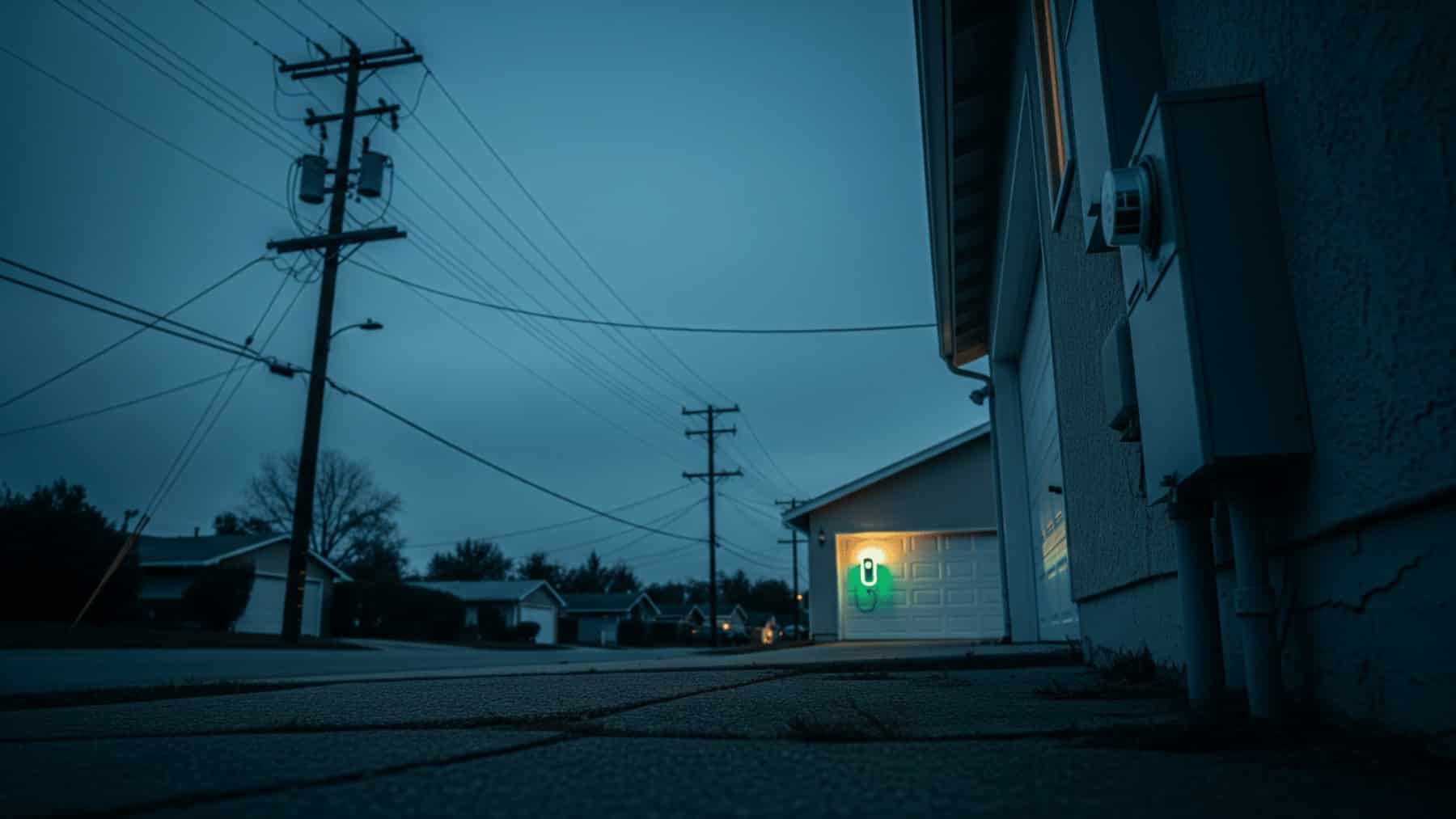
The pitch is almost perfect. Buy an electric vehicle, bolt a Level 2 charger to your garage wall, and wake up every morning with a full battery. No gas station. No exhaust. Just a hum overnight and a car ready to go.
Millions of Americans have done exactly that. And for most of them, the charger works just as advertised.
But somewhere between the garage wall and the power plant, something else is happening, and it is playing out not on anyone’s electric bill but on a piece of infrastructure almost nobody thinks about.
Why home charging became the default choice for almost every EV driver
About 80% of EV charging in the U.S. is done at home, according to the U.S. Department of Energy. The International Energy Agency places the U.S. figure even higher, at around 83%.
That number makes intuitive sense. Home charging is cheaper than a public fast charger, you do it while you sleep, and you never have to plan around a station the way you used to plan around a gas pump.
Installing an EV charger at home gives owners the convenience of charging overnight and reduces reliance on public stations.
The charger itself usually runs $300 to $900 for the hardware. Installation is extra, but the math still tends to beat years of gasoline.
The whole transaction feels finished once the electrician leaves. It mostly is, for the homeowner.
What the electrician checks when the quote arrives and why older homes get a longer look
Most Level 2 EV chargers require a dedicated 240-volt circuit with 40 to 60 amps of power.
That is a serious draw. It is roughly the same as an electric dryer , but you will likely be using it much more frequently, potentially every night.
A 100-amp panel was the standard for decades and is common in homes built more than 20 years ago. It may struggle to support both modern appliances and an EV charger simultaneously.
About 20% of homes need additional electrical work beyond basic charger installation, according to data from Qmerit. When that work is needed, the bill climbs fast.
Full panel upgrades can run $3,000 to $5,000 or more. Still, that cost stays on the homeowner’s side of the meter.
The bigger reckoning happens outside the house, on the neighborhood infrastructure that most people last thought about during a power outage.
How a charger that runs every night looks very different to the wires on your street
A single Level 2 charger pulling 7 to 11 kilowatts for several hours is not, by itself, alarming. The neighborhood transformer on the pole at the corner of your block has handled peaks like that for decades.
But a transformer that was sized in 1985 for a street of incandescent bulbs and gas ranges was not sized for six homes on the same block each plugging in at 6 p.m.
The location and timing of EV charging are critical factors, because unmanaged charging can cause peak demand surges that strain the grid and accelerate damage to the infrastructure.
The surge in EV adoption reshapes household energy demands and complicates grid management, especially during evening and nighttime charging hours.
This is the part of the story that the charger box does not mention. The U.S. energy picture is already under pressure as demand grows, and the distribution grid, the last mile of wires between the substation and your house, is where that pressure lands first and hardest.
The real catch is a multi-hundred-billion-dollar tab sitting in the neighborhood wires, not on your monthly bill
A pair of environmental engineers at the University of California, Davis, found that in order to meet the needs of the growing number of electric vehicles in that state in the coming decades, California power producers are going to have to produce more electricity and build more infrastructure to carry the load to consumer locations. In their paper published in the Proceedings of the National Academy of Sciences in 2024, Yanning Li and Alan Jenn describe their analysis of California’s electrical grid and how it will have to be changed to support the expected number of EVs on its roads in the coming decades.
The researchers found that 67% of distribution feeders in California will need capacity upgrades by 2045, with a total of 25 gigawatts of upgrades needed and a corresponding cost between $6 billion and $20 billion for that state alone.
Their work also found that feeders in residential areas will bear a disproportionately large share of those upgrade costs compared to commercial areas.
Scaled nationally, the picture is larger still. Industry analysts and government researchers studying high EV adoption scenarios have estimated that accommodating widespread EV charging across the United States could require hundreds of billions of dollars in cumulative distribution grid investment by mid-century.
The U.S. Department of Energy’s own 2024 Report to Congress confirmed the dynamic: the pace and scale of the EV transition is significant, and determining additional capacity requirements to meet vehicle charging will depend on several variables and the many decisions of stakeholders and customers.
That cost does not show up on any single homeowner’s installation receipt. It lands on utility capital budgets, rate cases, and eventually rate payers, spread thin across millions of bills over decades.
Researchers studying how land use and energy intersect have found similar patterns: infrastructure consequences often emerge years after the original decision, in places and forms nobody anticipated.
Why managed charging and smarter timing could rewrite that bill before it comes due
The good news is that the high-end cost figures assume the worst case, with millions of drivers all plugging in the moment they get home.
Achieving a balanced, resilient grid will require advanced charging technologies like time-of-use pricing, managed charging, and vehicle-to-grid integration.
The UC Davis researchers also found that the effect of additional infrastructure cost is partially offset by downward pressure on electricity rates due to the overall growth in electricity consumption.
Utilities in California, Texas, and beyond are already offering off-peak rates that reward drivers who charge after midnight, flattening the very peaks that stress transformers most.
The charger on your garage wall is still one of the smartest energy decisions most EV owners make. The wiring underneath the street just needs the rest of the grid to catch up, and the planning to do it is already underway.
