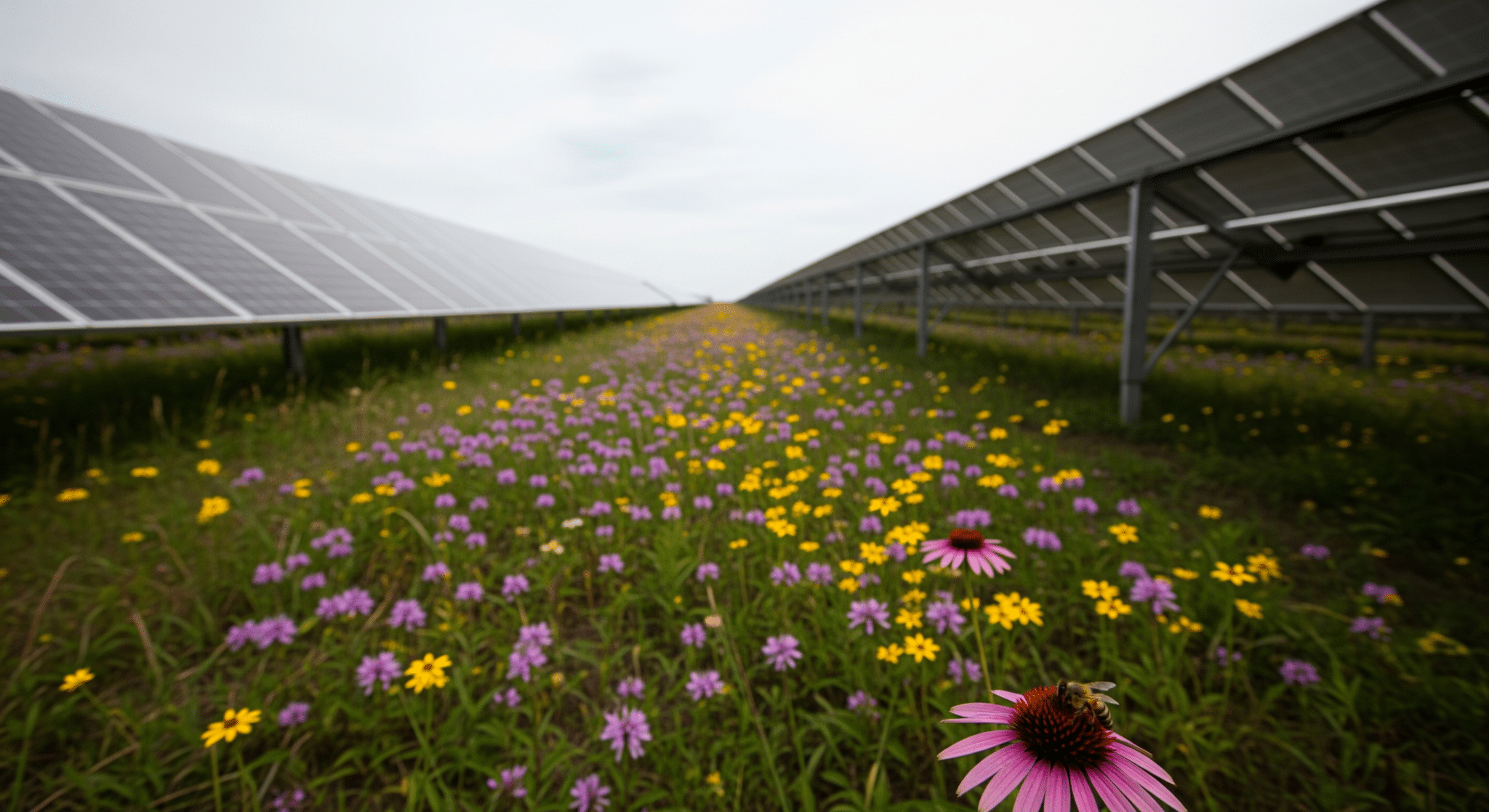
Two solar farms sit on a stretch of flat farmland in southern Minnesota that spent decades growing row crops and giving back less every season.
Nobody built them to make a nature reserve.
They were built to make electricity, the same as every other utility-scale solar project going up across the country right now.
What happened underneath the panels was something nobody put in the project plan.
Why two tired fields in southern Minnesota ended up wired to the grid
The five-year field study looked at two solar sites in southern Minnesota operated by Enel Green Power North America. Both sites were built on retired agricultural land.
The sites began operations in 2017. The soil was worn out. The biodiversity count on land like that is close to zero.
But instead of laying gravel under the panels, as many operators still do, the crews made a different call.
The two installations were built on former row-crop farmland that had been worked for decades. Much of the land beneath the panels was first cleared of weeds, then seeded with dozens of species of native grasses and flowers.
It looked like a long shot in year one.
What the ground looked like when the counting started
Federal scientists from two of the country’s most respected energy labs showed up in the summer of 2018 with clipboards and bug nets.
Researchers at the U.S. Department of Energy’s Argonne National Laboratory and National Renewable Energy Laboratory wanted to understand the ecological value of PV solar energy sites planted with native grasses and wildflowers. They examined how vegetation would establish and how insect communities would respond to the newly established habitat.
The two studied solar sites were planted with native grasses and flowering plants in early 2018. From August 2018 through August 2022, the researchers conducted 358 observational surveys for flowering vegetation and insect communities. They evaluated changes in plant and insect abundance and diversity with each visit.
The early results were modest, because prairie takes time to find its feet. The flowers were sparse at first, the insects scarce.
The researchers kept coming back anyway.
How the numbers shifted with each passing summer
Each season, something changed.
The team found increases over time for all habitat and biodiversity metrics: floral rank, flowering plant species richness, insect group diversity, native bee abundance, and total insect abundance.
The variety of blooming species grew. Then the insects began to follow the flowers.
As America’s energy demand keeps climbing, the pressure to convert land to large solar installations only intensifies.
According to the DOE’s Solar Futures Study, a very large amount of land in the U.S. will be needed for large-scale solar development by 2050 in order to meet grid decarbonization and climate change goals.
What these two fields were quietly proving is that those acres do not have to be dead land.
The 20-fold number that rewrote the playbook on solar land
By the end of five full years, the Argonne team tallied up what had moved in under the panels.
Total insect abundance tripled, while native bees showed a 20-fold increase in numbers.
Twenty times. On land that had grown nothing but commodity crops for decades.
Then came the detail that genuinely surprised the researchers.
In an added benefit, the researchers found that pollinators from the solar sites also visited soybean flowers in adjacent crop fields, providing additional pollination services to neighboring farms.
The five-year field study, led by Argonne landscape ecologist Leroy J. Walston and published in Environmental Research Letters, found rapid increases in both habitat quality and insect diversity at the two Minnesota sites, with the spillover into neighboring soybean fields among its most striking findings. The full Argonne write-up is published by Argonne.
Global insect biodiversity has been in decline due to habitat loss, pesticides, and climate change. These panels gave pollinators somewhere to go.
Why states are already writing this discovery into law
Minnesota did not keep this result to itself.
In 2016, a coalition of energy, agriculture, and conservation organizations worked together to pass the Pollinator-Friendly Solar Act, the nation’s first ground cover standard for solar facilities. Minnesota pioneered standards for what constitutes pollinator-friendly vegetation at solar sites, following that legislation in 2016 to prevent greenwashing, or false environment-friendly claims. Other states have since adopted their own voluntary pollinator-friendly solar standards, with Minnesota’s Habitat Friendly Solar Program among the most established models.
Habitat-friendly solar sites can help mitigate land-use conflicts associated with the conversion of farmland for solar energy production. As a large share of future ground-mounted solar development is expected to occur on agricultural lands, the proper siting of habitat-friendly solar on marginal farmland could make prime farmland more productive through the pollination services provided.
There is also a practical financial case. Using seed mixtures that cost less than 0.1% of the overall project budget, the flexible and science-based standard established minimum requirements for solar site owners. Solar-pollinator habitats also require less mowing and maintenance over time, which can offset establishment costs.
As the country debates how much land the clean energy transition really costs, these fields in southern Minnesota have already answered a quieter version of the question.
Build it right, and the bees will come. Then they will go next door and get to work.
For a country where fossil fuels still dominate the national energy mix, that kind of unplanned dividend from solar land may matter more than anyone expected.
