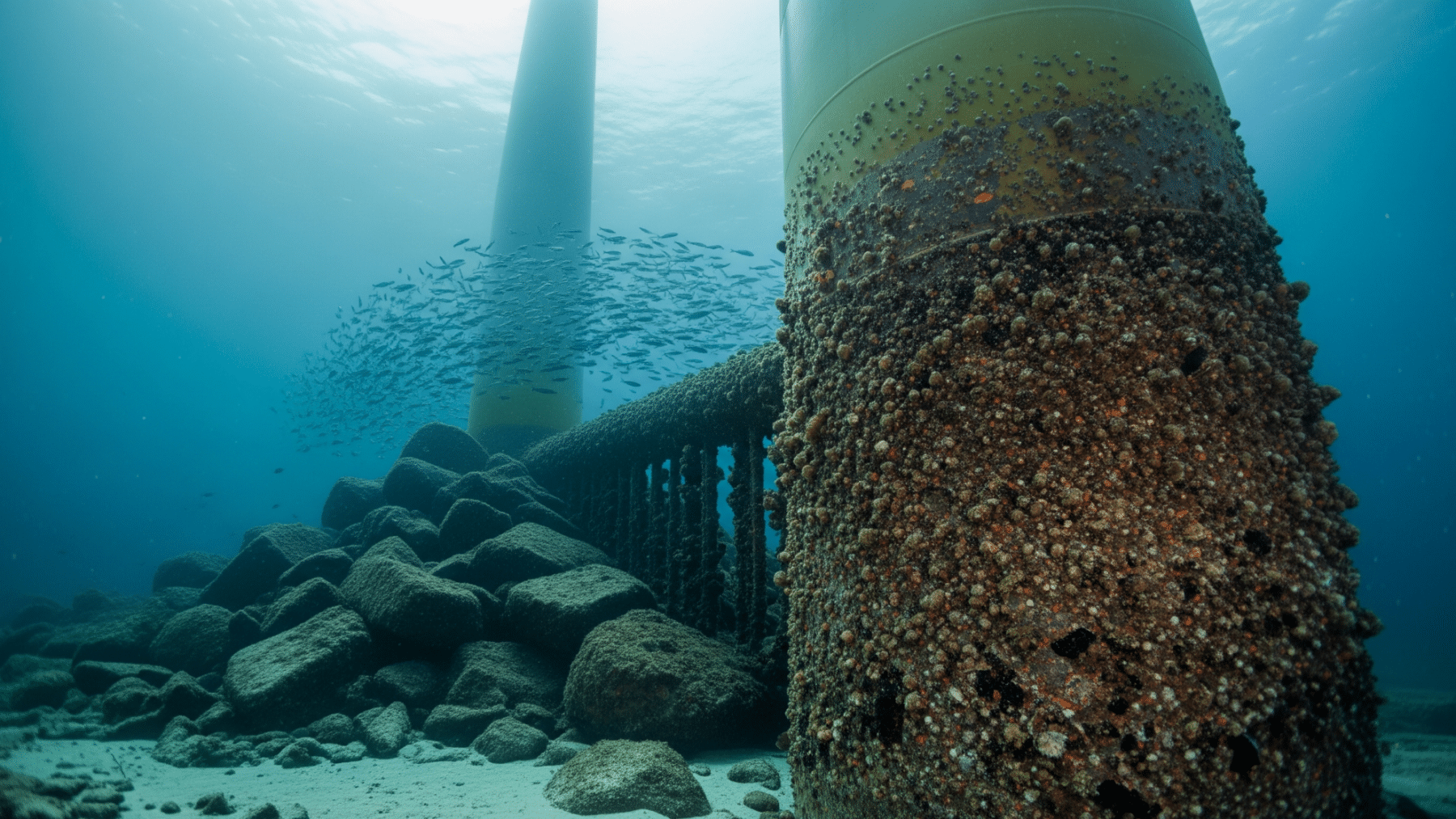
Something enormous is standing on the floor of the Atlantic Ocean, about 35 miles east of Montauk Point, New York.
It weighs thousands of tons, it rises from the seabed through up to 135 feet of cold salt water, and it spins electricity into 70,000 Long Island homes every day.
But something else is happening down there, well below the waterline and well out of sight, that nobody fully predicted when the turbines first switched on.
What it took to drive steel into the ocean floor 35 miles off Montauk Point
The South Fork Wind project’s Construction and Operations Plan was approved by the Bureau of Ocean Energy Management on January 18, 2022, construction began the following month, and its 12 turbines were fully commissioned at 132 megawatts in March 2024.
South Fork Wind is New York’s first offshore wind farm and America’s first utility-scale offshore wind farm in federal waters, with a transmission system that generates enough clean energy to power 70,000 average homes.
The offshore wind farm consists of 12 turbines supplied by Siemens Gamesa, supported by steel monopile foundations installed in a grid with an approximate spacing of 1.9 kilometers.
South Fork Wind is situated in water depths ranging from roughly 33 to 43 meters, approximately 108 to 141 feet.
That is a long way down for anything made by human hands.
Once those foundations hit the seabed, engineers expected them to hold turbines. They did not expect them to do much else.
The part of the structure nobody was watching very closely
Only the 12 turbine foundations and the large rock piles that protect them actually touch the bottom of the ocean.
This takes up just 0.02% of the project’s total area.
Think about that for a moment.
A $2 billion energy project spanning nearly 100,000 acres of federal ocean lease, and the part that physically contacts the seafloor is vanishingly small.
The construction process included relocating some boulders on the seafloor, and since boulders can provide key habitats for marine life, developers attempted to move as few as possible and minimized the distance that they were removed.
Researchers were watching, but they were mostly watching for damage. What they got instead was something harder to explain.
Why those rock piles around each foundation started changing almost immediately
Some sea creatures rely on rocky habitats with lots of nooks and crannies for hiding from predators and foraging for food, and the infrastructure that keeps offshore wind turbines anchored to the seafloor provides exactly that.
The scour-protection rock mounds dumped around each monopile to stop the current from eroding the seabed acted, from day one, like an invitation.
The turbine foundations became artificial reefs that gave species like mussels, which require hard surfaces to attach to, the right environment to thrive.
In turn, their presence attracted fish in search of a food source.
It is the same reason a ship that sinks in shallow water turns into a fishing spot within months. Hard structure in open sand is rare. Life rushes toward it.
Just like the native grasses that colonized the space under solar panels in Minnesota, the footprint of renewable energy infrastructure keeps producing surprises for scientists who look closely enough at what moves in.
The reef effect: lobster, sea bass and cod showing up at a wind farm
Between first installation and 18 months of operation, scientists observed a shift from bare steel and rocks to “artificial reefs,” glimpsing beloved species like lobster and black sea bass in and around the structures.
Marine science firm INSPIRE Environmental reports that “the new habitat and availability of food resources brings fish and shellfish to the area in what is known as a ‘reef effect,'” and the firm has documented “numerous commercially, recreationally, and ecologically important species such as black sea bass, lobster, and flounder” near the South Fork structures.
Similar reef effects had been documented at European wind farms and during a seven-year study at the nearby Block Island Wind Farm, which showed a greater amount of Atlantic cod and black sea bass in the wind farm area compared to two control areas outside it.
By 18 months after commissioning, the South Fork Wind Benthic Monitoring Program confirmed that the project had created a positive reef effect with minimal environmental impact on the surrounding marine ecosystem.
Wind farms add new structure to the marine environment that marine invertebrates attach to and grow on, and the rock scour-protection mats and monopile foundations at South Fork have followed that pattern from the earliest surveys.
This early report suggests that the construction has had beneficial impacts by adding new structures to the environment that marine invertebrates attach to and grow on.
What this means for every offshore wind project the U.S. still plans to build
The United States has ambitious plans for offshore wind along its coasts, and South Fork Wind is the first utility-scale proof of what those foundations actually do to the ocean around them.
Researchers now conclude that offshore wind energy production can be used as a tool to combine climate change mitigation with local biodiversity conservation, provided the wind farm design takes the reef effect into account.
Advanced monitoring systems including acoustic monitors continuously track wildlife activity at South Fork, and the project’s turbine spacing allows commercial fishing operations to continue between turbines, with local fishing vessels regularly operating within the site area.
That last detail matters. The same structures that generate electricity for Long Island homes may also be concentrating the fish that local fishing boats have long chased across open, featureless seafloor.
The U.S. energy grid has always shaped the landscape above ground, from coal plants to 250 years of fuel transitions that remade the American countryside. Now, for the first time at commercial scale, it is reshaping what lives below the waterline too, and the creatures moving in around those steel legs did not wait for anyone’s permission.
