A power company built a solar farm on 13 acres of rural Virginia land to generate clean electricity for about 400 homes. The fence went up. The panels went in. The engineers moved on.
Then someone opened the gate and brought in the one thing nobody had put on the blueprint.
What happened next is now being watched by energy developers across the entire state, and the math it produces is unlike anything a standard kilowatt-hour calculation covers.
A patch of Virginia farmland that quietly became two things at once
Black Bear Solar sits in rural Dillwyn, Virginia, running at a peak capacity of 1.6 megawatts on just 13 acres of land that could otherwise grow food.
That tension, solar versus agriculture, is exactly what made the site a test case.
Buckingham County, where the farm sits, holds nearly 80,000 acres of farmland and more than 400 farms, according to the Central Virginia Land Conservancy.
Losing even a sliver of that land to a fence line and a field of panels is a genuine sore point for the farming community.
That community is already watching the Virginia Clean Economy Act, a 2020 law that requires Dominion to direct a growing share of power from renewable sources and aims for the commonwealth’s Phase II utility sector to reach zero carbon emissions by 2045.
What the engineers built, and what the fence was actually keeping out
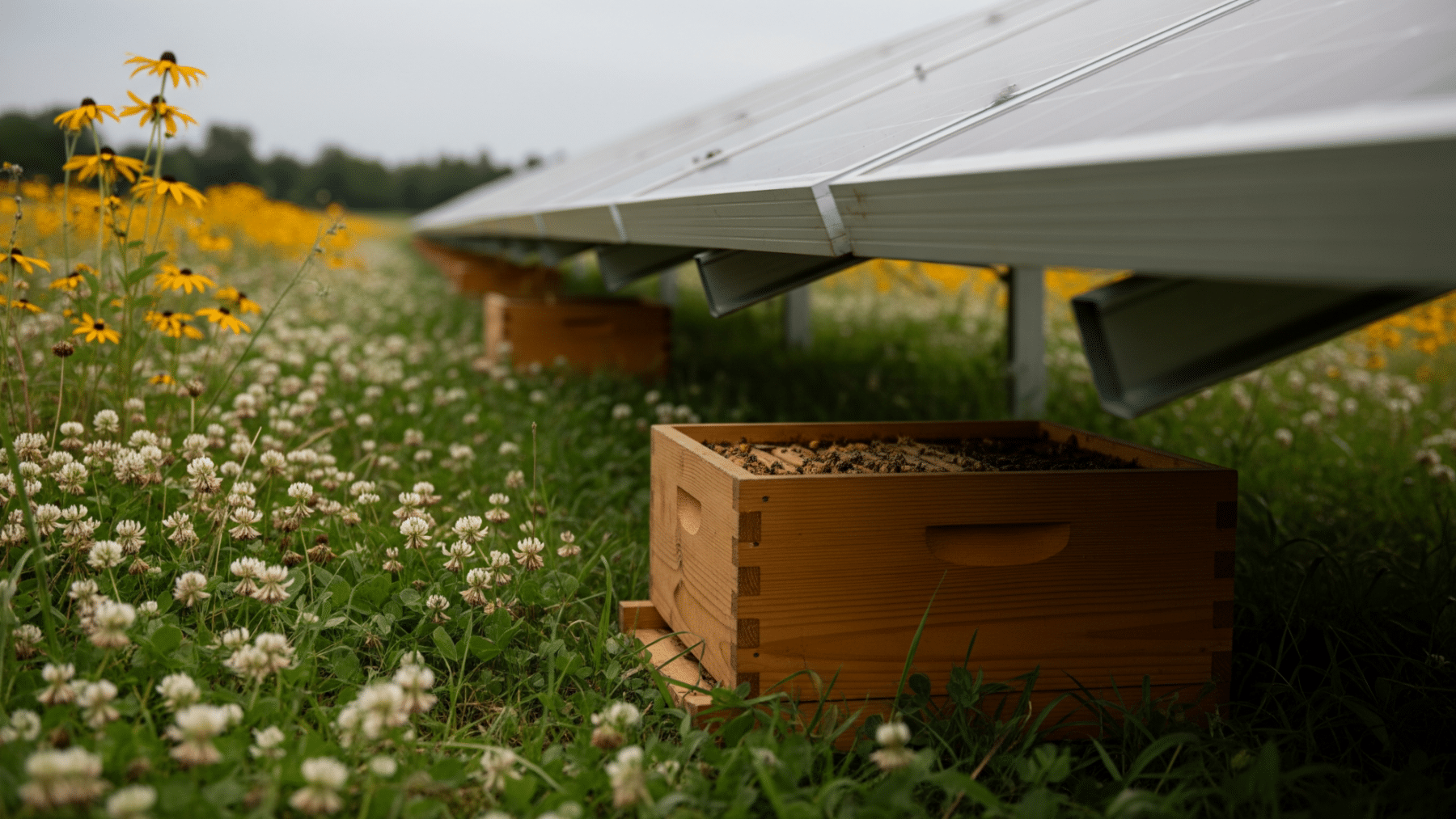
Black Bear Solar is equipped with solar panels on racked mounts above a ground layer seeded with native plants, white clover, little bluestem, black-eyed susan, eastern columbine, and lance-leaf coreopsis.
That ground cover was planted partly to manage soil erosion and partly to look better than gravel.
But the wire perimeter fence had an unintended benefit for the bees: it physically keeps out protein-hungry critters like bears and raccoons.
Black Bear Solar went online in September 2023. The black bear in the farm’s name proved a fitting one: the fence that protects solar infrastructure also serves as a means of protecting the honeybees from one of their primary predators in Virginia: black bears.
The number that made a local beekeeper stop and do the math
Dominion has been exploring agrivoltaics at Black Bear Solar, and reached out to Chuck Burden of Mountain House Apiaries to install and monitor honeybee hives at the solar farm.
The vetting process was strict. Burden evaluates chemical use on nearby farms, since farmers often use a mixture of herbicides and pesticides which can kill bees. He is also careful not to overpopulate an area with competing hives: “One of the things we don’t want to do when we’re putting in a new apiary is overpopulate an area,” Burden said.
Burden determined that Dominion’s solar farms have all a bee could need: native wildflowers, water retention ponds, fences keeping predators out, and no pesticides on the property.
Burden’s conclusion was direct. “A solar farm is an oasis, it’s kind of like a safe place for honeybees,” he said.
He then ran the numbers on carrying capacity and came back with a figure that surprised even the utility that hired him.
180,000 bees moved into a solar farm, and immediately went to work on the neighbors’ crops
Each hive has about 45,000 European honey bees and one queen, for a total of around 180,000 bees across the four hives currently on site.
Those bees pollinate wildflowers and crops within a five-mile radius around the farm, covering a significant portion of the same Buckingham County farmland that farmers feared the solar project would take away from agriculture.
Instead, the hives are sending pollinators back out across that land every single day.
On average, each hive produces up to 200 pounds of honey annually, though Burden has committed to collecting only the surplus: between 40 and 80 pounds per hive.
Black Bear Solar is capable of sustaining up to 24 hives, and Burden plans to expand over time.
The Department of Energy’s InSPIRE agrivoltaics database lists Black Bear Solar among its tracked sites, noting that the project partners with Mountain House Apiaries and homes roughly 180,000 honey-producing bees in four hives, meaning the project is part of the national picture federal researchers are building on dual-use solar land.
Earlier reporting on solar farms on Minnesota cropland found that native bee populations rose twentyfold over five years at two solar sites built on retired agricultural land, and pollinators from the solar sites also visited soybean flowers in adjacent crop fields, providing additional pollination services to neighboring farms.
Why a fence full of honeybees is now part of how Virginia thinks about its energy future
Nationally, honeybee colony losses have reached alarming levels in recent years, pressures that Buckingham County’s farming community, dependent on pollinators for their crops, feels directly.
About one-third of total crop production in the U.S. is dependent on honeybees and other pollinators. Buckingham County’s hundreds of farms feel that number directly.
Dominion is rapidly expanding its solar footprint in Virginia. It has enough solar capacity today to power 500,000 homes at peak output, and plans to build enough to support 2.5 million over the next 10 to 15 years.
At that scale, the question of what lives under the panels becomes as important as how many kilowatt-hours they produce.
As U.S. energy use hits record levels, the pressure to build more solar only grows, and so does the acreage it will occupy.
Solar beekeeping can boost rural economies by providing multiple income streams: Burden’s Mountain House Trading Company shop in Nelson County sells an abundance of honey-based products, including soaps, mead, beer, and vinegar, infused with harvest from the apiaries he maintains across Virginia.
A 13-acre field in Buckingham County set out to power a few hundred homes. It ended up feeding the countryside around it too, one foraging bee at a time.
