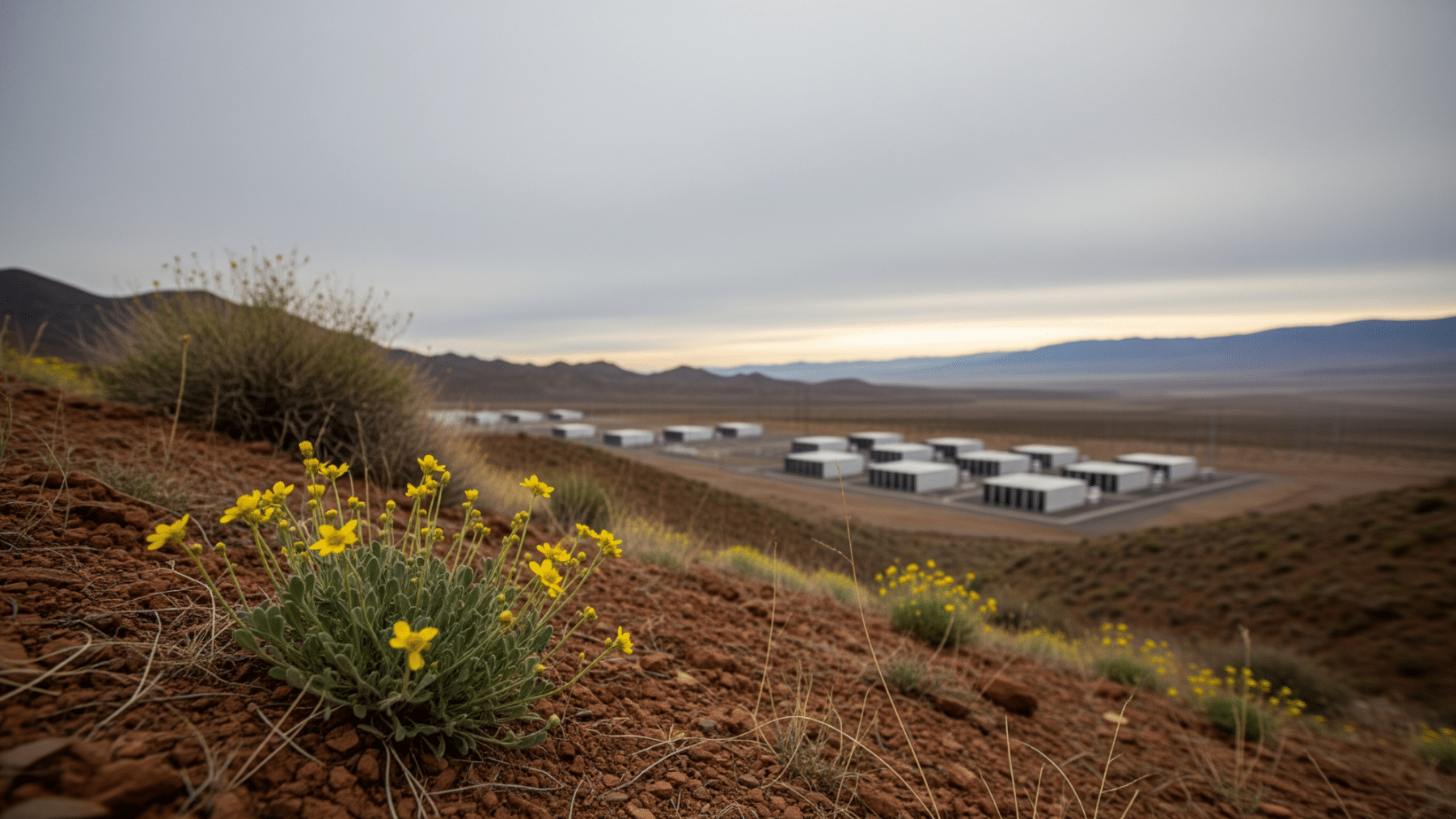
Every time summer heat pushes electricity demand past what ordinary power plants can handle, a fleet of gas-fired backup generators roars to life somewhere nearby. Most Americans never see them. They just feel the bill.
For decades those plants were the only answer the grid had. Then came a technology that promised to change everything, and in 2025 it finally arrived at scale.
The backup plant that nobody wanted to talk about
When demand for electricity spikes, such as on very hot days when air conditioners are running full blast, grid operators fire up fossil-fuel-powered plants that can quickly ramp up to meet peaks in demand.
The U.S. relies on approximately 1,000 peaker plants, mostly fueled by natural gas, to meet infrequent peaks in electricity demand.
Because peaker plants are used sparingly during periods of high demand, they carry higher costs per kilowatt-hour than baseload plants.
They also tend to sit in the neighborhoods least able to push back.
Fossil fuel plants are disproportionately sited in low-income communities, communities of color, and areas already overburdened by pollution.
Why engineers started stacking giant metal boxes instead
The idea was elegant: replace those gas turbines with lithium-ion battery packs, charge them when the grid is flush, and discharge when demand spikes. No smoke. No roar. Just electricity flowing out of a container.
Lithium-ion battery prices plummeted by nearly 90 percent since 2010, making solar-plus-storage systems cost-competitive with natural gas peaker plants.
Utilities and grid operators took notice fast.
In 2010 the U.S. had just 4 megawatts of battery storage capacity, and that number remained relatively unchanged until 2020.
What happened after that was not gradual.
How a trickle became a flood almost overnight
Cumulative utility-scale battery storage capacity exceeded 26 gigawatts in 2024, with generators adding more than 10 gigawatts of new battery storage capacity that year, the second-largest generating capacity addition after solar.
Then 2025 arrived. The U.S. energy storage market hit a record 18.9 gigawatts of battery energy storage system installations in 2025, a 52 percent increase over 2024, according to the U.S. Energy Storage Monitor report released by the American Clean Power Association and Wood Mackenzie.
Momentum is set to continue, with the U.S. projected to install half a terawatt-hour of storage between 2026 and 2031, a 250 percent increase over the previous five-year period.
Over 50 GW of cumulative energy storage has been installed in the U.S. since 2019, with average annual installations growing 107 percent year-over-year on a megawatt-hour basis.
The promise looked clean and simple: a box on a pad, no fuel line, no exhaust stack. That’s where the story gets complicated. Consider what’s already happened out at the grid’s edge where new load keeps arriving and the strain compounds daily.
Every one of those cells needs lithium, and there is only one place left to get it
Here is the catch the sales brochures skip. Each of those grid-scale battery packs is built around lithium, and the fastest path to a large new domestic supply runs straight through a ten-acre ridge in the Nevada desert.
Eriogonum tiehmii, known as Tiehm’s buckwheat, is a species of flowering plant endemic to the Silver Peak Range of Esmeralda County, Nevada, and its only known population is at high risk of destruction due to proposed mining for lithium used for batteries.
The proposed Rhyolite Ridge Lithium-Boron Mine in Esmeralda County is sited directly on the only known habitat in the world for the wildflower.
Tiehm’s buckwheat only grows on about 10 acres of land, and federal wildlife officials estimated the remaining population at roughly 15,757 individuals.
Under the final mine plan, the open-pit Rhyolite Ridge operation would directly destroy up to 21 percent of the buckwheat’s 910 acres of protected critical habitat, while severely degrading the rest because of its proximity to mining operations, with the open pit coming within 44 feet of the rare plants. Expert reports indicate significant degradation of the entirety of the critical habitat would result from dust and pollutant deposition, erosion, and pollinator disruption.
The proposed mine could quadruple the nation’s current production of lithium and potentially supply up to 370,000 electric vehicles annually, though at the cost of a significant share of an endangered wildflower’s critical habitat.
In late March 2026, U.S. District Judge Cristina D. Silva ruled in favor of the Department of the Interior and its Bureau of Land Management, rejecting conservation groups’ claims that federal agencies violated the Endangered Species Act, the Federal Land Policy and Management Act, and the National Environmental Policy Act when approving the project, according to the U.S. Energy Storage Monitor report. The Center for Biological Diversity subsequently appealed the ruling to the Ninth Circuit Court of Appeals.
This is the real-world consequence of the land tension that shows up whenever clean energy needs a footprint on actual ground.
Where the grid and the desert floor are now headed together
The tension is real, but so is the engineering work underway to ease it. Beyond lithium-ion, advances in solid-state batteries, flow batteries, and thermal storage are broadening storage applications across different durations.
The Center for Biological Diversity, which successfully pushed for Tiehm’s buckwheat’s endangered species designation in 2022, has appealed the ruling to the Ninth Circuit, arguing the case could have implications for other species and protected habitats under the Endangered Species Act.
Scientists have also raised concern over the mine’s groundwater consumption in a basin already under water-resource pressure.
Battery storage is genuinely challenging the smoky peakers that made power dirtier and costlier. The record growth is real, and the grid is cleaner for it.
But every box stacked on a Texas or California pad draws a line back to a specific patch of Nevada soil.
Conservationists recognize lithium mines are crucial to reducing carbon emissions, but they want companies to pursue the metal in a way that does as little harm to the surrounding habitat as possible. That negotiation, between the clean grid and the wild ground beneath it, is now before a federal appeals court, and it is not finished.
