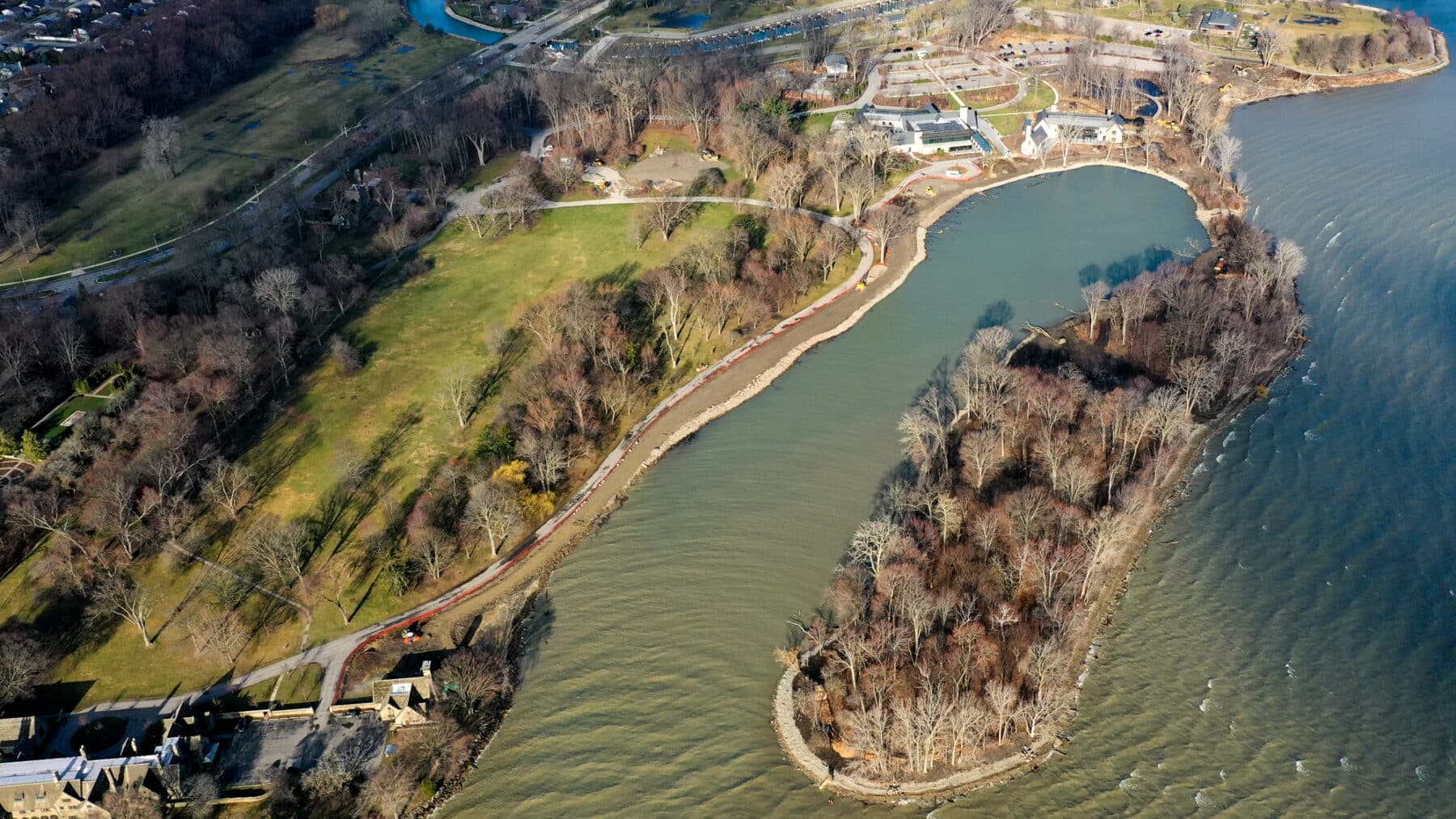
Somewhere along the waterfront of a grand 1920s estate in Grosse Pointe Shores, Michigan, heavy machinery spent months ripping out concrete slabs and rock that had lined the shore for decades.
The work was loud, unglamorous, and deliberate.
And what it has made room for is something nobody planned when the estate was first built, but something scientists say the Great Lakes urgently need.
Why 99.9 percent of this Michigan shoreline became a problem
About 99.9 percent of Michigan’s Lake St. Clair shoreline is hardened with concrete and rock, according to NOAA, which strips away the shallow, vegetated zones where fish spawn and young fish grow.
That figure sounds almost impossible, but it is the reality along that stretch of water.
Shoreline hardening helps prevent erosion and flooding, but it also removes important fish habitat. “The hardened shoreline essentially eliminates that nearshore habitat that’s important for fish spawning, breeding, and nursery areas,” said NOAA Marine Habitat Resource Specialist Terry Heatlie.
And fish aren’t alone in suffering for it.
Ford House is removing hardened shoreline and replacing it with nature-based features that reduce flooding while rebuilding habitat for fish, amphibians, reptiles, and birds.
The estate that sits at the center of one of Michigan’s top restoration priorities
The property in question is not a public park or a nature reserve.
It is the historic lakeside estate of Edsel Ford, Henry and Clara Ford’s only son, where he lived with his wife Eleanor and their children beginning in 1928.
NOAA considers this project one of the top three priority coastal restoration projects in the State of Michigan.
In June 2023, Ford House was awarded a Transformational Habitat Restoration and Coastal Resilience Grant from NOAA, providing up to $7 million to support the restoration of natural habitats along Ford Cove and nearly one mile of Lake St. Clair shoreline.
The Edsel and Eleanor Ford House has opened nearly one mile of restored Lake St. Clair shoreline to the public, marking a major milestone in the Lower Lake St. Clair Habitat Restoration Project. A ribbon-cutting opened public access to a reopened Bird Island and a new universally accessible path along the berm, part of a restoration that focused on improved fish habitat within Ford Cove and in Lake St. Clair.
It is the kind of commitment to land and living things that echoes what other automakers have quietly begun, like the pollinator programs tied to Toyota’s vast North American land footprint, or the 640 certified acres converted into living habitat across 17 corporate sites.
What nearly a mile of concrete and rock removal actually looks like on the ground
The plan calls for restoring nearly one mile of Lake St. Clair coastline, a full ecological overhaul of the cove and Bird Island.
Work has included tree and concrete removal, earth moving, and installation of natural stone, with pathways, habitat building, and planting taking place during spring and summer. Crews also placed downed logs into the cove to create complex underwater habitat and planted native wetland vegetation, including undercut sections of shoreline that create protected spaces where fish can rest and hide from predators.
The Lower Lake St. Clair Habitat Restoration Project involves removing the concrete and rock, planting native plants along the shoreline, and restoring the nearby coastal marsh. Phase 1 focused on the wooded wetlands area near the Visitor Center, where dead trees and invasive species were carefully removed to allow native flora to thrive.
The restoration has already added over 50,000 native perennial plants and 500 trees and shrubs, with more to come.
Ecological restoration work will continue into 2027.
The creature nobody expected, and what its return means for the cove
Scientists already knew that ospreys and bald eagles might return once the food chain recovered. Project team members have noted that the property sits on a major migratory bird pathway where more than 200 species have been documented, and that more habitat and food sources are expected to draw even more activity.
But the creature that genuinely surprised researchers is far stranger and far smaller.
The Ford House is adding underwater rock structures to encourage the return of mudpuppies, fully aquatic salamanders with external red gills. These unusual animals had virtually no recorded presence here.
Then came the frog observation.
Previous restoration work on the property had recorded almost no frog sightings in its history. After a small wetland project, frogs began returning within a year, a sign of how quickly nature can respond when habitat is rebuilt.
Mudpuppies, it turns out, are not just a curiosity. The salamander mussel is the only freshwater mussel in North America to use a non-fish host. It is unique among freshwater mussels in using mudpuppies as its glochidial host, making it the only known unionid mussel to use an amphibian rather than a fish. Its larvae, called glochidia, attach to the gills of mudpuppies, where they receive necessary nutrients before dropping off into the substrate to complete their development.
A critically imperiled mussel, completing part of its life cycle on the gills of a spotted aquatic salamander, on the grounds of an American automotive dynasty’s estate. NOAA Fisheries has documented the chain of species this restoration is intended to support.
Why a ribbon-cutting on a century-old estate points to something bigger
The Edsel and Eleanor Ford House has opened nearly one mile of restored Lake St. Clair shoreline to the public for the first time, marking a major milestone in the Lower Lake St. Clair Habitat Restoration Project.
The project will reduce the impact of waves and flooding, reduce polluted runoff and nutrient loads, and increase recreational fishing opportunities. It will also increase public access to the shoreline for future educational and recreational activities.
Phase 2 will continue along the Lake St. Clair shoreline, restoring the shoreline’s natural contours, preventing erosion, and expanding wetland habitat. The full project is anticipated to be completed by 2027.
The story is a reminder that automotive history and living ecosystems do not have to be opposites.
A shoreline that spent a century locked under concrete and rock is now, one natural stone and one native plant at a time, becoming something alive again.
