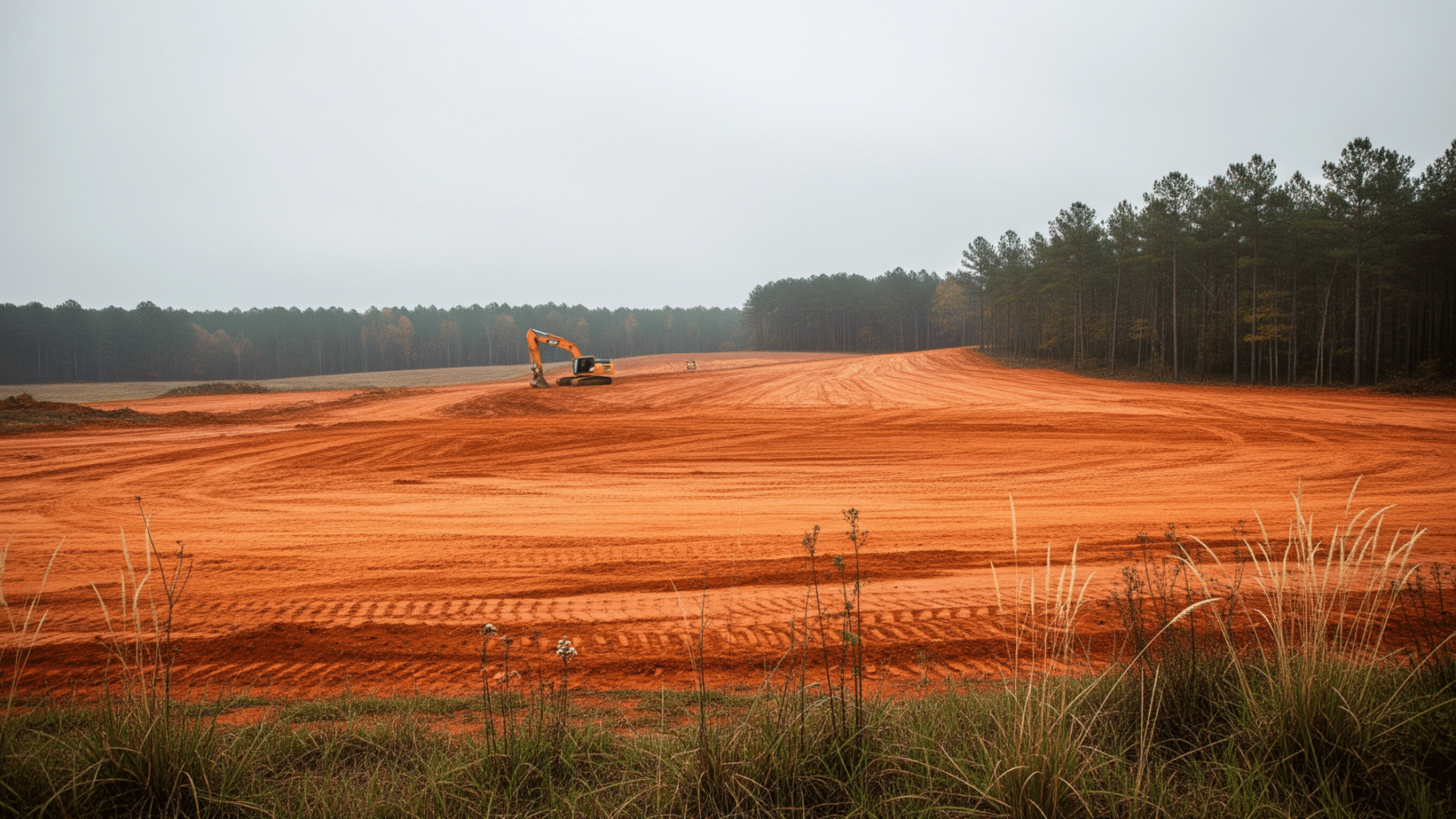
About 45 miles east of Atlanta, along the Interstate 20 corridor, a wide stretch of Georgia countryside has been quietly transforming.
It is not a suburb. It is not a shopping center. It is a factory floor in the making, one that will eventually stamp out hundreds of thousands of electric vehicles a year.
But before that happens, something else had to be dealt with first. Something that had nothing to do with robots, weld lines or stamping presses.
Why this patch of Georgia farmland suddenly became one of the most watched pieces of land in the country
The site, formerly known as the East Atlanta Megasite, spans just under 2,000 acres in Morgan and Walton Counties.
It is a mix of open grassland, trees, ponds and stream corridors that had been zoned for agricultural and residential use for generations.
Several nearby landowners filed lawsuits challenging the project. Those legal fights stretched on for years, delaying everything.
The state bypassed a potentially contested rezoning vote by taking direct ownership of the land before leasing it to the local joint development authority, which in turn leased it to Rivian.
Courts ultimately dismissed the challenges, ruling that government-owned land is exempt from local zoning ordinances, but the litigation delayed the project significantly.
The scale of what is being built here is hard to picture from a highway overpass
On September 16, 2025, Rivian Founder and CEO RJ Scaringe and Georgia Governor Brian Kemp were joined by company, state, and local officials to break ground at the company’s manufacturing site at Stanton Springs North.
The facility represents the single-largest economic development investment in Georgia’s history.
The investment figure attached to it is five billion dollars.
Originally slated to open in 2024, the project will now be developed in two phases, with vehicles expected to begin rolling off assembly lines in 2028.
Once the second phase of construction is complete, an annual production capacity of up to 400,000 vehicles is expected at the facility. The $5 billion investment is expected to create 7,500 long-term jobs by 2030.
That is a city-sized payroll rising out of what, not long ago, was pastureland and pine forest.
And the people watching the site most closely were not investors. They were ecologists, and neighbors who had watched wildlife inhabit those stream corridors and tree lines for years.
Before the groundbreaking, a federal agency had already completed its environmental review
The U.S. Department of Energy’s Loan Programs Office issued a draft environmental assessment for Rivian Stanton Springs North, which assesses the potential environmental impacts associated with providing potential financial assistance, a federal loan, for the construction of a proposed new electric-vehicle manufacturing facility and ancillary infrastructure in Morgan and Walton Counties, Georgia. That process was finalized in December 2024, when the DOE Loan Programs Office completed its environmental assessment and issued a Finding of No Significant Impact for the proposed federal loan for the facility in Morgan and Walton Counties.
That assessment was not a formality.
The EA addresses Rivian’s construction at the Stanton Springs North site, located about 45 miles east of Atlanta in the business park development of Stanton Springs North.
It required, among other things, wetlands mitigation work to be completed as a condition of the federal loan deal.
The final 20% of the estimated value of the state’s contribution is delivered through site work such as wetlands mitigation, a 500-acre pad ready for development and road improvements, according to Georgia Department of Economic Development Commissioner Pat Wilson.
The living thing the construction crews had to contend with before a single wall could go up
The land at Stanton Springs North was not empty. It was alive.
The site encompasses grasslands, trees, lakes, and streams, precisely the mosaic of habitat that, according to state planning documents, made conserving wildlife buffers and outdoor recreation areas a high priority for local partners and Rivian alike.
That obligation is reflected in Rivian’s own public statements. Rivian is actively working to ensure that both the construction process and future facility meet the company’s high standards of conservation and sustainability for a cleaner, wilder future.
Employing modern construction techniques and advanced environmental management, the nearly 2,000-acre site is elegantly integrated with the surrounding environment and is intended to feature recreational trails, including a Rivian experience trail.
Site development activities involved course grading plans, cut and fill, soil preparation, initial site grading, temporary access roads, and development of 11 stormwater retention and detention features, the last item being a direct nod to the water systems that wildlife depend on.
The DOE’s Finding of No Significant Impact, finalized in December 2024, confirmed those obligations as formal conditions of the federal loan.
It is a rare thing to see a factory blueprint designed around the concept of what was already living there. For readers following how the automotive industry manages its land footprint, the Rivian approach is a markedly different starting point.
What the finished campus is actually supposed to feel like, and why that matters beyond the assembly line
The nearly 2,000-acre site is intended to feature recreational trails, including a Rivian experience trail, integrated with the surrounding environment.
That is a factory that doubles, in part, as a landscape.
Rivian plans to produce its midsize R2 SUV and R3 crossover at the campus located outside of Social Circle, near the I-20 corridor east of Atlanta.
The first vehicles are expected in 2028, though for many people nearby, the more pressing question has always been what the land looked like before the first pour of concrete.
The answer, confirmed in federal environmental review documents, is that it looked like something worth protecting. And for now, the plan says it still will be, at least in part.
Whether an EV factory and the wildlife that already called this land home can truly share 2,000 acres of Georgia countryside is a question that will take years to answer.
But it is the kind of question that, not long ago, nobody thought to ask an automaker at all. For EV owners already watching how the industry’s costs and promises stack up, the real-world calculus of electric vehicles keeps turning up in unexpected places.
