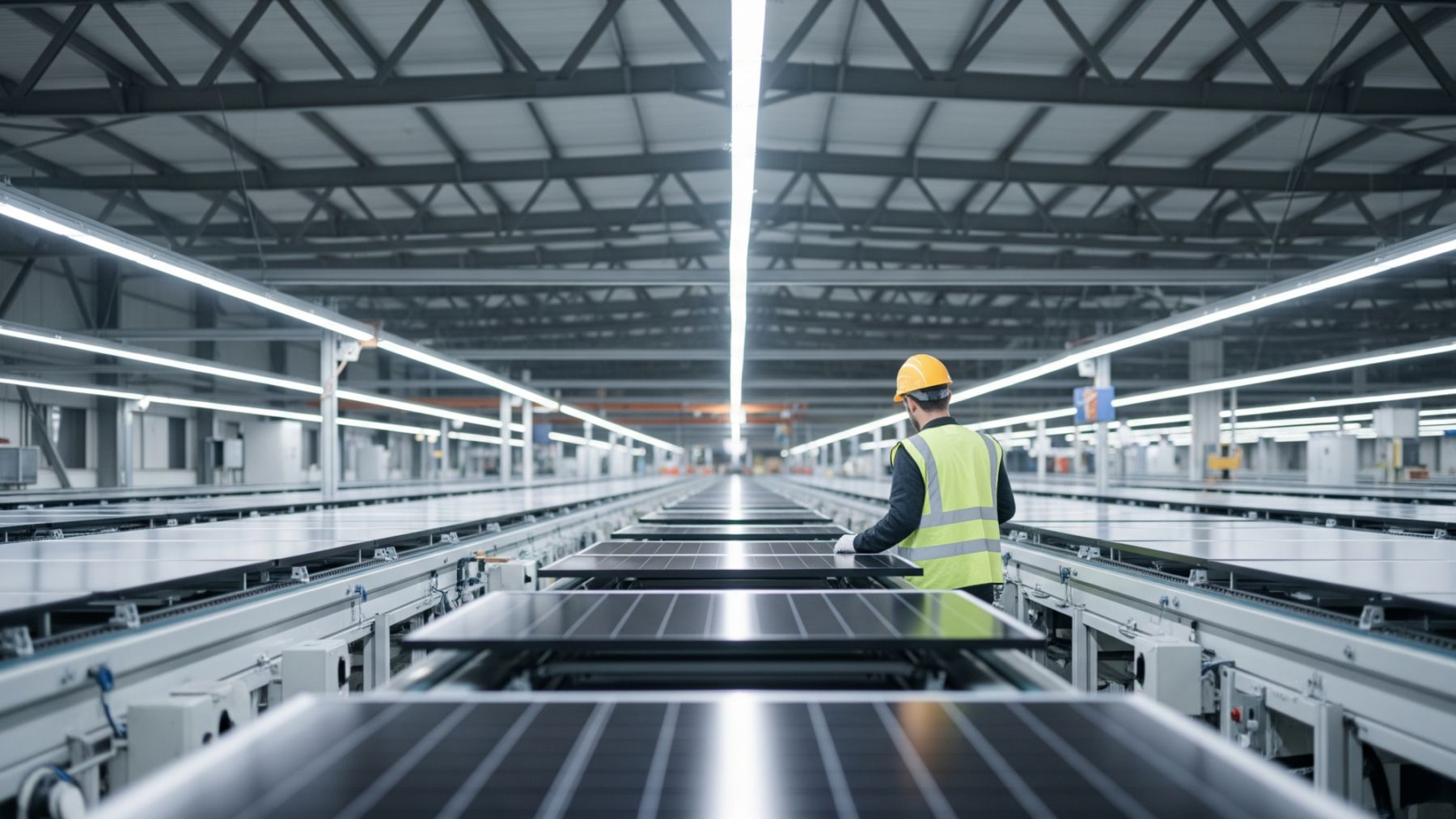
SEG Solar announced on June 1, 2026 that it will build a third solar module factory in the Greater Houston area, a move the company says will lift its planned annual U.S. production capacity to 10.6 gigawatts and position it among the largest domestic solar manufacturers in the country.
A third factory in rapid succession
The Houston-headquartered company plans to develop the new 4.6 GW facility in Greater Houston, Texas. According to SEG Solar’s announcement, the site will span approximately 1.15 million square feet, including a factory and a warehouse, and SEG has already signed an agreement with a local construction company to begin development.
The announcement comes ahead of the grand opening of SEG’s second 4 GW factory, scheduled for August 7, 2026. Construction of the third facility is projected to be completed by March 2027, with commercial production expected to begin in May 2027.
The latest announcement came less than one month after SEG announced its second U.S. site, a new 4 GW solar manufacturing facility in Houston, Texas, announced May 7, 2026. By the end of 2025, SEG had shipped over 7.5 GW of solar modules worldwide and reached a module production capacity of 6.5 GW.
Next-generation technology and supply chain strategy
The new facility is designed with the flexibility to support next-generation heterojunction technology, or HJT, enabling high-efficiency module production aligned with the evolving needs of the U.S. market. The company says it is also evaluating potential U.S. sites for a dedicated HJT cell manufacturing facility.
The facility is also designed to support FEOC-compliant module production through strengthened supply chain traceability, material control, and compliance management. FEOC, or Foreign Entity of Concern, rules restrict the domestic content bonus available under federal tax credit programs for projects using equipment linked to adversarial nations, making traceability an increasingly commercial priority.
SEG had previously disclosed plans to develop a 5 GW ingot and wafer manufacturing facility in Indonesia, with construction of that phase expected to begin in Q2 2026. Once completed, the company says it will be positioned to deliver modules through a fully integrated supply chain spanning ingots, wafers and cells.
Texas anchors a broader domestic buildout
Texas is projected to surpass 15 GW of solar module production in 2026, representing roughly half of all silicon-based photovoltaic modules manufactured in the United States. SEG’s expansion is part of that broader domestic solar module manufacturing trend.
Other manufacturers are also adding domestic capacity. Suniva announced it will open a second monocrystalline silicon solar cell manufacturing facility in Laurens, South Carolina, with a projected opening in Q2 2027. The new 4.5 GW site will join Suniva’s existing 1 GW manufacturing site in metro Atlanta to bring the company’s total domestic manufacturing capacity to 5.5 GW annually.
The expansion reflects a broader trend across the U.S. solar industry, where manufacturers are investing heavily in domestic production in response to federal industrial policy incentives and rising demand for domestically sourced equipment. Regulators are simultaneously tightening sourcing requirements and scrutinizing foreign-linked components, adding urgency to supply chain reshoring efforts.
Policy backdrop shaping investment decisions
The domestic manufacturing rush is unfolding against a shifting trade landscape. Since 2018, the U.S. government has placed Section 301 tariffs on many Chinese products including polysilicon, solar wafers, cells, modules and inverters. In 2024, tariffs on solar modules, cells, wafers and polysilicon were raised to 50 percent.
Three significant tariff actions remain pending: a new antidumping and countervailing duty petition against solar imports from India, Indonesia and Laos, with a decision expected mid-2026; a Section 232 polysilicon national security investigation with uncertain timing; and routine bifacial and cell-tier exemption reviews.
The solar manufacturing surge feeds directly into a rapidly expanding grid storage pipeline. U.S. battery storage capacity is on track to reach 67 gigawatts by early 2027, and first-quarter storage records are being shattered as paired solar-plus-storage projects proliferate across the Sun Belt states where SEG is concentrating its investment.
