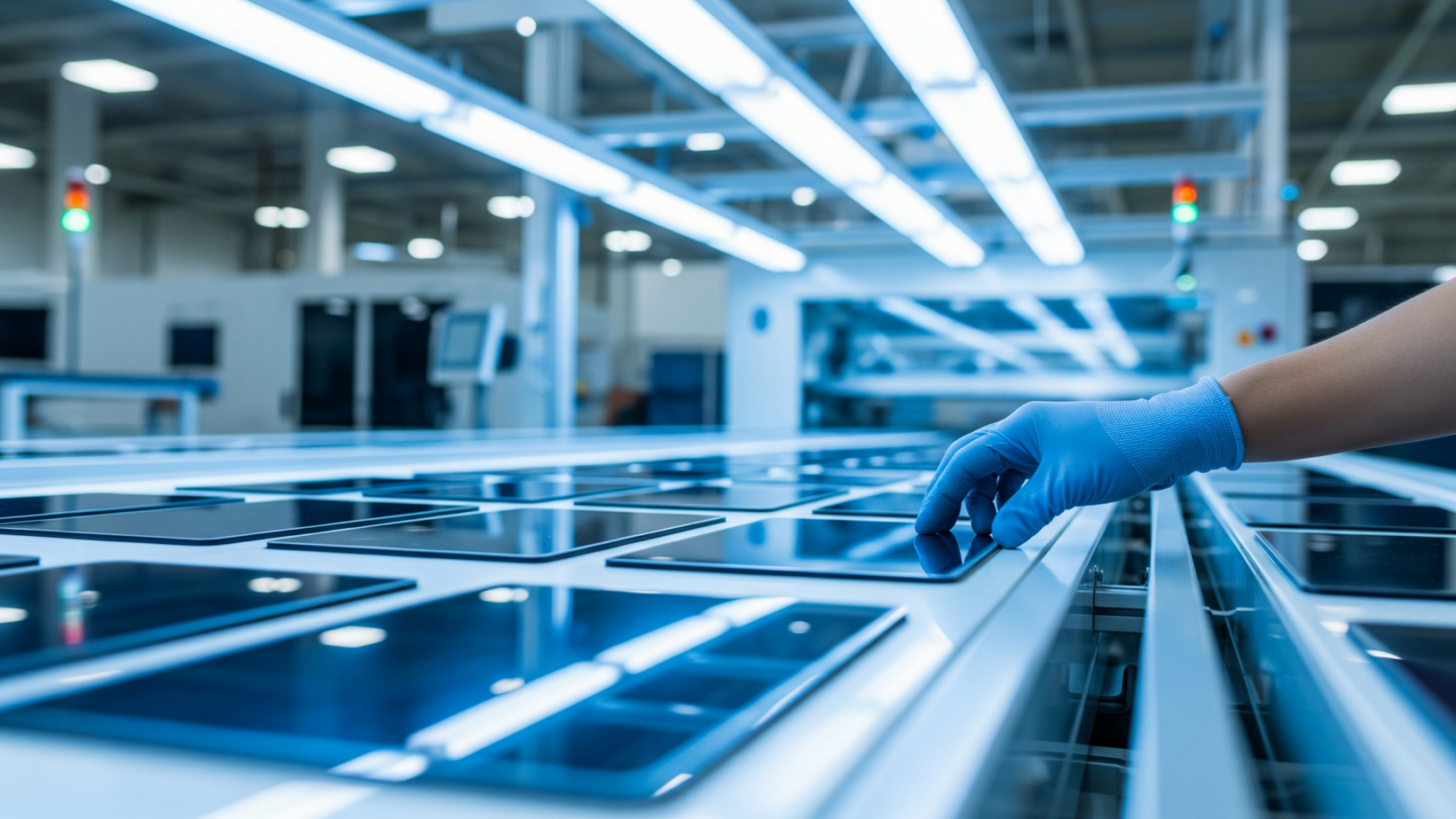
Qcells announced on June 9, 2026, that its Cartersville, Georgia factory has begun manufacturing solar cells, making it the first facility in the United States to produce ingots, wafers, cells, and finished modules under a single roof.
The company expects to reach full production by the third quarter of 2026, at which point Cartersville will become the largest operating solar cell factory in U.S. history.
What makes Cartersville different
Cartersville is the first and only U.S. factory to produce the major parts of a solar photovoltaic module under one roof, from ingot to finished panel. That distinction matters because, until now, domestic solar manufacturing was largely limited to final module assembly using imported cells.
When Qcells announced the factory in January 2023, cell and wafer manufacturing was described as nearly nonexistent in the United States. Scott Moskowitz, Qcells vice president of market strategy and public affairs, said during a media tour of the campus that what was being built represented the first solar cell manufacturing at that scale ever in the United States.
The Cartersville campus is composed of four factories working together as a single integrated manufacturing operation. It employs approximately 2,000 workers, including roughly 1,600 production employees.
Production targets and Georgia footprint
When cells and upstream lines reach full capacity, Cartersville will produce 3.3 gigawatts each of ingots, wafers, and cells annually, alongside 3.5 gigawatts of finished modules. Module assembly on the site is already running at full speed, with the Cartersville module line currently building 16,700 panels a day.
Together with the expanded Dalton factory, which tripled module capacity to 5.1 gigawatts in late 2023, Qcells’ total module capacity in Georgia will reach 8.6 gigawatts a year, or 47,000 panels a day, approximately the energy needed to power roughly 1.3 million U.S. homes for a year.
Together with the expanded Dalton campus, Qcells’ Georgia operations are expected to employ nearly 4,000 people, with an estimated 3,800 direct jobs across Bartow and Whitfield Counties.
Federal backing and the supply chain gap it addresses
In December 2024, the Department of Energy’s Loan Programs Office closed a $1.45 billion loan guarantee to Qcells, specifically to support the Cartersville supply chain facility.
The investment targets a well-documented gap in domestic solar production. The U.S. is now actively producing all the major components in the solar supply chain, polysilicon, ingots, wafers, cells, and modules, something that had not happened for years. The Department of Energy describes Cartersville as the first vertically integrated silicon-based solar manufacturing facility built in the United States since 2016.
Solar module manufacturing capacity has grown sharply as companies race to qualify for the Section 45X manufacturing tax credit. According to the Solar Energy Industries Association’s supply chain dashboard, domestic module manufacturing capacity has grown from approximately 8 gigawatts before the federal manufacturing tax credits to 69.9 gigawatts.
As GCN has reported, battery storage capacity is on track to reach 67 gigawatts by early 2027, reflecting a broader push by domestic manufacturers to build out every segment of the clean power supply chain.
Why the timing is significant
The addition of 3.3 gigawatts of cells to the U.S. solar supply chain comes at a critical time, with electricity demand at an all-time high and solar projects rushing to begin construction before the deadline for tax credit eligibility.
Anti-dumping and countervailing duties finalized against imports from Cambodia, Malaysia, Thailand and Vietnam took effect in 2024. Separate proceedings targeting India, Indonesia and Laos were at the preliminary determination stage as of early 2026. Those trade measures have made a factory capable of producing upstream components domestically, rather than relying on imported cells, especially valuable for developers seeking to lock in both supply and tax credit eligibility.
The EIA projects that storage installations are continuing to break records, with solar accounting for 51 percent of all planned new generating capacity in 2026. Qcells’ Cartersville cell lines, once at full capacity, will represent the largest single addition to domestic cell manufacturing capacity the country has seen.
Andy Park, Global CEO of Qcells, said in the company’s official announcement that “a dependable domestic supply chain doesn’t just create thousands of good-paying jobs, it gives our customers greater certainty on price, supply, and tariffs, and a product they can trust from start to finish.”
