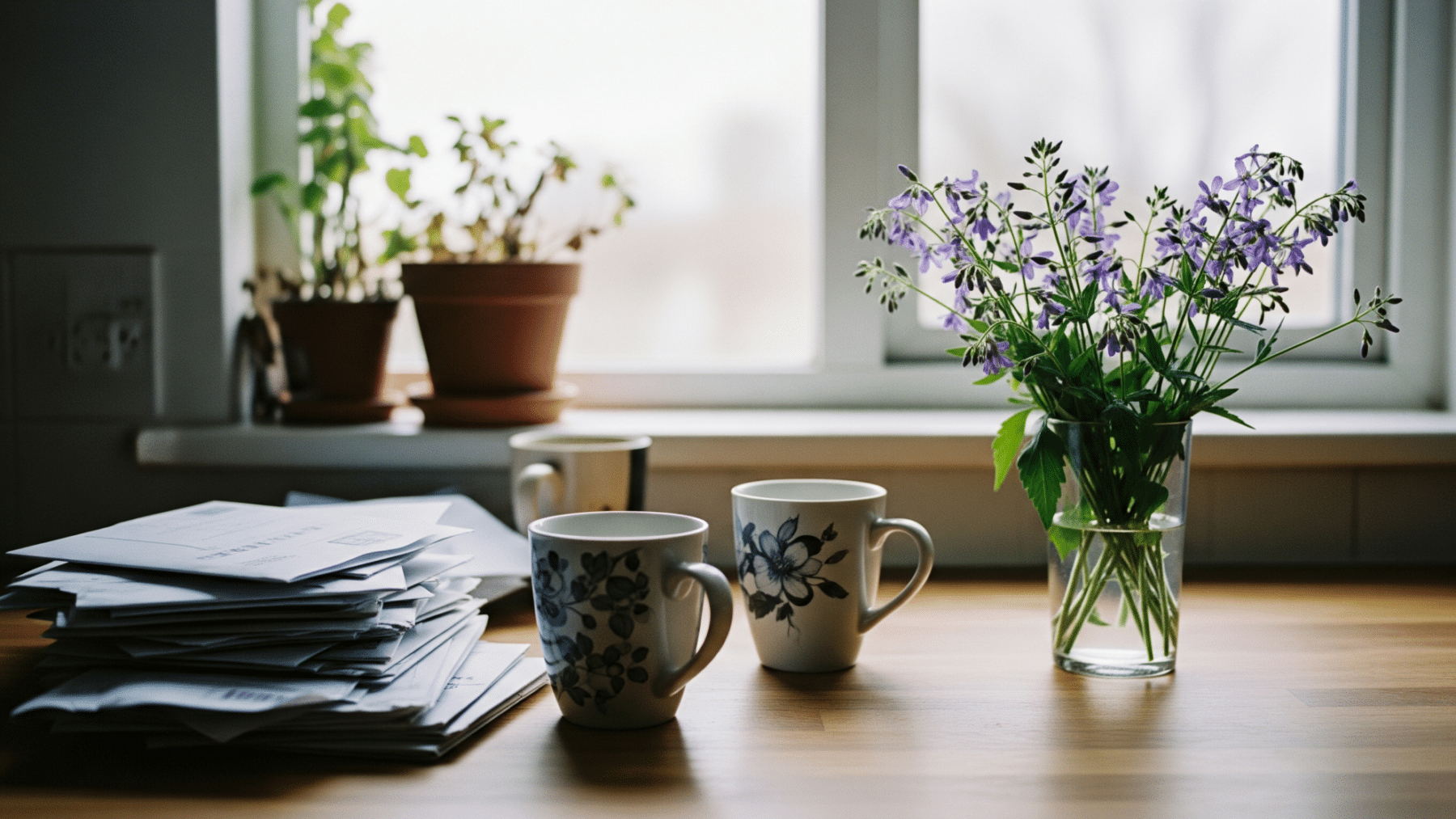
There is a pile on the counter right now in millions of American kitchens. It may be mail, or charging cables, or the three things that had no better place to go.
More than half of all Americans feel overwhelmed by clutter in their homes, and nearly eight in ten report not knowing what to do about it or finding the process too complicated to start. That is a lot of people quietly frustrated with their own four walls.
But a fresh line of research suggests the story is more nuanced, and considerably more forgiving, than the decluttering industry would have you believe.
What Americans quietly lose to the stuff piling up around them
Americans spend 2.5 days every year searching for misplaced items, and more than $2.7 billion annually replacing things they simply cannot locate.
Roughly one in ten households rents a storage unit, spending around $85 a month just to house belongings that no longer fit inside.
Those numbers make clutter sound like a purely logistical problem. Researchers have found it runs far deeper than that.
If you find yourself tracking your spending more closely lately, it may be worth knowing that the cost of a cluttered home is not only financial.
The real toll that a crowded room quietly takes on a person
Women feel it first. On average, women find a cluttered home more stressful than men do, and that stress shows up in measurable patterns of the cortisol hormone throughout the day.
Clutter also reduces the psychological attachment people feel to their own homes, and the same dynamic plays out in offices, where it increases emotional exhaustion and reduces both productivity and work satisfaction.
Research by NiCole Keith of Indiana University into physical activity among middle-aged and older adults has found that interior home condition can be a significant predictor of physical activity levels, not just the neighborhood, traffic patterns, or access to parks, but the state of the home itself.
That is a striking result. The inside of a room shapes behavior in ways that extend well beyond the room.
Why the person who hates their pile is actually the one most at risk
Here is where the science gets genuinely interesting. Researchers have found for years that the objective amount of stuff in a space matters less than you might expect.
Clutter, regardless of its volume, is a subjective construct, individually defined and experienced.
What operates on wellbeing is the person’s own internal criteria about tidiness, whether the space infringes on rules the person has set for themselves, and it is this subjective judgment that drives the outcome, not an outside observer’s measure.
In other words, a room another person might call perfectly fine can feel like chaos to its owner. And that perception is what does the real damage.
The worry over holding onto things, the old gifts, the items kept for sentimental reasons, is a big part of what makes the pile feel so loaded.
The 2025 finding that reframes what a messy home is actually doing to you
A 2025 study published in the Journal of Environmental Psychology found that people who considered their homes more cluttered had lower levels of wellbeing and life satisfaction, as well as higher levels of negative feelings.
That part is not surprising. The mechanism behind it is.
Lead researcher Francis Quinn found that home clutter is associated with reduced wellbeing, and that these relationships are explained partly by reduced home beauty, with greater home beauty itself associated with better wellbeing.
The primary source is published in the Journal of Environmental Psychology and represents one of the most targeted looks yet at why clutter harms how people feel at home.
Beauty, not tidiness, is the mediating variable. The room does not have to be spotless. It has to feel, to the person living in it, like a place worth being.
A small, specific reframe that changes what “fixing it” actually means
In general populations, clutter considerations are neither mundane nor trivial but central and important to wellbeing, and the key variable is not the objective pile but how a person relates to their own space.
That distinction matters enormously for what you do next. Researchers are not prescribing minimalism.
Reducing clutter may ease the burden of housework, but the goal is not a picture-perfect home. What matters is creating spaces that reduce stress and support daily goals, whether that is resting, working, or connecting.
The practical implication is smaller than a full weekend purge. Adding one deliberately beautiful element to a room, a cleared surface, a plant that is actually alive, a lamp angled properly, shifts the perception of the entire space.
The pile on the counter is not the enemy. The feeling that the room has stopped belonging to you is.
