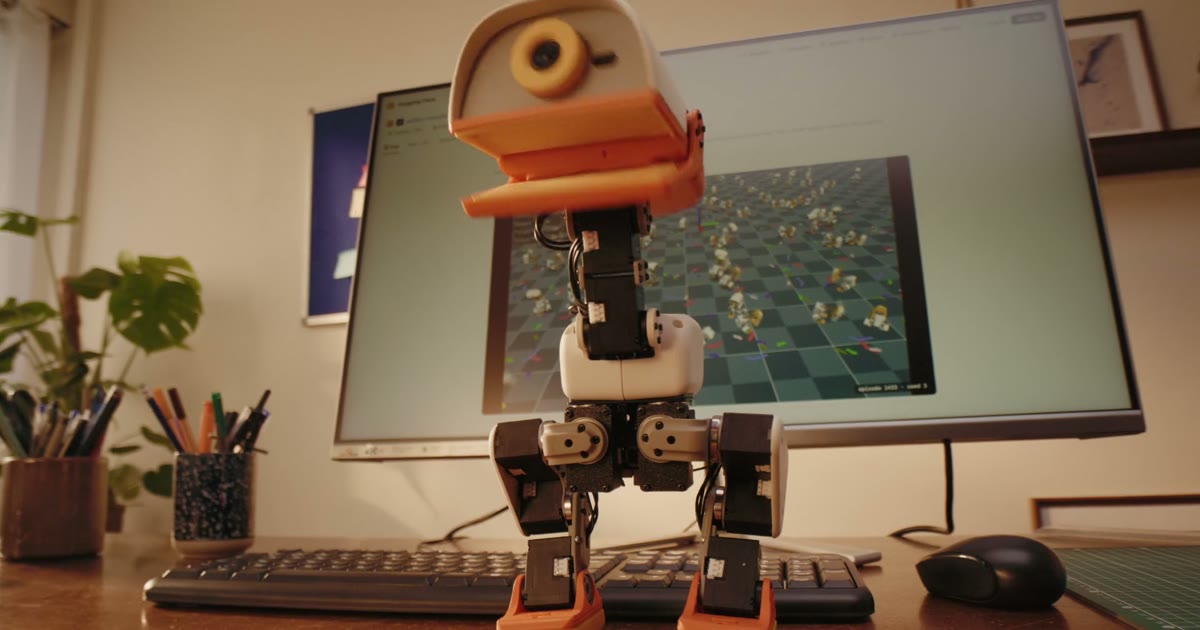
A two pound machine shaped like a cartoon duck wobbles across a stage floor, sits down, then attempts a clumsy somersault.
It looks like a toy.
It is actually a demonstration of something much bigger happening inside a server rack far from that stage.
Every wobble, every recovery, every failed flip had already happened thousands of times before the robot ever stood up in front of a crowd.
So where did all that practice actually take place, and how does a machine learn to move before it moves at all?
Inside the digital gym where robots fall down for free
The trick starts with a simple physical limit nobody can get around in the real world: a robot can only fall, stumble and recover one attempt at a time. A chipmaker’s simulation software solves that by running the robot’s entire body, from motors to sensors, as math inside a graphics processor instead of as metal on a floor.
That software, called Isaac Sim, trains robots in virtual environments at up to 1,000 times real-time speed.
For the duck demonstration, called Microduck, engineers trained a perception and locomotion policy at scale with 4,096 parallel environments on an NVIDIA RTX PRO 6000 Blackwell Workstation Edition GPU , adapting a pretrained locomotion policy for traversing ramps and obstacles . Each copy tried ramps and obstacles slightly differently, and the system kept the movements that worked while discarding the rest.
That is the entire mechanism in plain terms. Instead of one robot slowly learning to walk through months of real falls, thousands of virtual copies fail simultaneously, and the best learned version gets packaged into a single file that downloads into the real machine afterward.
What the stage demo actually showed the crowd
At Nvidia’s GTC Berlin conference, a video of Nvidia CEO Jensen Huang playing with a flock of waddling Microducks during his keynote went viral . The Microduck is built by French robotics company Pollen Robotics, part of Hugging Face, and weighs under 800 grams. Microduck’s keynote demo offered a rough public test of a tiny consumer robot: of the 4 robots on stage, 3 immediately fell over, while the remaining robot needed additional encouragement . A couple managed the somersault, and one robot got back up after a spill and eventually returned to Huang.
Even so, the point was never a flawless performance. The point was showing a full pipeline on stage, a digital twin of the hardware, cloud based training, and then a finished movement file loaded straight onto the physical robot in front of the audience.
That same pipeline already runs at industrial scale elsewhere. A wheeled humanoid robot built by a UK robotics startup and powered by the same simulation stack recently completed an eight hour shift moving totes inside a real electronics factory in Germany.
That trial mattered because it moved the idea past a stage prop.
The evidence behind the speed claims
None of this rests on marketing language alone. The Siemens trial, which ran for two weeks in January 2026 ahead of the April announcement, was the most demanding deployment to date. The simulation-first development approach, training and validating the robot’s behaviors in a virtual environment before physical deployment, allowed the startup Humanoid to slash hardware development from the usual 18, 24 months to just seven months , the companies said.
Separate published workflows from the chipmaker show a related number worth sitting with. Using the GR00T Blueprint, NVIDIA Isaac Sim trains robots at up to 1,000x real-time speed and GR00T Blueprint turns a few demos into 780K trajectories in 11 hours , equivalent to roughly 6,500 hours of human demonstration data.
That ratio is the real engine behind what looks like fast learning on stage. The company has continued to expand this toolkit at subsequent conferences, adding new runtime and training software built around GPU-accelerated physics simulation for more complex, dexterous tasks like gripping and cable insertion. Manufacturers are increasingly folding pieces of that simulation stack into their own factory planning software.
Where the simulation shortcut still runs into real limits
None of this means a robot trained entirely on a processor walks perfectly the moment it touches a floor. The viral clip of the Microduck demo mostly showed AI agents planning the training workflow itself, not a finished solution to the harder problem of transferring a simulated skill cleanly into real hardware.
That gap between virtual practice and physical reality remains the industry’s hardest unsolved piece. A locomotion skill pretrained in simulation still needs real world tuning once gravity, friction and uneven floors stop behaving exactly like the math predicted.
Even the factory success in Germany was a trial run, not a permanent installation.
The companies described the trial as a milestone in the journey to bring physical AI from vision to industrial reality, but did not give a timeline for when such systems could be rolled out more widely. A separate AI system approving its own steps in software development shows the same caution applies broadly, letting an automated process move fast still requires a human checking the output.
Why this matters beyond one robot duck on a stage
The broader shift is that robot training is becoming a computing problem as much as a mechanical one. Years of real-world experience are being turned into hours of simulated training, which is cheaper, faster and does not break expensive hardware when something goes wrong.
That shift mirrors a pattern showing up across other corners of computing, where heavier workloads get pushed onto distant servers while the end device does less work locally. It looks similar to how a routine scheduling feature quietly hands off tasks to infrastructure a user never sees.
For factories, warehouses and robotics startups, the promise is a shorter runway between a hardware idea and a working machine on a real floor. The duck wobbling through its somersault was never really the achievement, the thousands of invisible copies that fell down first were.
What remains open is how reliably that simulated confidence survives contact with an actual factory, an actual warehouse aisle, or an actual uneven sidewalk. That answer will keep arriving one real deployment at a time.
