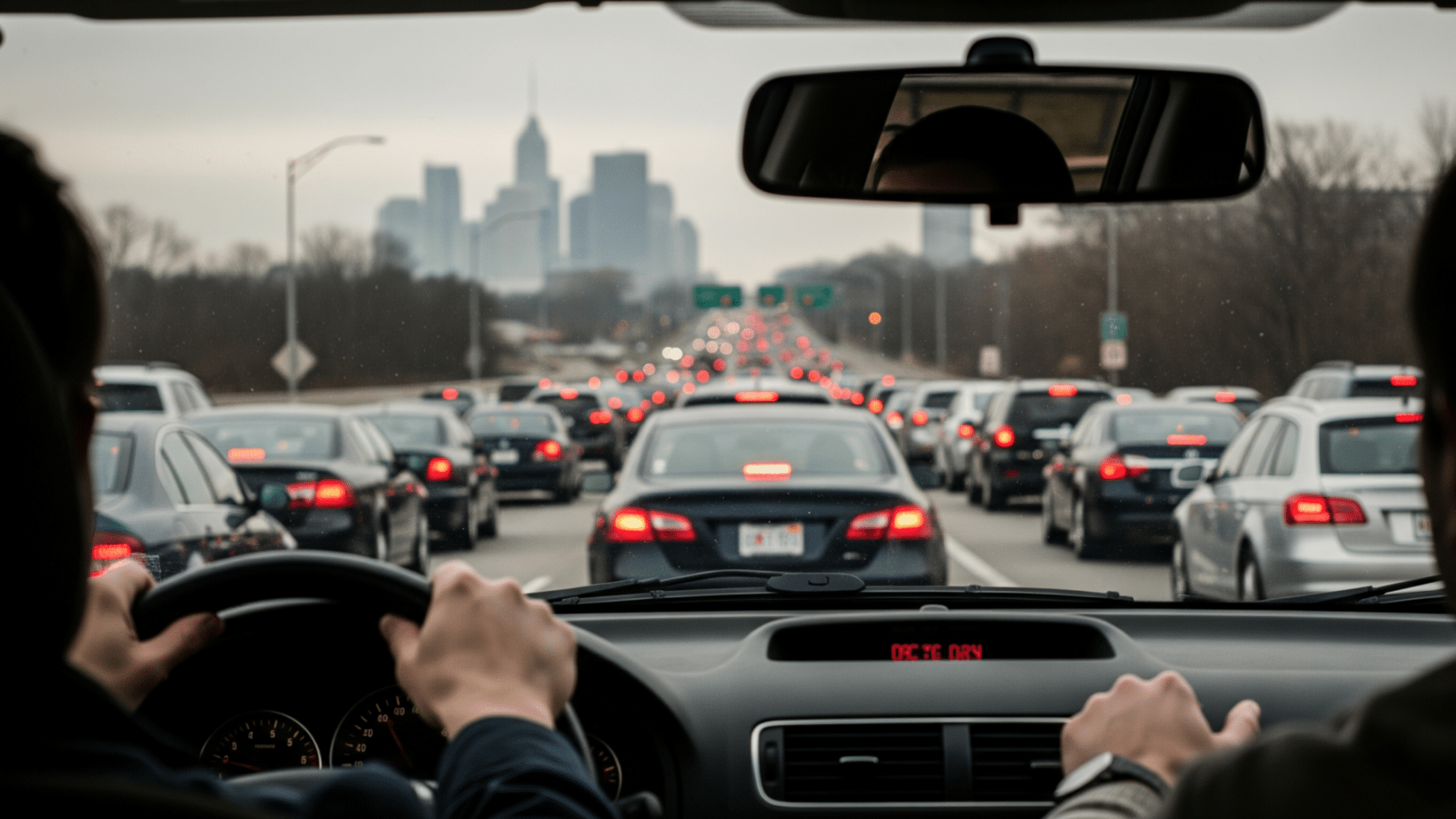
Most Americans think of sitting in traffic as one of life’s minor irritations. A few lost minutes. A little frustration. Nothing that adds up to real money.
A major new industry report just demolished that assumption, and put an exact dollar figure on every single hour you spend staring at taillights.
The commute that quietly bleeds your wallet dry
Think about the last time you sat through a backup on the highway on your way to or from work.
Now multiply that feeling across an entire year.
Traffic congestion continued to mount nationwide, causing the typical American driver to lose 49 hours in 2025 due to traffic jams, up six hours from 2024.
That is more than a full workweek, every single year, contributed entirely to sitting still.
The delays are equivalent to more than six full workdays spent in traffic.
Nationwide, the economic burden of congestion jumped more than 11% in a single year.
Rush hour is no longer just rush hour anymore
Here is something almost nobody expected: the problem has gotten worse even as millions of people shifted to hybrid work schedules.
Despite traffic volumes returning to pre-pandemic levels, travel patterns have fundamentally changed.
Traditional weekday rush-hour congestion has now expanded into midday periods, midweek timeframes and weekend travel.
Gridlock is no longer a predictable twice-daily window you can route around.
Work-from-home norms are stretching and redistributing the traditional rush hour, meaning the issue is no longer just how many people are on the road, it is about when they travel.
That unpredictability has its own hidden cost, separate from the hours themselves.
Some cities are suffering far worse than the national average
Of the 290 U.S. cities analyzed in the latest scorecard, congestion increased in 88% of them.
The percentage of people commuting by car is nearly back to 2019 levels, while public transit ridership still lags roughly 20% below pre-COVID levels, according to INRIX.
That gap between driving and transit recovery is pushing congestion higher in city after city.
Americans are also tracking spending more closely than ever, yet the commuting drain rarely shows up as a line item on anyone’s budget, which may be why it keeps being underestimated.
Bob Pishue, a transportation analyst at INRIX, noted that “congestion is going up and the infrastructure struggles to keep up.”
Pishue added that “when the road system doesn’t meet the demand, that’s when we get traffic congestion.”
The $894 price tag and the city that just took America’s crown
Here is the number the researchers put on it.
The typical U.S. driver lost 49 hours to traffic congestion in 2025, an 11% increase from 2024, amounting to $894 in lost time per driver.
Congestion cost the U.S. around 4.7 billion hours due to traffic last year, or at least $85.8 billion in lost time.
Those figures come directly from the INRIX 2025 Global Traffic Scorecard, which tracked congestion across nearly 1,000 cities worldwide.
And the city at the top of America’s list is not the one most people would guess.
As Chicago overtook New York as the most congested U.S. city, American drivers lost 49 hours overall, costing the nation $85.8 billion in lost time.
Chicago commuters lost 112 hours in traffic in 2025, about two weeks’ worth of eight-hour workdays, representing an estimated $2,063 in lost time per driver.
New York drivers, meanwhile, lost 102 hours in 2025, costing the average driver $1,879 and the city $9.7 billion.
With so many Americans already feeling squeezed, and with vacation spending under pressure, the realization that sitting in traffic alone costs nearly $900 a year reframes just how expensive the ordinary commute has quietly become.
What the data suggests drivers can actually do about it
The INRIX report points to one city where congestion held flat despite everything: New York, where congestion pricing appears to have been a stabilizing factor in controlling traffic delays.
Congestion levels in New York City remained flat in 2025, and the city’s congestion pricing policy is a likely factor in its control of traffic delays.
At the individual level, the math is equally clear.
Shifting even part of the week to remote work can meaningfully reduce annual commuting costs for drivers already near or above the national average.
Commuter benefits let workers pay for transit or parking with pre-tax dollars.
As of 2026 the IRS allows up to $340 per month in pre-tax income to be used for qualified transit or vanpool expenses.
The $894 figure will keep climbing if driving patterns continue on their current track. The first step toward shrinking it may simply be knowing it exists.
