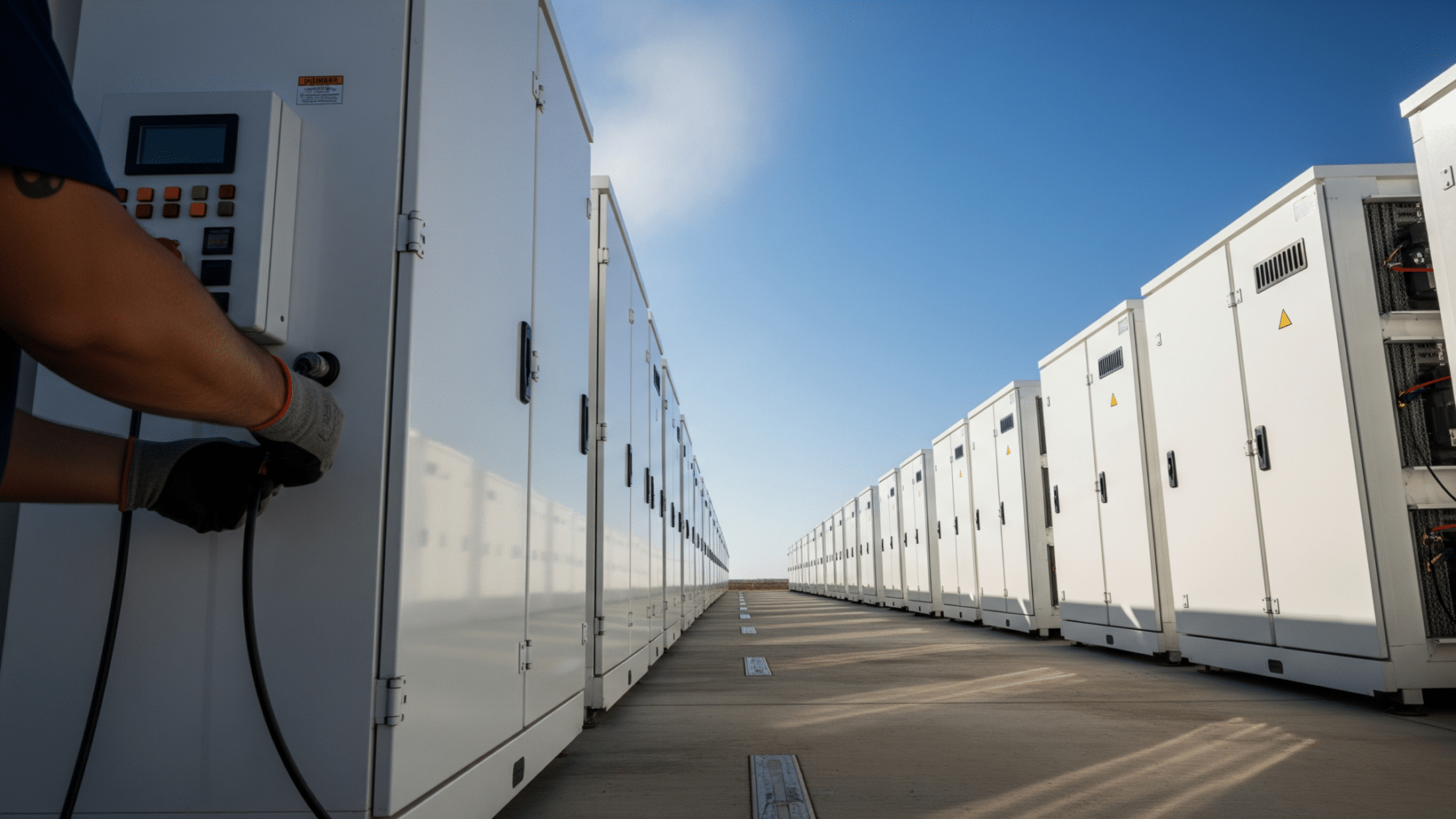
Texas is on course to receive more than half of all utility-scale battery storage installed across the United States this year, according to federal data, underscoring how the state’s deregulated power market has become the dominant proving ground for grid-scale energy storage in America.
The EIA figures
Developers plan to add 24 GW of utility-scale battery storage to the U.S. grid this year, compared with a record 15 GW added in 2025.
Within that national total, Texas alone accounts for 53 percent of planned 2026 battery storage capacity additions, with California following at 14 percent and Arizona at 13 percent. Based on the 24-gigawatt planned total, those shares translate to approximately 12.9 GW for Texas, 3.4 GW for California, and 3.2 GW for Arizona.
The figures come from the EIA’s Preliminary Monthly Electric Generator Inventory, the agency’s most current tally of planned generating resources.
Nationally, battery storage makes up 28 percent of all planned 2026 utility-scale capacity additions, second only to solar power at 51 percent.
U.S. battery storage capacity has grown exponentially over the last five years, with more than 40 GW added to the grid during that period. By the end of the first quarter of 2027, the EIA projects total U.S. battery storage capacity will rise from 44.6 GW to over 67 GW.
Why Texas leads the build
Among the large battery storage projects expected in 2026, several are located in Texas, including the 621 MW Lunis Creek BESS project in Jackson and the 418 MW Tehuacana Creek 1 battery storage project in Navarro County.
The concentration reflects the economics of the Electric Reliability Council of Texas (ERCOT), the state’s independent grid operator. Energy-only market rules there create strong price spreads that battery operators can capture by charging during midday solar surplus and discharging into evening demand peaks.
Several of the largest standalone battery projects advancing toward commercial operation in 2026 and 2027 are sited in ERCOT, where proximity to rapidly expanding data center clusters near Dallas and Houston creates both merchant revenue opportunities and reliability value. That co-location dynamic has accelerated developer interest in the state beyond what grid reliability mandates alone would explain.
Texas claims about 40 percent of all planned utility-scale solar additions in 2026 , giving developers a ready supply of curtailed daytime generation to absorb. That makes the business case for storage straightforward even before capacity payments are factored in.
Supply-chain pressure on the pipeline
The scale of the Texas pipeline does not insulate it from the compliance pressures now reshaping project finance across the sector.
The One Big Beautiful Bill Act, enacted on July 4, 2025, introduced new foreign entity of concern (FEOC)-type restrictions on claiming investment tax credits for energy storage projects. For energy storage technology, the threshold of non-prohibited-entity costs starts at 55 percent for projects beginning construction in 2026, rising to 75 percent for projects beginning construction in 2030 and beyond. Under these provisions, companies with ties to China, Russia, Iran, or North Korea are considered prohibited foreign entities.
Import tariffs have raised equipment costs for storage projects that locked in capacity agreements before the tariff schedule was set. Developers facing that cost pressure must also document the geographic origin of battery cells, modules, and enclosures in detail sufficient to satisfy federal auditors.
The One Big Beautiful Bill largely preserves tax credits into the next decade for battery storage , meaning the federal investment tax credit for qualifying energy storage systems can offset 30 percent or more of deployment costs. Developers whose projects clear the foreign-entity rules can still access those offsets, keeping the economics intact for compliant projects even as equipment prices remain elevated.
Market implications
The concentration of storage capacity in a single state raises questions that grid planners and market regulators are already studying.
The policy question hanging over the second half of 2026 is how many projects in the pipeline can demonstrate the supply-chain compliance needed to capture the federal credits that underpin their financing.
For utilities elsewhere watching rate cases pile up, the Texas storage surge offers both a reference point and a contrast. Unlike the vertically integrated utilities behind recent rate proceedings, such as BGE’s $156 million Maryland rate case or the rate hike sought by Tucson Electric Power for more than 400,000 customers, most of the Texas battery buildout is merchant-financed.
That means developers bear the market risk themselves rather than passing construction costs through to captive ratepayers. Whether that model spreads beyond ERCOT’s deregulated boundaries will depend heavily on how the supply-chain compliance picture resolves in the months ahead.
