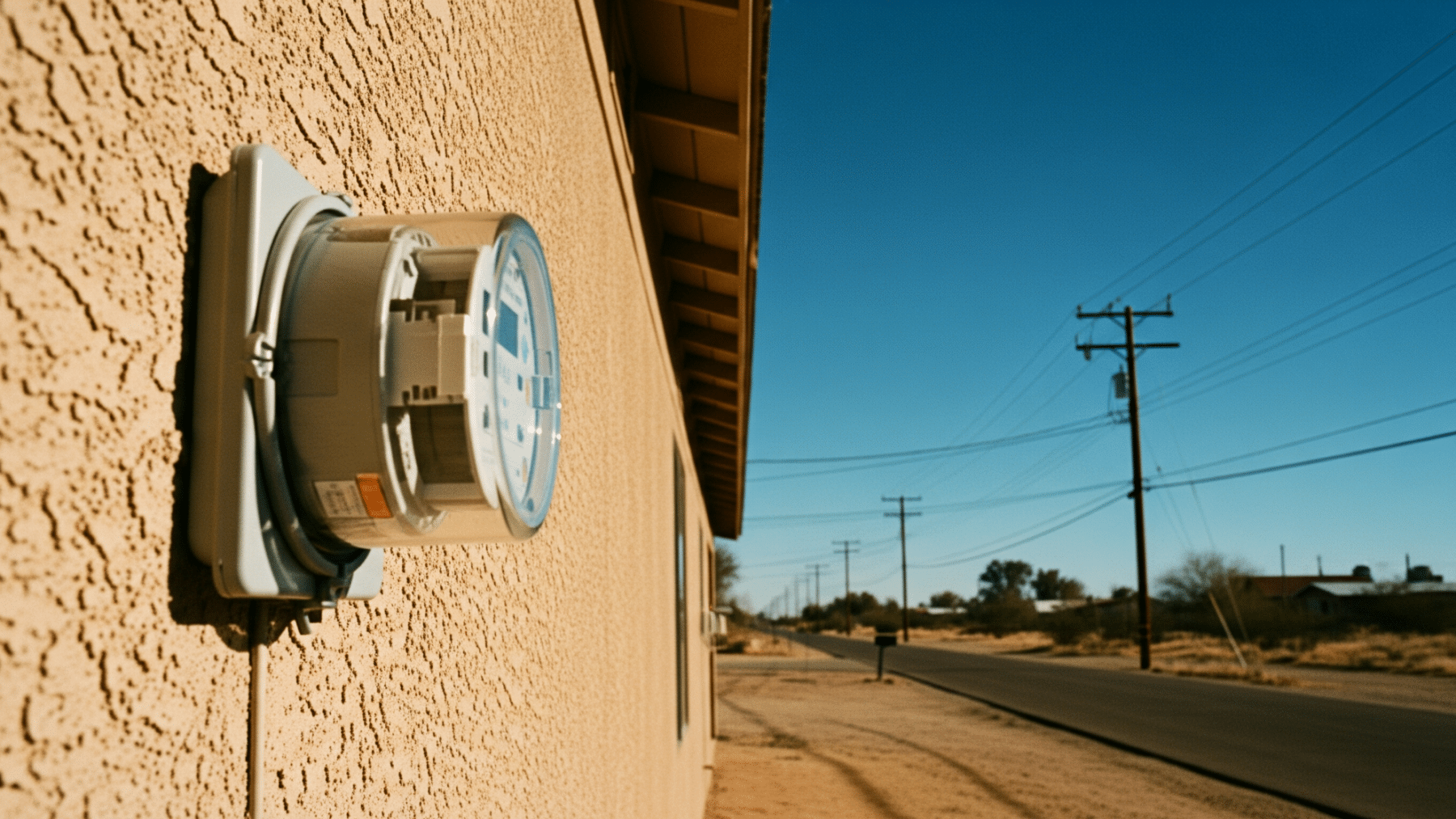
Every summer, a Tucson electric bill has two enemies: the desert heat and the rate on the bottom line. But this summer, something else has been quietly moving through a state hearing room that could change both numbers for more than 400,000 customers at once.
The story starts with a routine-sounding regulatory filing and ends with a question nobody expected to hear a state commissioner ask out loud in a rate case.
A utility filed paperwork that most customers will never read
Tucson Electric Power, an investor-owned utility with a monopoly on providing electricity in southern Arizona, must apply to the Arizona Corporation Commission to raise its rates.
TEP, which serves more than 400,000 customers, is asking the Arizona Corporation Commission, the state’s utility regulator, to increase its rates by 14%. Its service territory includes the Tucson metropolitan area, Pima County and the Fort Huachuca U.S. Army base in Cochise County.
That is a large share of ordinary households depending on a single company for power.
Under the traditional rate case system, investor-owned monopoly utilities cannot set their own prices for electric service and instead must ask the commission to approve those prices. Utilities file thousands of pages of evidence to justify changing rates, and the process can drag on for a year or more.
Most customers never see a word of it.
The number on the filing is big enough to notice
TEP said its 14 percent rate hike would raise its revenue by $172 million annually, and it wants the new rates in effect by September 2026.
That translates into real money on real bills.
For a customer on TEP’s basic pricing plan who uses an average amount of electricity, the increase would be about $16 per month, though individual bills would vary. Other estimates put the typical residential increase closer to $20 a month.
Months of hearings, thousands of pages of evidence, and all of it pointed toward that one line on a bill.
It involves hours of sworn testimony, legal documents, and complicated electricity rate tables.
Something else was moving through the room at the same time
Commissioners are elected in Arizona, which means they answer to the same households that pay those bills.
During testimony, they started asking a different kind of question.
TEP’s evidentiary hearing began April 22, 2026, and commissioners challenged TEP over whether residential customers were subsidizing infrastructure costs tied to Project Blue, a large Pima County data center, making this a leading test case for data center cost-shifting at a state commission.
Blue Owl-owned Beale Infrastructure is looking to develop a 290-acre data center campus known as Project Blue in Pima County. City documents noted Amazon Web Services was long interested in being the end user of the site, but county officials have since heard from multiple sources that the cloud giant will no longer be the end user, with potentially seven or eight different prospective tenants now in the picture.
By 2028, TEP will be providing as much power to the project as it would take to cool 57,000 homes, about 286 megawatts. The 10-year agreement includes monthly billing requirements at the same standard rate as other large customers.
And that is only phase one.
The $1 billion answer the utility gave, and why it did not close the argument
TEP said in June 2025 that its rate request was not influenced by Project Blue, saying it was for work that had been done since 2021. The company also said the operator of Project Blue would pay more than $1 billion for power over the next decade, which would reduce the amount TEP needed to collect from other customers.
The Arizona Corporation Commission voted on December 3, 2025, to approve an energy supply agreement between Tucson Electric Power and the developers behind Project Blue. Despite hours of public testimony in opposition, the agreement passed on a 4-1 vote, which will allow TEP to provide electricity to the data center starting in 2027.
But Arizona’s attorney general did not accept that as the end of the story.
Arizona Attorney General Kris Mayes challenged the December decision by the Arizona Corporation Commission that authorized Tucson Electric Power to enter into a private energy agreement to supply electricity to Project Blue, citing concerns over transparency and consumer protections and arguing that the agreement allows electricity rates to be set privately, outside the Commission’s public ratemaking process.
Mayes asserts that a thorough review of TEP’s private energy agreement for Project Blue by the Commission could have eliminated a key flaw: a provision allowing TEP and the data center customer to set their own electricity rates without Commission oversight.
Separately, the pattern of data centers driving rate case complexity is already spreading. Pennsylvania’s Public Utility Commission released a Final Order establishing a first-of-its-kind model tariff framework for large load customers, including rapidly expanding data centers, marking a major step in the Commission’s ongoing effort to manage unprecedented electricity demand growth while protecting existing utility customers. The model tariff serves as a framework for Pennsylvania’s electric distribution companies, which may incorporate these guidelines into utility-specific tariff filings and future rate proceedings, subject to Commission review and approval. The guidelines call for utilities to charge large-load customers for upgrades that would not have been needed but for the interconnection of that customer, regardless of whether other customers will benefit from the infrastructure.
This is exactly the kind of rate-structure question that has been reshaping how grid costs land on ordinary bills. If you’ve been following coverage of grid tariff refunds hitting customers’ bills, the underlying dynamic is the same: who built what, and who ends up paying for it.
What comes next for anyone who pays a Tucson electric bill
The TEP rate case is still moving toward a final decision, and if or when the rate increase passes, it will appear on customer bills.
The broader context is not unique to Tucson. Retail electricity prices have increased faster than the rate of inflation in recent years, and regulators expect them to continue rising.
TEP says the rate hikes are necessary to account for inflation and interest rates, as well as $1.7 billion in infrastructure investments made since 2021 in aging generation and delivery infrastructure, among other factors driving those increases.
What is new is the intensity of the fight over who counts as a customer and who carries the cost when a single hyperscale tenant arrives needing the equivalent of a small city’s worth of power.
The TEP case is now a bellwether, and state commissions across the country are watching its outcome closely.
The data center boom has many winners. The open question regulators are now formally asking, on the record, is whether the household paying $20 more a month is supposed to be one of them, or whether that bill is quietly subsidizing someone else’s server room.
Pennsylvania’s commission already answered that question with a new tariff framework. Arizona’s answer is still being written, and when it lands, it will show up on more than 400,000 bills at once. The cost-allocation battle buried in utility rate filings has never been more consequential for ordinary households.
