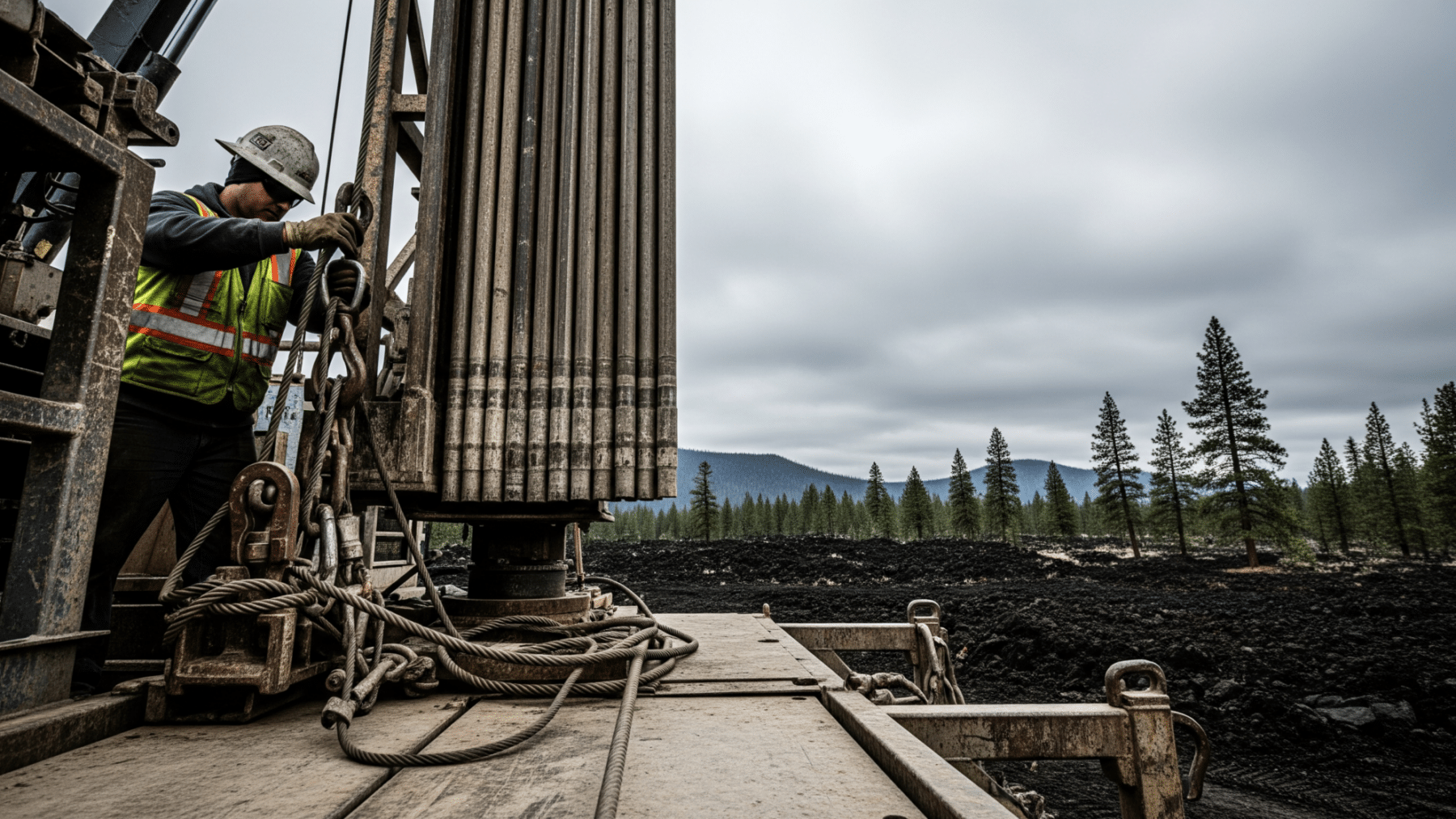
Mazama Energy is now in the injection-well drilling phase of a three-well 2026 campaign at Newberry Volcano in Central Oregon, pushing toward rock temperatures above 400 degrees Celsius that the company says could make geothermal power economically competitive with natural gas. The Texas-based developer’s active field program marks the most aggressive step yet toward a commercial superhot rock geothermal plant in the United States.
World’s hottest EGS as the launching pad
The 2026 work builds on a 2025 pilot at the Newberry Crater geothermal field, where engineers reached bottomhole temperatures of about 331 degrees Celsius (629 degrees Fahrenheit) and demonstrated fluid circulation between two wells in an enhanced geothermal system. That result, confirmed in a paper presented at Stanford University’s 51st Workshop on Geothermal Reservoir Engineering in February 2026, was recorded as the hottest engineered geothermal reservoir anywhere in the world.
Mazama is pursuing what it calls a “SuperHot Rock” enhanced geothermal project on the western flank of the volcano, targeting temperatures above 400 degrees Celsius that could significantly boost power output compared with conventional geothermal wells. A single superhot well can produce five to ten times more energy than conventional 400-degree wells, fundamentally reducing the need to drill multiple, expensive holes and driving down costs.
Three-well sequence underway in 2026
Drilling began with an observation well in the second quarter of this year, followed by an injection well in the third quarter and a production well in the fourth quarter. Permitting is continuing in parallel with the field work, and the injection and production wells will be drilled as a horizontal pair designed to circulate fluids through hot rock underground.
According to company spokesperson Pete Lumley, the work will include field validation of drilling with supercritical carbon dioxide and planning for a deeper, higher-temperature well. Supercritical CO₂, which behaves simultaneously as a liquid and a gas at extreme pressure and temperature, is being tested as a drilling and heat-transfer fluid that could perform far better than water in the extreme conditions Mazama is targeting.
The first well in the sequence, Project Athena, is the observation well supporting Newberry field operations, built to monitor conditions and provide downhole data that informs drilling and longer-term development planning for what the company describes as the world’s first SuperHot Rock enhanced geothermal system. Project Ceres, the injector-producer doublet, supports the first-of-a-kind commercial pilot phase, helping validate the economics of enhanced geothermal systems and inform future development.
Commercial pilot and long-term scale targets
If the configuration performs as designed, it could generate roughly 15 to 20 megawatts of net power. Mazama describes 2026 as launching staged development at Newberry: a 15-plus megawatt commercial pilot enabling a first 200 MW project, within a site the company pegs at more than 5 gigawatts of potential.
Mazama’s initial project is the development of 200 MW at Newberry, a fully permitted geothermal site with superhot rock at less than five kilometers’ depth, supported by the U.S. Department of Energy in collaboration with state and federal agencies. The DOE context is significant: although the United States leads the world in geothermal electricity capacity with about four gigawatts, DOE analysis shows the potential for at least 300 gigawatts of reliable, flexible geothermal power on the U.S. grid by 2050.
The Newberry campaign is one of several concurrent bets on next-generation geothermal. Congress recently passed the Next-Generation Geothermal Research and Development Act on a bipartisan basis, underscoring federal interest in the sector’s commercial readiness. Separately, industry has been forging large-scale offtake arrangements: a framework deal for up to 3 gigawatts struck in March 2026 was aimed at supplying data centers around the clock from geothermal sources.
Why superhot rock changes the math
Harnessing these superhot resources would allow Mazama to extract up to ten times more power density, use 75 percent less water, and drill 80 percent fewer wells than current approaches. Those economics matter because well costs remain the single largest obstacle to geothermal’s wider deployment.
Combining new drilling and materials technologies with real-time downhole sensor data has already cut well costs by up to 30 percent across the next-generation geothermal industry and may extend asset lifetimes beyond 25 years. Mazama’s use of supercritical CO₂ drilling, if validated at Newberry this year, would be an additional cost lever that no commercial geothermal developer has yet proven at field scale. The Q4 production well will determine whether the company exits 2026 with a functioning horizontal doublet, and a credible path to its 200 MW development phase.
