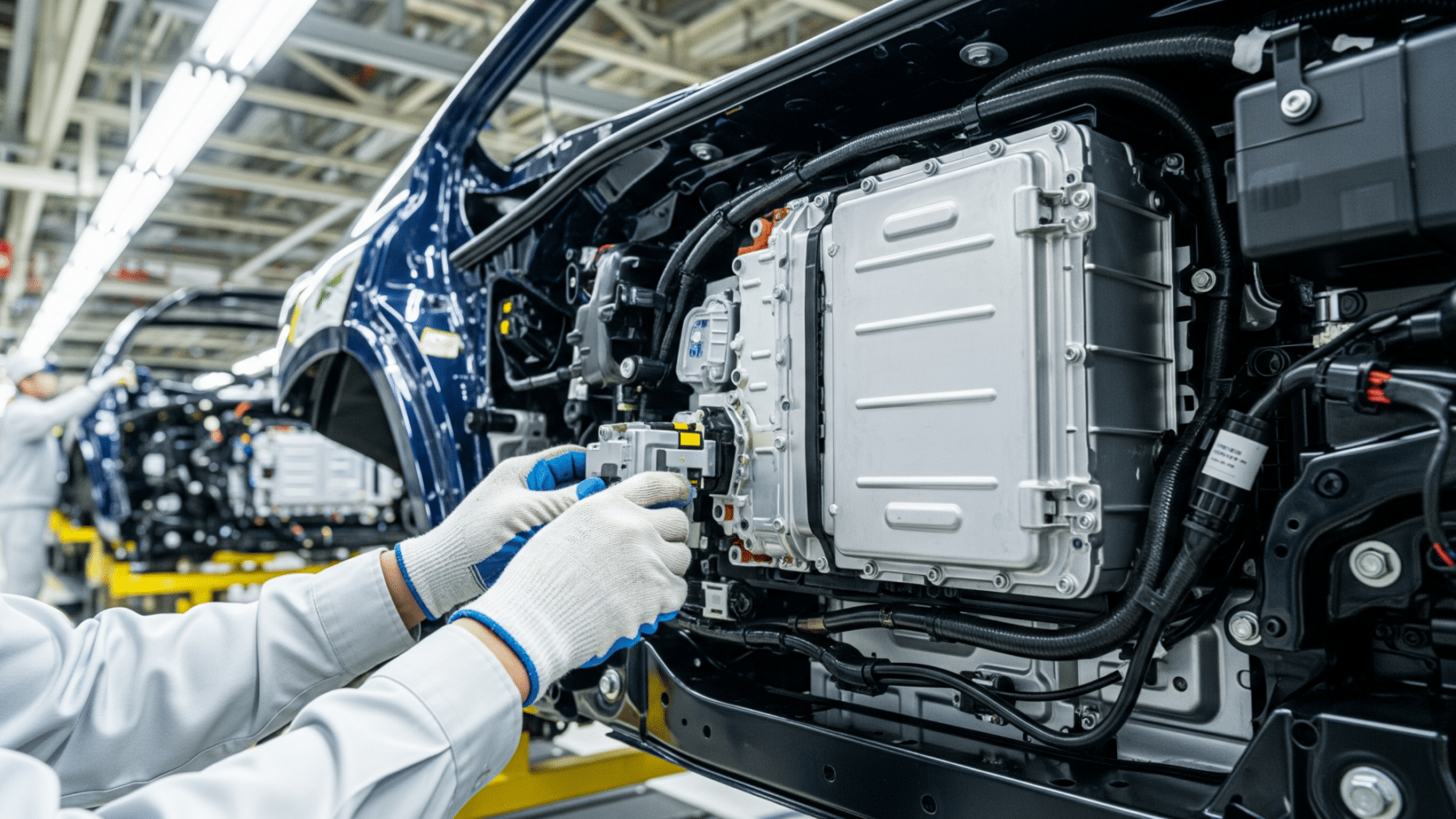
Toyota expects to surpass 5 million hybrid vehicle sales in a single calendar year for the first time in its history, the automaker disclosed this week, and it plans to back that growth by converting battery production lines in Japan to next-generation lithium-ion technology capable of supplying roughly 600,000 vehicles annually.
Record hybrid sales projected for 2026
In an otherwise unremarkable press release dedicated to the first-quarter results for the 2027 fiscal year, Toyota said it expects to sell more than 5 million hybrid electric vehicles in calendar year 2026, which would mark an all-time record.
That figure would be the first time the automaker has crossed the 5-million milestone, a landmark for a company that helped bring hybrids to the mass market with the Prius, the first mass-produced hybrid car launched in 1997.
The automaker sold roughly 2.3 million hybrid vehicles worldwide during the first six months of 2026, accounting for about 86 percent of its total electrified vehicle sales, while electrified models overall climbed 9.1 percent year-on-year to 2.7 million units.
Toyota Chief Accounting Officer Takanori Azuma stated: “Demand for HEVs remains strong, and the HEV mix continues to rise in many regions around the world. Toyota plans to sell more than 5 million HEVs for the first time in 2026. To steadily meet customer demand, we will continue to expand HEV battery production capacity.”
Nickel chemistry gives way to lithium-ion
Dating back to the Prius of the late 1990s, Toyota’s hybrid models have relied on nickel-metal hydride batteries, although the new RAV4 has shifted to a lithium-ion pack, and other Toyota hybrids will follow.
Between 2027 and 2028, Toyota plans to convert battery capacity in Japan for as many as 600,000 new vehicles, with the new cells expected to boost efficiency while also costing less.
Azuma stated: “We plan to gradually transition from nickel to lithium while simultaneously expanding our production capacity. This will result in a cost reduction of approximately tens of thousands of yen per vehicle.”
The new battery supply will cover not only Toyota-badged vehicles but also its Lexus lineup, and the production ramp-up is expected to continue until at least the end of 2030.
Market forces accelerating the push
High fuel prices tied to the war in Iran have increased electrified vehicle sales across the world, while in the United States the rollback of federal EV tax credits and fuel economy norms has reset EV growth and spurred hybrid adoption.
Toyota also recently made two of its top sellers, the Camry and RAV4, hybrid-only. As GCN previously reported, Toyota’s redesigned RAV4 went hybrid-only this year, a strategic call that has reshaped competitive rankings among the country’s top-selling vehicles.
Those tailwinds have spilled across the broader industry, pushing America’s best-selling non-truck to go fully hybrid for the first time and reshaping nameplate competition at the top of the sales charts.
Solid-state batteries remain a longer-term target
Beyond the lithium-ion transition, Toyota is also developing solid-state batteries, which can charge from 10 to 80 percent in under 10 minutes. Specifics about the new batteries Toyota is developing remain limited at this early stage.
Toyota expects the hybrid take rate to increase in the coming years, which is why it is already considering expanding battery production for hybrids beyond the initial 600,000-vehicle-per-year capacity.
With the 5-million-unit sales target firmly in sight, the battery investment signals that Toyota is treating hybrid vehicles not as a transitional product but as a core, long-running platform in its global lineup.
