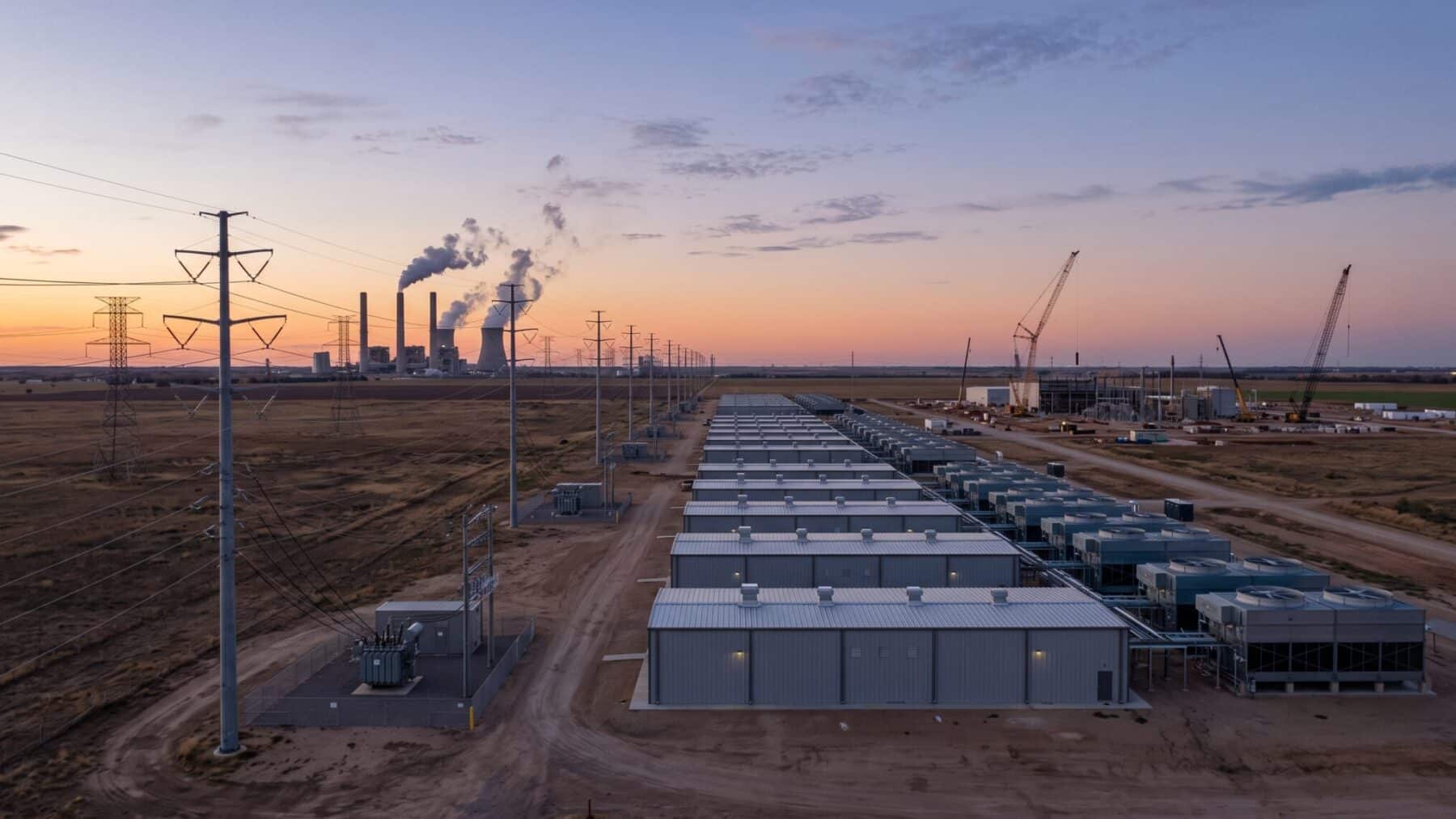
Flat soybean fields stretch for miles in Richland Parish, a rural corner of northeastern Louisiana most Americans have never heard of.
Then the cranes appear. Hundreds of them, above steel frames the size of city blocks. Inside those frames, rows of graphics processors will run hotter and draw more power than entire city grids. The price tag has already climbed past $50 billion.
So what, exactly, is being built here, and how is it different from every other data center on earth?
Why a supercluster draws power on a scale no ordinary data center can match
A conventional data center is a general-purpose machine. It runs email servers, video streams and cloud storage, spreading workloads across many kinds of hardware. A supercluster is different in every physical sense.
It concentrates racks of graphics processing units at densities standard buildings cannot handle. Each rack can pull 100 kilowatts or more, against the 10 to 20 kilowatts a typical enterprise rack draws. That gap forces everything around the chips to change: cooling loops must carry far more heat per square foot, and power feeds must run at transmission-level voltages directly to the building.
The network fabric connecting the GPUs must also move data between chips fast enough that processors never stall waiting for each other. So the power plant question is not a footnote. Hyperion will draw 5 GW of compute, supplied by 10 gas-fired plants whose combined output amounts to approximately 7.5 gigawatts, enough capacity to represent more than 30 percent of Louisiana’s entire existing grid.
Pulling 5 GW across shared transmission lines would destabilize regional grids and trigger regulatory obstacles taking years to clear. Generation must be nearby, which is why the plants are being built on the doorstep of the campus itself.
What the Richland Parish site looks like on the ground right now
First announced as a $10 billion project in December 2024, Hyperion originally called for roughly 2 gigawatts of capacity. That figure has since been revised upward. The campus is now planned as a 5 GW facility costing more than $50 billion.
A new agreement with Entergy announced in March 2026 added seven plants generating approximately 5.2 gigawatts, on top of the initial three plants approved in August 2025. The power infrastructure more than tripled in roughly seven months. Meta will pay for all 10 plants and has committed to funding 2.5 gigawatts of new renewable energy, 240 miles of transmission lines, and battery storage systems.
The footprint is staggering. Zuckerberg has said Hyperion will cover a significant part of the footprint of Manhattan, and that physical scale shapes how chilled-water loops and fiber backbones are laid out across the site.
The financing structure that keeps much of the cost off the main balance sheet
Building a campus this large from a single treasury would alarm investors. The mechanism chosen is a joint venture that lets a private-credit firm own the physical buildings while Meta leases them back and keeps operational control.
In October 2025, Meta and Blue Owl Capital announced a joint venture committing roughly $27 billion to the project’s buildings and infrastructure. Blue Owl holds about 80 percent of the venture, with Meta retaining 20 percent and leasing the completed facilities.
That arrangement is a lever the whole industry is now pulling. The largest hyperscalers are collectively expected to spend hundreds of billions in capital expenditures in 2026, and this is directly relevant for anyone watching global chip demand, because it determines how quickly GPU orders flow to the campuses consuming them. Even with the joint venture absorbing some of the load, Meta’s remaining on-balance-sheet spend exceeds the annual revenue of most Fortune 500 companies.
Where the Hyperion model runs into its hardest constraints
The same power density that makes a supercluster useful creates its sharpest limits. At 5 GW across a single campus, even a modest inefficiency in cooling multiplies into hundreds of megawatts of wasted heat.
Water is the second constraint. Cooling towers at hyperscale facilities evaporate millions of gallons per day, and rural Louisiana’s water infrastructure was designed for farms and small towns. The expanded project will include more than a billion dollars in local infrastructure improvements covering roads, water and wastewater systems, because the existing pipes and treatment plants cannot handle the campus at full draw.
The supply-chain reality is that the bottleneck is rarely the chip. It is the water main and the substation feeding it.
There is also a timeline risk. Hyperion should reach 2 GW by 2030 and the full 5 GW by around 2032, a six-year construction window in an industry where AI investment cycles are turning over in months. A model trained on hardware ordered today may be obsolete before the building housing the next generation is finished.
What Hyperion signals about where data center infrastructure goes next
In recent earnings calls, Microsoft, Alphabet and Meta all shifted focus from aggregate capex to “time-to-energy,” a phrase signaling the race is no longer just about who spends the most. It is about who gets power flowing to GPUs fastest, and Hyperion’s dedicated generation fleet is a direct answer to that constraint.
The economic footprint is already reshaping Richland Parish. Local businesses have received more than $1.6 billion in contracts since construction began, and the campus has delivered a wave of public investment that a community with little prior infrastructure leverage could not have attracted on its own.
Meta is also building a one-gigawatt data center in El Paso, Texas, backed by a $14 billion joint venture with BlackRock. Hyperion is the largest node in what amounts to a private national compute grid, and Meta’s own Richland Parish data center page confirms the campus will deliver 5 gigawatts of compute capacity to house what it calls its largest multi-gigawatt AI cluster.
The open question is whether the power, cooling and permitting constraints slowing the campus today will still apply when the last gigawatt comes online in the early 2030s, or whether new hardware will have already changed what 5 gigawatts of compute actually needs to do.
