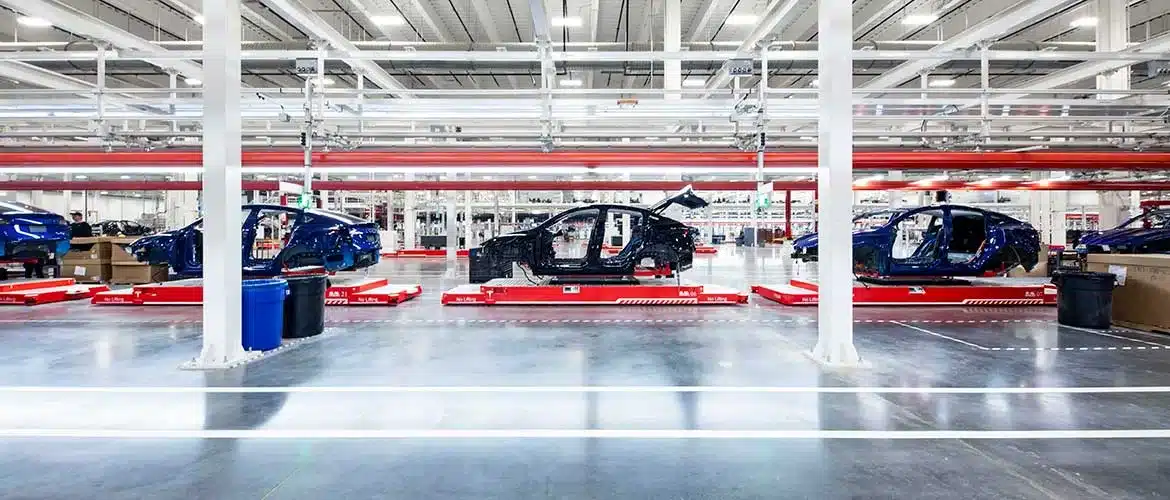
A stamping press sits quiet on a factory floor, waiting on new tooling that has not arrived yet.
Down the line, robots that once practiced building battery floor pans now sit reprogrammed for a completely different job.
Workers who spent three years hearing about one future are instead reading a notice about another.
The machines did not switch tasks by accident, and the paperwork behind that shift explains what happens next.
How a factory built for EVs can legally end up building gas engines
The mechanism here is simpler than it sounds: a factory can be funded, equipped and staffed for one product, then legally repointed at another without returning the money. Lansing Grand River took a federal conversion grant built specifically to help combustion plants shift toward electrified production, and spent years preparing its body shop and paint lines around that goal. Grant money pays for flexible equipment, not a locked outcome.
Robots and tooling bought for one powertrain can often be reprogrammed for another. That flexibility is what let GM redirect the same investment toward a gasoline engine once electric vehicle demand did not show up on schedule and federal EV policy shifted in 2025.
So the plant broke no rule. It just shows that a factory billed as part of a company’s electric future can end up building a gasoline model instead.
Inside the shutdown: what workers and the plant are actually facing
At Lansing Grand River, the numbers are concrete. GM filed a notice confirming it will lay off 350 employees at the assembly plant and a nearby stamping facility starting in mid January, as crews tear out and rebuild equipment for a new Cadillac CT5.
That timing matters because the plant currently builds the brand’s last two gasoline sedans, the CT4 and CT5, and GM had told employees and federal officials both nameplates were headed toward electrification. Instead, the CT4 is being discontinued with no gasoline or electric successor announced, and the CT5 returns with a gasoline engine on an updated platform, a reversal few workers saw coming.
Under the national labor contract, affected workers qualify for 74 percent of their hourly wage during the retooling. Even so, that safety net does not erase the scale of what is being undone at a plant that once built the Chevrolet Camaro and already absorbed one major layoff when that car ended production.
The paper trail behind the reversal, and what the grant actually required
None of this is speculation pieced together from rumor. GM announced it would invest $1.25 billion preparing Lansing Grand River for electric vehicle production as part of its national contract commitments, then followed that with a separate federal award the next year. That second piece came from the Department of Energy’s Domestic Manufacturing Conversion Grant program, which delivered roughly $500 million meant to help combustion plants shift toward hybrid or electric lines, and GM called Lansing part of its EV journey at the time.
Industry EV sales slowed well below those projections. Cadillac confirmed the CT4 and CT5 would both retire after this model year, then reversed course on the CT5, keeping it alive as a gas powered car built at the very plant the grant was meant to electrify.
The retooling notice names both Lansing Grand River and Lansing Regional Stamping directly, tying the layoffs to that same $1.25 billion investment once billed as an electrification project.
Where the promise still holds, and where it clearly does not
This is not a story about GM abandoning electric vehicles altogether. The company still builds EVs at several other American sites, and keeps investing in battery and software programs even as it slows specific models. But the catch for anyone watching a plant described as EV ready is that the label describes the equipment, not a guarantee.
A factory fully capable of building electric vehicles can still end up building something else, depending on what the sales numbers show once the tooling is finished. Similar flexible retooling decisions have already reshaped other popular vehicle lines across the industry.
Which is why the workforce angle deserves equal weight. The pay guarantee softens the landing, but hundreds of families are still planning around roughly a six week income gap heading into the new year.
What happens next for Lansing, and the bigger lesson for buyers
GM expects to recall workers once retooling ends, with some returning before the close of 2027, and the new CT5 is expected to reach production not long after. That gives the workforce a concrete date to plan around, even as the broader market keeps shifting under it.
The lesson travels well past one Michigan plant. When an automaker announces a factory conversion tied to federal grant money, that announcement describes intent at a single moment, not a locked promise years later. That same flexibility is quietly reshaping staffing at other manufacturing programs built around shifting demand.
For Lansing, the ending looks hopeful enough. A historic plant stays open, a familiar nameplate survives, and most workers expect to come back.
