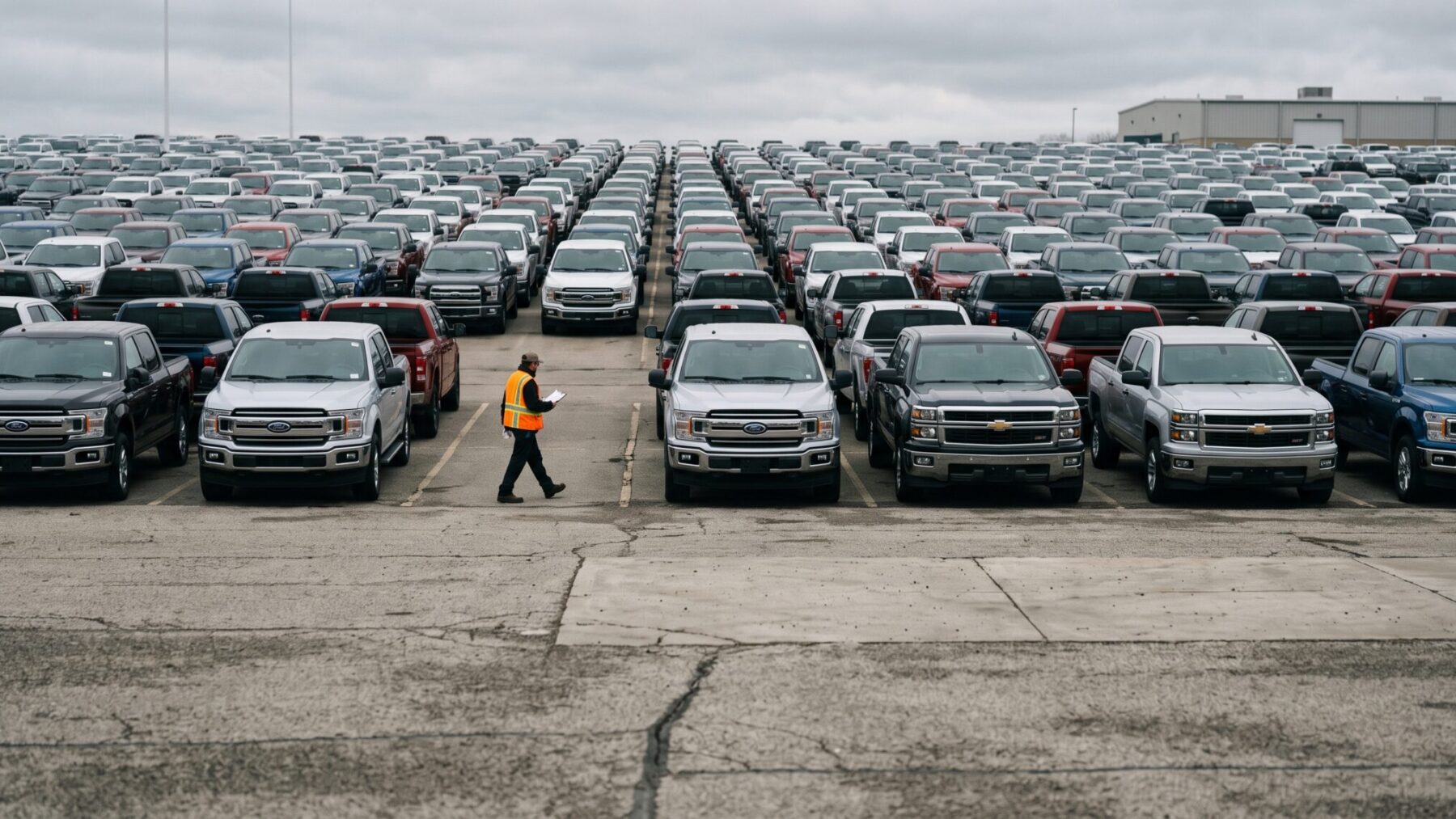
Rows of full-size trucks sit in the midday sun on a dealer lot, barely moving.
A clipboard count at the front gate shows more inventory than this time last year. Meanwhile, a counter inside the sales office keeps ticking lower. The numbers from the first half of this year landed hard. How did America’s most storied truck maker end up here, and who gained while it slipped?
The aluminum shock that knocked Ford’s production line sideways
Ford’s six-month slide traces directly to a supply chain failure that hit the company where it hurts most: the F-Series. The shortages stem from production problems at Novelis, one of Ford’s key aluminum suppliers, where multiple fires at a major facility last year severely disrupted output, with effects still being felt months later. A late-night fire at the plant damaged the hot mill that supplies aluminum sheets for automakers, rendering it unusable, and Ford lowered its annual earnings guidance as a result.
Ford said the Novelis aluminum plant fire would result in a 2025 adjusted EBIT headwind of $1.5 billion to $2.0 billion, also affecting full-year cash flow. When the hot mill that stamps body panels for the best-selling truck in America goes short on metal, production schedules compress and dealers run thin.
Second-quarter revenue fell 4 percent year over year to just over $48 billion, and the period ended with a $1.3 billion net loss after a $3.6 billion special-item charge tied to an EV battery joint-venture write-down. So the headline profit figure looked far worse than the underlying business. But the underlying business still has a real problem with volume.
Although customer demand remained high, first-half F-Series sales reflect a retiming of commercial production following last year’s aluminum supply shortages. Constrained supply and fewer model choices, including the discontinued Escape, which saw sales plunge 67%, left the brand nowhere to make up lost ground in the middle of the market.
What the first-half scoreboard looks like in cold numbers
Through the first six months of this year, GM remained the largest vehicle producer in the US, though sales were nearly 7 percent weaker than during the first six months of 2025. The brand holds roughly a 16.9 percent share. Second-placed Toyota had flat sales and remained the largest automotive brand in the US in the first half of 2026, holding around 15.7 percent share. Ford is third at just over one million units, 1,006,515 total, down 9.6 percent from the 1.1 million units sold in the first half of 2025, the steepest decline among the major automakers.
That gap between Toyota and GM is now closer than at any point in recent years. The distance has been closing month by month as Toyota’s hybrid lineup pulls buyers who want better fuel economy than a straight gasoline engine delivers but are not ready for a full electric vehicle.
Behind the top three, the Hyundai-Kia group continues to gain, up more than 3 percent. FCA was the best-performing top vehicle producer in the US with sales up approximately 5 percent during the first two quarters of 2026. The industry is sorting itself into brands with hybrid depth and brands without it, and the scoreboard reflects that split almost perfectly.
Where the verified data points and what the sources confirm
Hyundai Motor, up 4 percent during the second quarter, reported a 67 percent increase in hybrid sales during the first half of the year. These are not rounding-error moves; they are structural gains driven by buyers choosing electrified powertrains on their own terms.
Kia set a record-breaking first half on the back of electrified Sportage, Sorento, and Carnival variants. As GCN has reported, plug-in hybrid sales jumped nearly 190 percent in July after a 50-state rollout, underlining how wide the electrified footprint has become for brands that invested early. A Hyundai Motor America spokesperson told reporters the hybrid momentum was “broad-based across nearly every segment we compete in.”
GM reported second-quarter sales down around 4 percent, though Chevrolet’s SUV lineup had its best second quarter ever. The Trailblazer was up 28 percent and Traverse up 20 percent, while GMC posted record Sierra sales. So GM is not collapsing; it is holding its truck base while losing ground in the middle segments where hybrid crossovers dominate buyer conversations.
Where Ford still wins and where the floor has given way
Ford’s pain is not uniform. Bronco posted record sales in both the second quarter and the first half. Explorer sales climbed 21 percent year over year to 126,925 units during the first half. Ford’s own sales release confirms the F-150 remains the number-one truck, outselling the second-place Chevrolet Silverado by more than 80,000 units in the first half and on track for 50 straight years at the top.
The EV side is a different story. Ford has axed production of the F-150 Lightning electric truck as part of a $19.5 billion write-down on its EV programs. Ford’s electric-truck bet ran ahead of demand, and now the company is writing down the infrastructure it built to support it.
The chip cost environment pressing on every automaker’s margin is not easing either. As GCN has covered, chip lead times on dashboard memory have stretched past 58 weeks, with automotive DRAM prices up as much as 180 percent in three months. Higher component prices squeeze the middle of the market precisely where Ford needs volume most.
