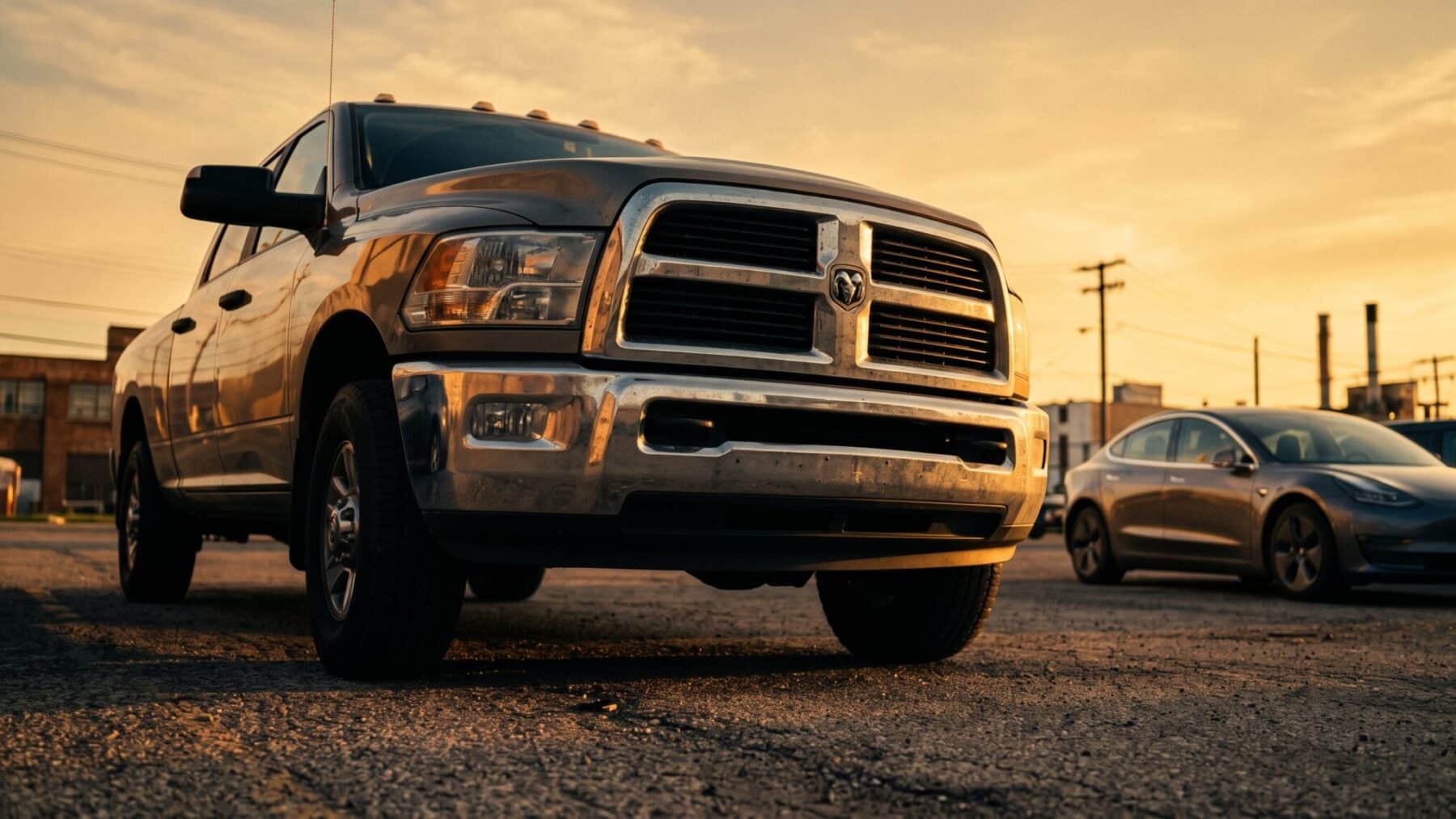
The assembly lines were quieter than planned.
An aluminum shortage had slashed output of the company’s most profitable trucks. Revenue came in below what Wall Street expected. Yet the earnings report still sent shares surging nearly 7 percent after the bell.
So how does a carmaker sell fewer vehicles, collect less money, and walk away with a bigger profit margin than a year ago?
Selling fewer trucks but charging more for each one is how the math works
The mechanism is product mix. When an automaker steers buyers toward its highest-margin variants, the revenue line can fall while the profit line climbs. Ford has spent several years engineering exactly this outcome, pushing off-road trims such as the Bronco, the Tremor and the Raptor to the front of its showroom and pulling lower-margin base models back. Those off-road variants now account for a quarter of US sales.
A buyer who walks in for a Raptor spends tens of thousands more than one shopping a base trim, and the cost to build the two trucks is not nearly as far apart as the sticker prices suggest. That gap is pure margin.
Because fewer units were moving off lots, the company also held the line on discounts and incentives rather than flooding dealers with cash to clear inventory. Less discounting on a smaller volume can still produce a fatter bottom line than heavy discounting on a bigger one. That is precisely what the numbers showed.
What the three business units actually produced last quarter
Second-quarter revenue fell 4 percent year over year to $48.3 billion, but adjusted EBIT rose 17 percent to $2.5 billion. Wall Street had penciled in adjusted earnings of 35 cents per share. The company delivered 42 cents, beating the estimate by 20 percent.
Shares gained nearly 2 percent during the regular session, then surged an additional 4.98 percent in after-hours trading to $15.71.
Ford Blue, the gas and hybrid unit, delivered $1.1 billion of EBIT on $26.1 billion of revenue. Ford Pro, the commercial and fleet division, generated $1.7 billion of EBIT on $17.8 billion, down $600 million year over year as it recovered from aluminum supply constraints tied to fires at a supplier facility. Full-size trucks are Pro’s core product, so the aluminum crunch hit it hardest.
Ford Model e recorded a $919 million EBIT loss on $1.0 billion of revenue. Together, the gas and commercial sides more than covered the EV shortfall, leaving combined adjusted profit at $2.5 billion for the quarter.
The hard evidence behind the guidance raise
For the first six months of this year, the company generated $91.5 billion in revenue, up 1 percent year over year, while adjusted EBIT surged 90 percent to $6.0 billion. That first-half swing is the real number that prompted executives to revise the full-year outlook upward.
The company raised its full-year EBIT guidance to between $10 billion and $11 billion, up from the prior range of $8.5 billion to $10.5 billion, as confirmed in the official second-quarter results press release. It also lifted its full-year adjusted free cash flow target to $6 billion to $7 billion, versus the previous $5 billion to $6 billion. The gas and hybrid unit alone now carries a full-year profit target of $5 billion to $5.5 billion.
The reported GAAP result looked very different. Ford posted a GAAP net loss of $1.3 billion, primarily due to a large one-time charge related to the BlueOval SK battery joint venture disposition. That charge was largely non-cash and did not affect the adjusted operating picture markets were watching.
Where the EV unit stands and what its losses still mean
Model e’s loss of $919 million represented a 31 percent year-over-year improvement, the segment’s third consecutive quarter of progress. The gains reflect structural cost reductions, lower incentives and right-sized first-generation EV volumes.
Full-year Model e losses are still expected to land around $4 billion, a number that would erase the entire profit of most carmakers. The broader industry is navigating a slower EV ramp than anyone projected, and the competitive picture has not made restructuring easier, as our look at one EV’s 90 percent sales jump while others slid makes clear.
Paid software subscriptions on the Pro side grew 20 percent year over year to 900,000, signaling that software revenue is becoming a genuine buffer against hardware losses. The company’s first Universal EV platform vehicle arrives next year, and that new architecture is the bet that reshapes the EV unit’s cost structure for good.
What the profit shift means for the market going forward
The pattern emerging from Detroit is that selling fewer, pricier vehicles can be more lucrative than chasing volume. The average new vehicle listing price reached $49,336 in June, up 1.4 percent year over year, and in that environment leaning on premium trims is a defensible strategy.
The aluminum shortage that cost Ford billions in truck output is on track to resolve in the second half of this year. The company expects to recover about $2.5 billion of lost vehicle volume, which would add another tailwind to an already raised guidance range. The broader parts cost picture remains a wild card, with supply chain pressures across the industry still running hot.
The real question is whether the mix strategy holds if incentives industry-wide start rising to clear growing inventories. If that pressure intensifies, premium mix gains could narrow fast. For now, the gas and hybrid playbook is producing results the EV roadmap has not yet matched.
