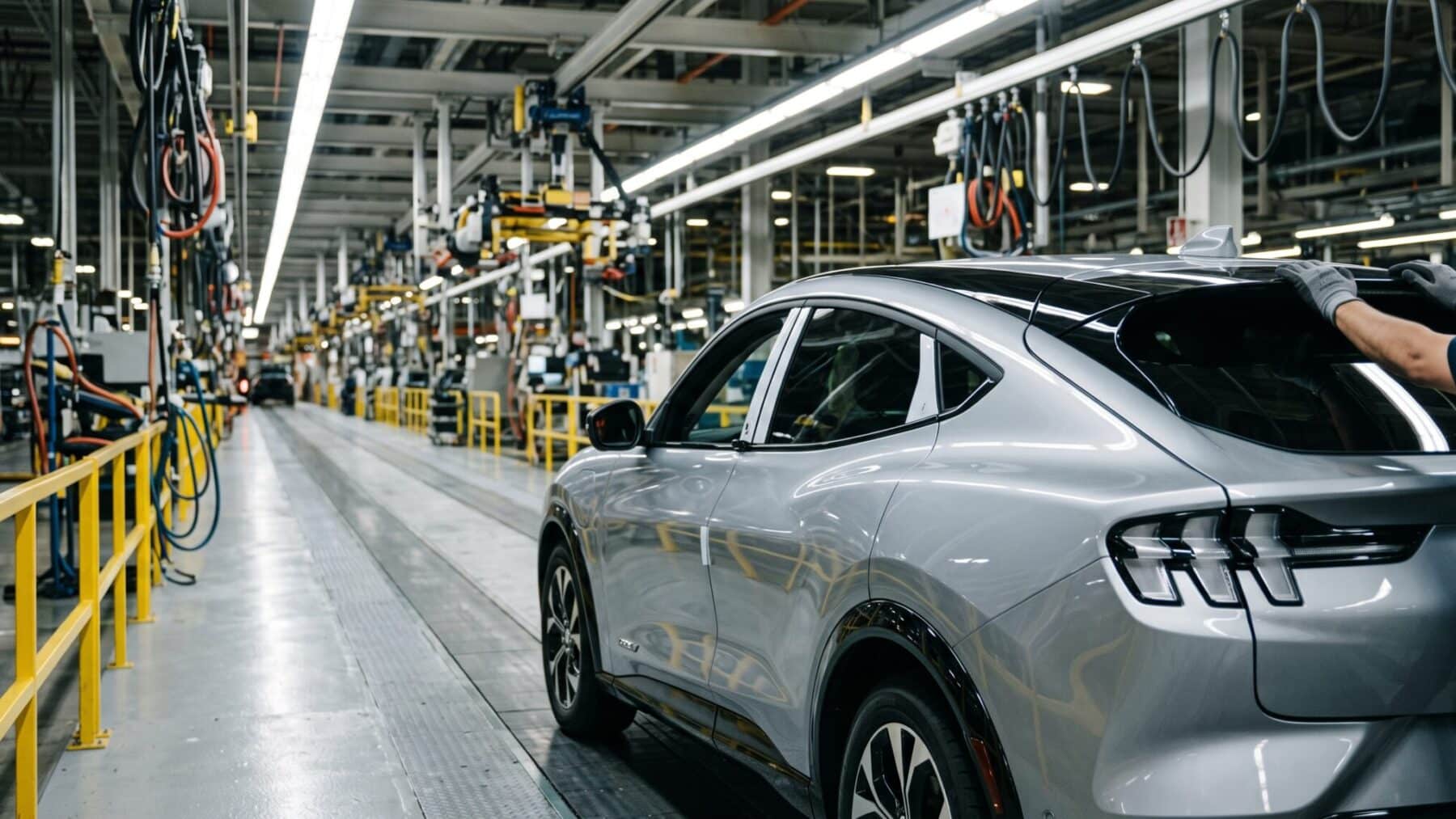
A nameplate last seen on a sport compact liftback coupe is back, wearing four doors and a charging port.
The original wore a clean hood and a short deck. This one wears a fastback roofline. The factory is in Ohio, not Japan.
And the platform underneath it belongs entirely to the automaker that built it, which is precisely what makes this launch different from the one that came before it. So what does building your own architecture actually change?
Why building the platform yourself changes everything a luxury brand can offer
When a carmaker borrows an electric platform from a rival, it inherits that rival’s architecture: the battery layout, the charging speed ceiling and the software stack on top of it. Every downstream decision, from how the suspension loads to how fast the pack charges, is shaped by engineering choices made in someone else’s boardroom. The borrower can dress the exterior and tune the seats, but the core product is not really its own.
Cutting that cord means designing the motor, the battery management system and the cabin operating system from scratch. That costs more up front but hands the brand full control of every number on the window sticker and every update pushed to the car after sale.
That vertical control is the mechanism behind this launch. It explains why the new Ohio-built electric SUV is being positioned as a genuine turning point rather than another badge-engineering exercise.
What the car actually is, and what sits inside it
The model first appeared as the Acura Performance EV Concept at Monterey Car Week in 2024. The RSX Prototype, the production-intent version, made its global debut at Monterey Car Week the following summer. It is slated for production as the first electric vehicle developed entirely in-house by the brand, built on its parent company’s global EV platform. The silhouette is a coupe-like fastback that sits closer in size to the brand’s existing compact gas SUV, but the proportions pull it into its own space on a dealer lot.
The RSX will also be the brand’s first implementation of its new ASIMO OS, developed in-house by the parent company. That matters because the software layer controls everything from driver-assist calibration to energy management, and owning it means the company can push meaningful updates rather than waiting for a third-party supplier to act.
The RSX EV is expected to carry dual-motor all-wheel drive and deliver around 490 horsepower, accelerating to highway speed in approximately four seconds. Third-party estimates project a 92 kWh battery providing up to 320 miles of range, and DC fast charging at 220 kilowatts, meaningfully higher than most rivals in the segment can accept today. Acura has not officially confirmed those figures.
The factory, the platform shift, and the numbers behind the pivot
The RSX is expected to be the first EV produced at the Honda EV Hub in Marysville, Ohio, built on the same production line as the Acura Integra. Assembling an electric performance vehicle alongside a gas-powered sport compact is an unusual configuration, and it signals that the Ohio plant is being repositioned as the center of the brand’s electric future.
The contrast with the brand’s previous EV is sharp. The ZDX was based on the GM Ultium platform, which also underpins the Cadillac Lyriq, and its starting price was expected to land in the $60,000 range at launch. That borrowed-platform strategy let the brand reach the market faster, but it also meant the product was downstream of another company’s roadmap.
The RSX is the first vehicle that makes the in-house transition concrete and drivable. Lance Woelfer, VP of automobile sales at American Honda Motor Co., noted publicly that the RSX represents the brand’s first chance to define its EV identity entirely on its own terms.
Where the pricing lands and who the real competition is
The RSX is expected to arrive in the second half of 2026. Official pricing has not been announced, but analysts expect the RSX to open in the high $50,000s to mid-$60,000 range. That would place it above mainstream electric crossovers and directly below the European luxury brands that have owned this segment for years.
The fastback body style and in-house performance positioning are aimed at pulling buyers who would otherwise spend more with a German brand. For some buyers, the RSX badge carries two decades of enthusiast credibility that no amount of spec-sheet polish can manufacture.
The timing is awkward for some rivals. As one Scandinavian brand slashed prices and stepped back from the US market, this brand is moving in the opposite direction: building domestically, owning its platform and pushing into a segment where premium EV buyers have had limited American-made choices.
What the launch does not yet answer, and what comes next
The biggest open question is real-world range. Published estimates of 320 miles assume EPA-cycle conditions, and performance SUVs driven at their rated output tend to come in below that figure in daily use.
Fast-charging capability at 220 kilowatts is strong on paper, but the density of stations that can actually deliver that rate to a non-Tesla platform remains thin outside major corridors. Bidirectional charging, which lets the car power a home or campsite, has already been confirmed and remains rare in the segment, which could become a genuine selling point as grid reliability stays in the conversation.
Meanwhile, hybrid models recently claimed a record share of new US vehicle sales, and pure electric vehicles are fighting harder for every percentage point of that shrinking gap. A domestically built, in-house engineered performance EV with a credible range figure is exactly the product that could move the needle, if the pricing lands where analysts expect and the software behaves at launch.
What is different this time is ownership. The architecture, the operating system and the factory floor all belong to the same company. When something needs fixing, there is no other boardroom to wait on.
