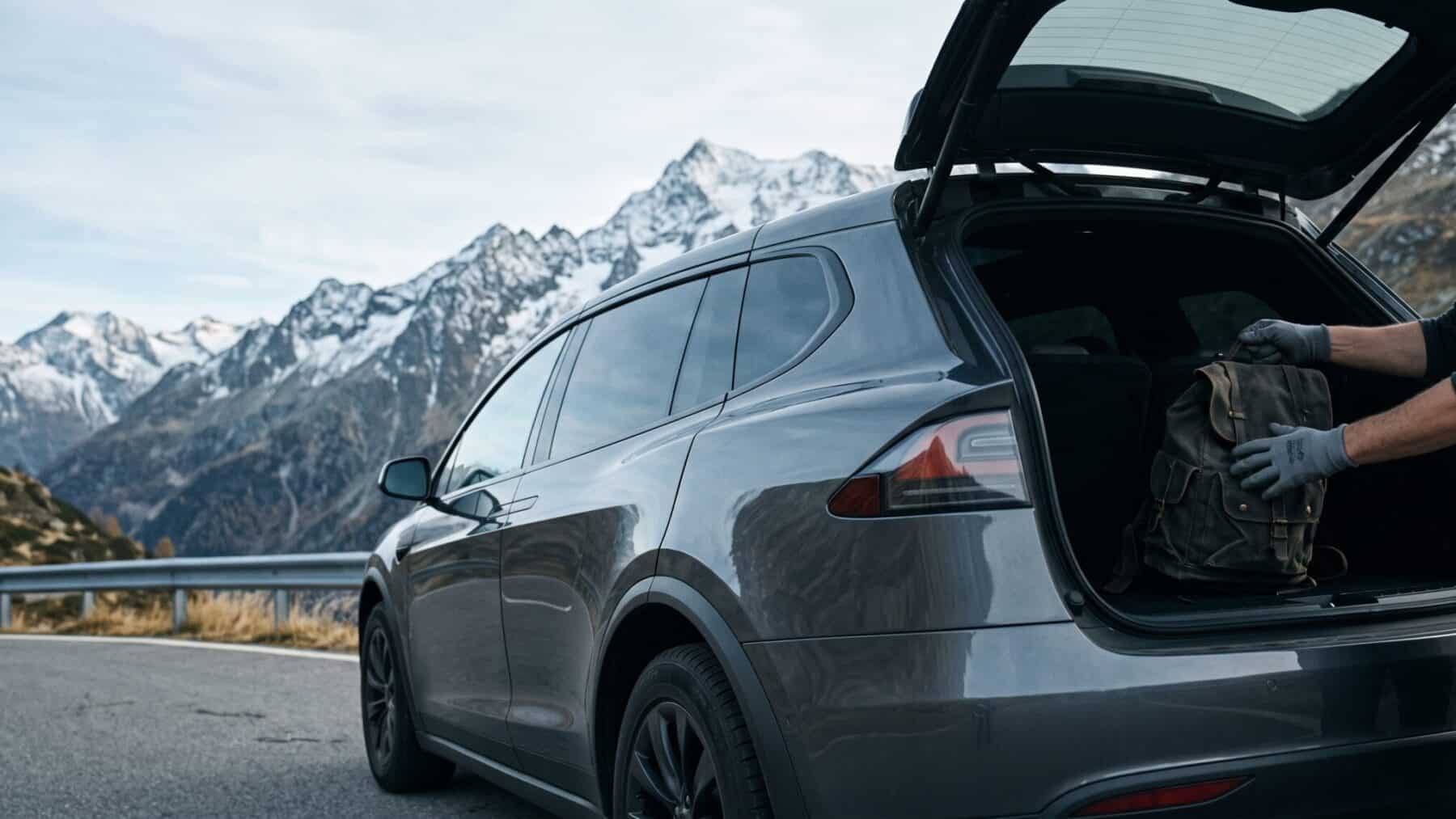
Seven seats, three rows, and not a single drop of gasoline under the hood.
The doors swing open and there is enough headroom in the back for a six-footer. A large lithium-ion battery sits under the floor. The question sitting behind all of it: how did a brand best known for modest all-wheel-drive wagons end up building the most powerful production vehicle in its own history?
Why going AWD-only on every trim changes the math against the platform partner
The new three-row SUV shares its underpinnings with the Toyota Highlander EV, both built on the modified TNGA-K platform co-developed by the two automakers. That partnership produces nearly identical bones: same battery sizes, same basic proportions. But the two brands made opposite calls on one pivotal spec.
The Toyota Highlander EV’s base XLE trim is a single-motor, front-wheel-drive model rated at 221 horsepower. Every Getaway, by contrast, delivers maximum grip from the start. Locking AWD into every trim means the dual-motor setup is never replaced by a cheaper single-motor configuration, and Subaru has tuned those two motors to a combined 420 horsepower, 82 more than the Toyota Highlander EV’s AWD output of 338 horsepower.
A buyer cannot accidentally option their way down to the weaker setup. There will be no front-wheel-drive Getaway, and that single product decision separates the two vehicles at every price point on the sticker.
What the Getaway actually delivers inside and on the road
Unveiled at the 2026 New York International Auto Show, the 2027 Subaru Getaway is a fully electric, three-row family SUV packing 420 horsepower and over 300 miles of estimated driving range. Those numbers make it the most powerful production vehicle the brand has ever sold.
The EV sprints to 60 miles per hour in less than 5.0 seconds, carries a 3,500-pound towing capacity, and offers 8.3 inches of ground clearance. That clearance figure matters for a brand whose buyers tend to measure the weekend in elevation gained, not miles covered.
Every Getaway comes with one-touch second-row folding seats and a power-folding third row for cargo flexibility. With the third row folded, the Getaway offers 45.6 cubic feet of cargo space, more than the Kia EV9. With it upright, there is 15.9 cubic feet, which is what families actually live with on a daily school run or airport trip.
The battery, the charger and where the evidence on range comes from
The long-range model arrives first, featuring a large 95.8-kilowatt-hour lithium-ion battery with 150-kilowatt DC fast charging. A more affordable standard-range model follows in the first half of next year, carrying a 77.0-kWh pack.
The long-range Getaway can recharge from 10 to 80 percent in 30 minutes and comes standard with the North American Charging Standard, giving owners access to Tesla’s Supercharger network. Access to more than 25,000 fast chargers without an adapter has become the threshold question for long-haul family road trips, and the Getaway clears it from day one.
A standard on-board battery preconditioning system keeps charging speeds from lagging in cold weather. That is the kind of spec that only matters when you are at a Wyoming rest stop in January, but it is exactly when it matters most.
The official range figure comes from Subaru’s press release tied to the New York show unveiling, where Subaru’s product team noted that locking in AWD across the lineup was a deliberate move to match how owners actually use their vehicles year-round.
Where the Getaway runs into real limits and how it compares to rivals
The Getaway is the fourth Subaru electric vehicle, joining the Solterra, Trailseeker, and Uncharted, and the first Subaru EV with three rows. Building on an existing charging and software foundation reduces risk. But rivals like the Kia EV9 have had a meaningful head start winning over three-row EV families.
The platform-sharing arrangement with Toyota is a genuine efficiency win, but it creates a perception problem dealers will need to navigate. The dashboard, steering wheel, and center console are nearly indistinguishable from the Highlander EV, and buyers who cross-shop both vehicles will spot the overlap immediately.
There is also the question of price. The Getaway has not released official MSRP figures, which means early buyers are comparing the spec sheet against rivals in a market where hybrids claimed a record 16 percent of all new US vehicle sales last quarter. That share signals plenty of families are still not ready to go fully electric.
The long-range model arrives first, putting the most expensive trim in front of buyers before a lower entry point exists.
What the Getaway’s arrival signals for the broader family-SUV market
Three-row electric SUVs are a segment the market has been waiting on for years. Another credible option at 420 horsepower and over 300 miles of range tightens competitive pressure on every rival. The 2027 Subaru Getaway arrives at retailers nationwide in late 2026, putting it on dealer lots before the holiday season, when large family SUV purchase decisions tend to accelerate.
The AWD-standard call sets a benchmark rivals will feel. Buyers who previously accepted a front-drive-only EV as a compromise now have a fully electric seven-seater that refuses to make that trade. And because the Getaway ships with native NACS ports, it arrives plug-ready for the largest fast-charging network in the country.
The broader picture is a market where the three-row electric SUV is no longer a niche product built by one or two players. More options and an AWD-only entrant at 420 horsepower will push pricing conversations across the segment in ways that ultimately favor the buyer sitting across from a salesperson.
That is a shift worth watching through the end of this year and into the first sales data of the next.
