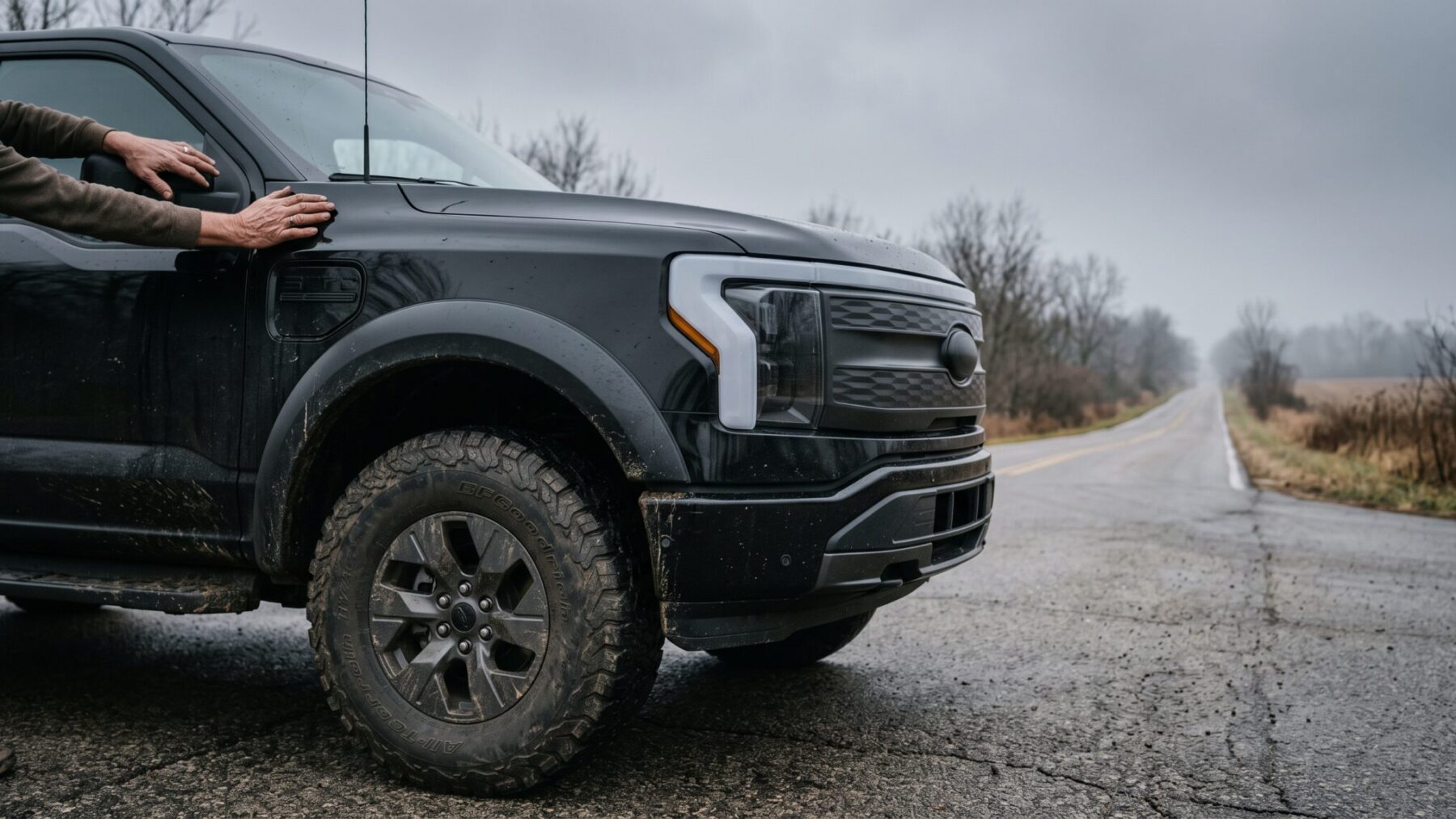
Seven days, forty engineers, and one production truck rolling through suburban Michigan streets on a challenge that started as a casual conversation among colleagues.
The odometer ticked past 800 miles, then 900, then crossed a number no electric vehicle had ever reached on public pavement. Michigan’s flat suburban streets had just become the backdrop for a world record nobody planned when the year began. So what exactly made the truck go twice as far as its window sticker promises?
How a 205-kilowatt-hour pack squeezes more than double its rated miles
The secret sits in a simple physics trade-off: aerodynamic drag rises with the square of speed, meaning a truck crawling at around 22 mph burns a tiny fraction of the energy it would burn at highway pace. The engineering team found that the truck’s most efficient cruising band sat between 20 and 25 mph, a pace close to normal neighborhood driving in southeast Michigan.
At that speed, the truck was using nearly all of its battery power to move down the road, with minimal energy going to other uses. The truck averaged roughly double its official EPA estimate of about 2.4 miles per kilowatt-hour, landing at 4.9 miles per kilowatt-hour across the full run.
Regenerative braking contributed as well. The team minimized hard braking and quick acceleration whenever safe to do so. The truck’s hardware and software remained stock, but the team made small, owner’s-manual-approved adjustments to maximize range, optimizing tire pressure and wheel alignment, reducing weight by removing the spare tire, using a tonneau cover for smoother airflow, and maintaining steady speeds between 20 and 25 mph.
Seven days on Detroit’s streets, one engineer per hour behind the wheel
Over seven days, a team of 40 engineers drove the truck in one-hour shifts on public roads near GM’s Milford Proving Ground in southeastern Michigan, wrapping up the route on Detroit’s Belle Isle. That detail matters: this was not a closed-course stunt with a dedicated crew. It was an extended public-road drive, executed in real traffic.
This was a side project for the engineers, who drove in one-hour shifts during their regular workday. Engineers kept the climate system off throughout, no air conditioning even in July heat, and logged data the entire time.
The record-setting truck was the Work Truck trim, the cheapest, lightest trim, equipped with the 205-kilowatt-hour battery pack, the largest offered on the electric pickup. That configuration is built for fleet buyers and contractors, not offered for direct retail sale. The achievement can be attributed in large part to the Silverado EV’s 205-kilowatt-hour battery pack.
The numbers that put 1,059 miles in context
That figure, more than double the Silverado’s official range of 493 miles, was achieved by a team of GM engineers who spent a week extracting every last electron from the battery pack. According to GM’s official announcement, the record surpasses the previous EV range record of 749 miles set by Lucid earlier that summer. Beating it by 310 miles in a pickup truck, a vehicle class not historically associated with efficiency, made the result genuinely historic.
The pickup clocked up 1,059.2 miles on a single charge, the longest distance ever driven by an electric road car without plugging in. The 1,059-mile distance marks the first time a production EV had achieved a four-figure range figure, sitting comfortably above any other result on record. For buyers weighing whether nearly-new used EVs hold their range over time, independent research consistently shows modern EV batteries retaining the great majority of their capacity across the first several years of ownership.
The 493-mile EPA estimate already placed the truck among the highest EPA-range estimates of any full-size electric pickup on the market, a particularly impressive result for a vehicle in that class with all-wheel drive. The record run proved the real ceiling of the underlying battery technology sits well above any EPA label.
Where the record does not apply and what it costs in practicality
A driver replicating this run on an interstate at 70 mph will not come close to 1,059 miles. The efficiency gain at low speed is not transferable to highway travel, where aerodynamic drag dominates and energy consumption rises sharply. The physics that unlocked the record actively work against a commuter in a hurry.
Towing narrows the picture further. A contractor hauling a heavy trailer will see range drop sharply, which is why the 493-mile EPA rating remains the most honest everyday benchmark for most buyers.
There is also the time cost: seven days at 20 mph covers the same distance a highway driver covers in about 15 hours. But range anxiety is still the single biggest barrier keeping buyers from EVs, and a truck that carries more stored energy than any driver could realistically use in a day reframes the conversation. Drivers weighing the wider charging picture can find useful context in the latest national charging reliability figures, which show steady year-on-year improvement.
What the result means for electric truck buyers shopping right now
The record matters most as a signal about where battery chemistry is heading. Deep integration across battery chemistry, drive-unit efficiency, software and vehicle engineering all contributed, and each of those levers is still being optimized. That means EPA-rated range on future model years will continue to climb even without a hypermiling test.
According to GM’s own customer research, range remains the top consideration, particularly among prospective Silverado EV customers, making it the top purchase driver for potential buyers in this segment. A truck that proves its pack can power more than a thousand miles of real driving, even at an optimized pace, answers that concern in the most concrete terms available.
The seven-day run fed real-world efficiency data back into an active development cycle. For buyers who have been waiting for an electric full-size pickup to feel as capable as what it replaces, that pipeline of improvements, grounded in a real public-road record, is the most convincing argument the numbers can make.
