A spare bedroom quietly stopped being a bedroom.
A corner of the basement fills with boxes. Half the garage disappears behind furniture nobody uses. Most Americans have at least one space that turned into a holding pen for things they might need someday. Nobody quite adds up what that square footage is actually worth. A report released in April 2025 by Storable and SpareFoot just did the math, and the number is large enough to stop anyone mid-step on the way to the attic.
How unused square footage becomes a silent mortgage you never agreed to pay
Every square foot of a home has a dollar value baked into the purchase price, the mortgage, the property tax and the opportunity cost of owning it. When that square footage is surrendered entirely to stored possessions, the owner is effectively spending real estate money to warehouse objects rather than to live in the space.
The mechanism is direct: cost per square foot multiplies against the area surrendered, producing a figure most homeowners have never consciously confronted. With the US median home listing price running around $227 per square foot, a household dedicating 300 square feet to storage is paying $68,000 in real estate value to house its belongings. Scale that to a larger footprint and the number climbs fast.
At more than 500 square feet, the embedded cost reaches $113,500. That is not a fee anyone sees on a statement.
It sits invisible inside the home’s price, and the calculation depends on nothing more exotic than price paid per square foot multiplied by rooms no longer used as rooms. Which is exactly why most families have never done it.
What a cluttered American home actually looks like room by room
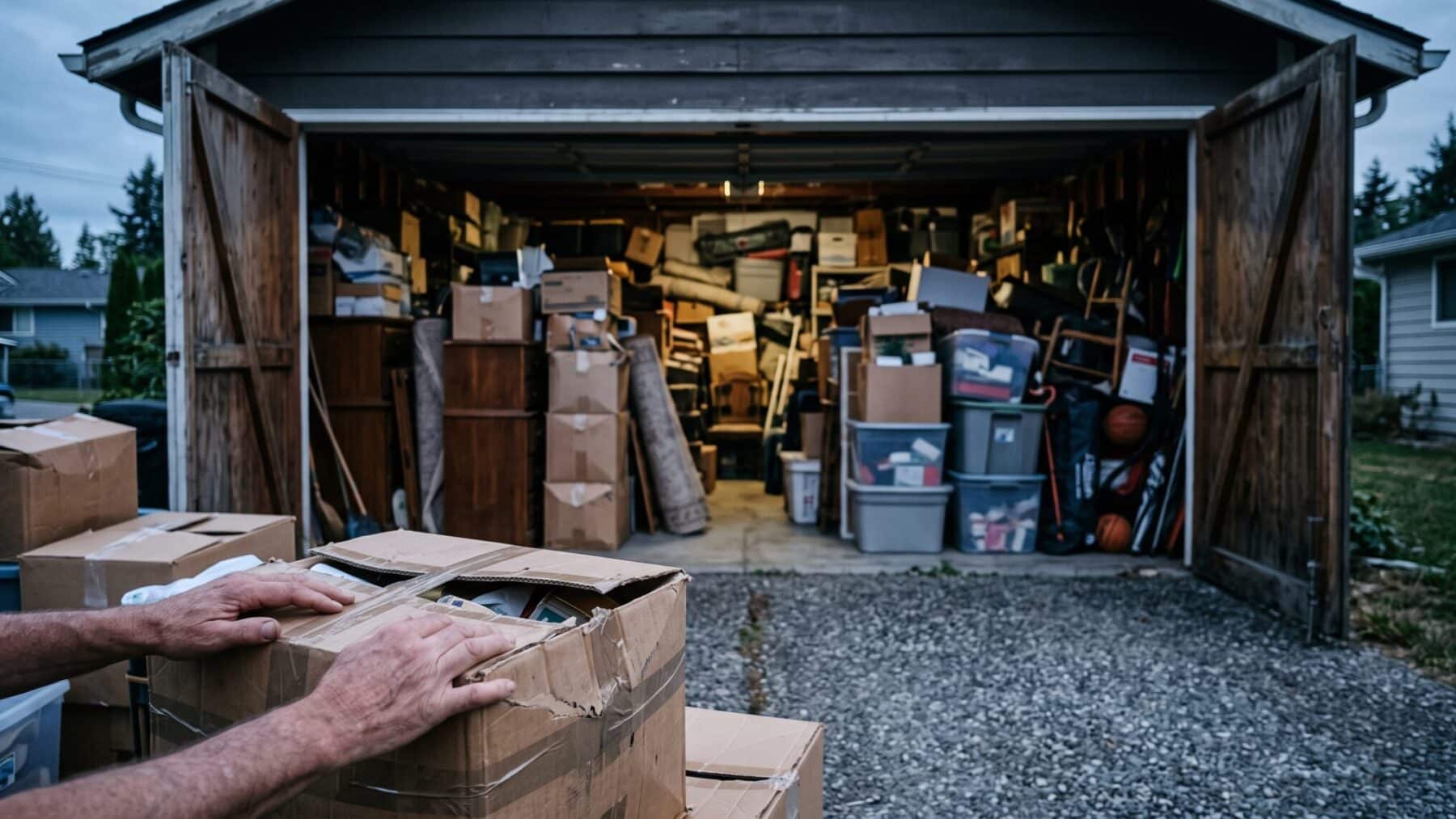
Picture the garage first. Thirty-one percent of Americans reported their garages are at least half-filled with clutter, while 9 percent cannot park their cars in the space at all. That is a room designed and priced for a vehicle sitting instead as a warehouse, often inside a renovation budget that never stretches far enough to address it.
The broader picture is just as striking. Over half of respondents, 54 percent, sacrifice between 100 and 500 square feet to possessions they rarely use. That middle band covers everything from a hall closet to a second bedroom packed with objects untouched for years. Southern households show a particular pattern: 23 percent dedicate 300 to 500 square feet to internal storage and are also the most likely to rent an external self-storage unit on top of that.
They are paying the embedded real estate cost and a monthly storage bill simultaneously. Two lines of spending, only one of which ever appears in a budget.
The report behind the numbers and the duplicate-purchase habit it exposed
The figures come from “The Real Cost of Clutter,” a survey of 1,000 Americans conducted by Storable, an integrated technology platform serving the self-storage industry, and SpareFoot, the largest online marketplace for finding and reserving a self-storage unit. It found that 21 percent dedicate over 500 square feet, roughly the size of a small apartment, purely to storage.
The same survey found that 71 percent of Americans have purchased an item more than once because they could not find the first one they bought. Scissors, power tools, phone chargers, measuring tapes, batteries: items small enough to vanish into a cluttered drawer and cheap enough to replace rather than excavate. Twenty-three percent of respondents have made that mistake more than three times.
Those repeat buys accumulate into a quiet annual drain. Duplicate purchases and missed deals, along with late fees on bills buried in paper piles, are what the report calls the secondary layer of the clutter tax. Americans also spend a significant amount of time each year searching for misplaced items, hours pulled from weekends without ever appearing on a household budget.
Where the self-storage industry fits in, and where the math gets complicated
For millions of households the answer to running out of room at home is to rent room somewhere else. According to industry figures cited in the report, around 11 percent of American households are renting self-storage units at an average cost of approximately $128 per month for a standard unit, a real monthly line stacked on top of the invisible cost already embedded in the home.
The US self-storage sector has grown into a $44-billion-a-year industry, the largest such market in the world by a considerable distance, precisely because clutter overflows the home before most families decide to address it directly. Yet the storage bill is at least visible.
On average, renters hold their units for well over a year, and many run far longer, often forgetting what they stored. That is a monthly payment for objects the renter can no longer name. Those living in dense zip codes face an added wrinkle: proximity shapes how people use shared space, and clutter spilling into common areas compounds the social as well as the financial toll.
What the numbers suggest for families deciding what to do next
The core finding is straightforward: square footage devoted to storage carries the same per-foot cost as every other part of the home. Treating it as a costless overflow zone means absorbing that price invisibly, every year, without ever accounting for it.
Once the figure is named, $68,000 for 300 square feet or $113,500 for 500 or more, the decision looks different. The options are real and measurable. Reclaiming a 200-square-foot storage room at the US median represents roughly $45,400 in living space returned to productive use.
Selling, donating or clearing the objects holding that space does not recover the embedded cost, but it stops the ongoing accumulation and eliminates the duplicate-purchase cycle. A household that never calculates the cost of its clutter is paying the clutter tax regardless. The number is real, it compounds quietly, and it now has a figure precise enough to write on a piece of paper and stick to the garage door.
