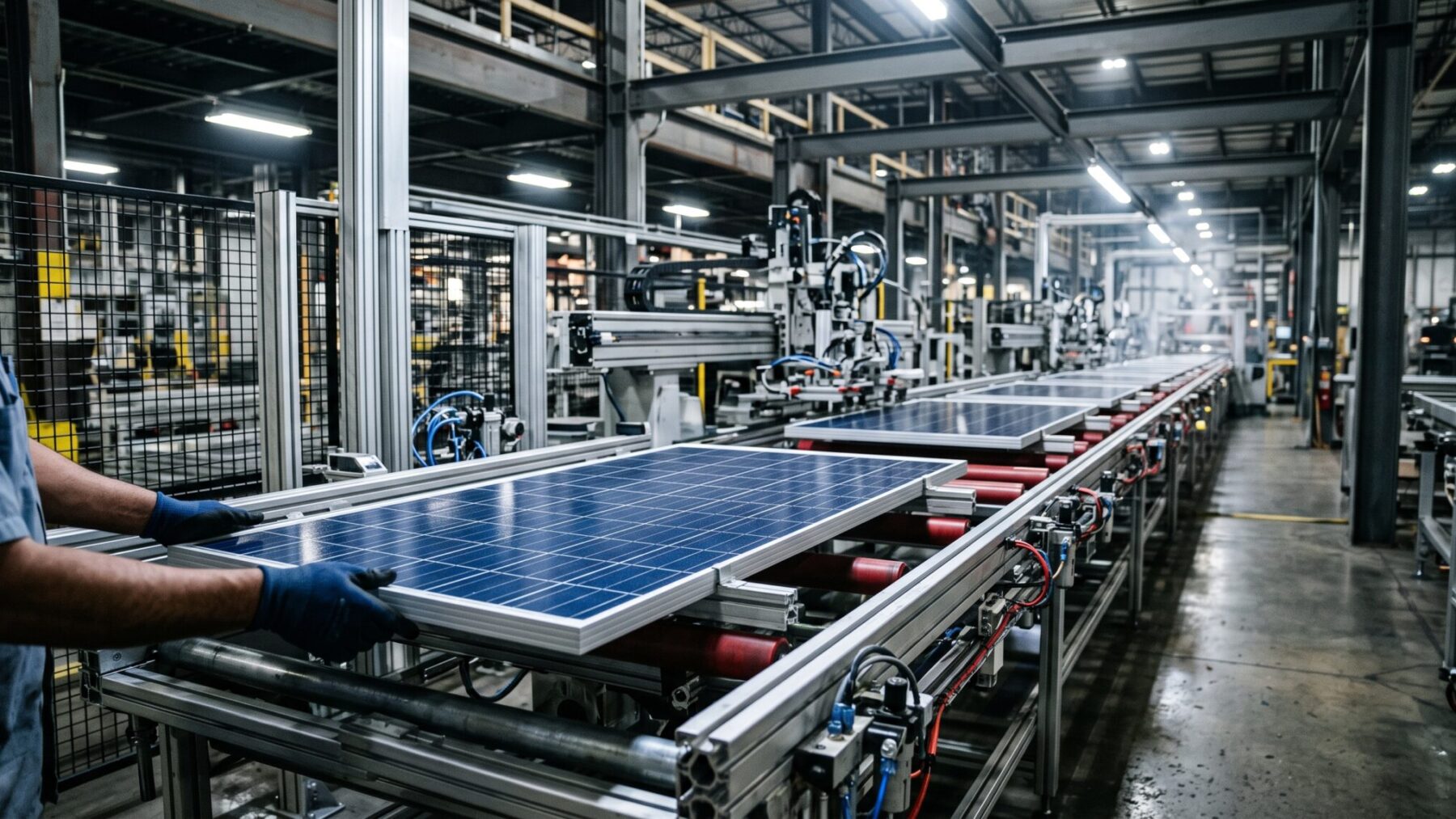
Rows of wafer-thin silicon squares move down a conveyor under cool white light.
A robotic arm places them with millimeter precision. Somewhere above the same concrete floor, a furnace is growing the ingot those squares came from. No truck pulled up to deliver raw material from overseas. This is what a fully closed supply chain looks like in practice, and until this summer it did not exist anywhere in the United States.
Why a solar assembly line is not the same as making a solar panel
Most Americans assume that a factory stamping out finished solar panels is making solar panels. It is not, not fully. A conventional module plant is really just the last stop on a very long conveyor belt that begins in a polysilicon refinery, passes through an ingot furnace, a wire saw slicing wafers and a chemical bath etching the cell structure, and only then arrives at the laminator that bonds everything into a finished panel.
The mechanism that makes the new Georgia factory different is vertical integration: collapsing every upstream step into one building so that raw silicon crystal never crosses a border before it becomes a panel. Crystal growth furnaces, wire saws, cell diffusion lines and module laminators all share the same address in Bartow County, Georgia.
Until this year, every US module factory imported at least one of those upstream pieces, almost always the cells and wafers, typically from Asia. That left the domestic industry as essentially a finishing shop, not a manufacturer in the full sense of the word.
What the Cartersville floor actually looks like in production
Module assembly at Cartersville has already reached full capacity, producing approximately 16,700 panels daily. Cell production lines started up in June, with ingot and wafer lines ramping alongside them.
An ingot is a cylinder of ultra-pure silicon grown slowly from a melt at around 1,400 degrees Celsius. Wire saws then slice it into wafers roughly 170 micrometers thin, which go through doping, anti-reflection coating and contact printing to become cells. The Cartersville facility is described by Qcells as the first operation of its kind in the United States in more than a decade.
Only then does a module factory add glass, encapsulant and a frame. Each of those steps has historically required a separate facility, usually in a separate country.
The numbers behind the supply gap and what the data show
The US now has nearly 70 gigawatts of solar module manufacturing capacity online, according to SEIA and Wood Mackenzie data, up from around 8 gigawatts before federal manufacturing incentives took effect. Yet that explosive growth in module capacity never pulled cell and wafer capacity along at the same pace, leaving a structural weakness that a tariff shock or shipping disruption could exploit overnight.
US solar cell manufacturing capacity stood at around 3 gigawatts, against nearly 70 gigawatts of module assembly capacity. That gap widened over the past decade as the domestic industry’s upstream production gradually exited, leaving module factories wired to overseas cell suppliers. You can read more about how Section 232 price floors have already set a threshold the US barely produces at the cell level.
When Qcells began manufacturing solar cells at Cartersville in June, it marked the first time a single US address could claim ingot, wafer, cell and module output simultaneously. When fully operational, Cartersville will produce 3.3 gigawatts each of ingots, wafers and cells, and 3.5 gigawatts of modules annually. Combined with a separate Dalton facility, Qcells’ total US module output is expected to hit 8.6 gigawatts by the end of the third quarter of this year, enough to power roughly 1.3 million American homes for a year.
The SEIA context makes the timing urgent. The US solar industry installed 43 gigawatts of new capacity in 2025, remaining the dominant source of new capacity added to the grid for the fifth consecutive year, according to the SEIA and Wood Mackenzie 2025 Year in Review report. A domestic supply chain that can produce cells and wafers locally matters far more when installation volumes remain at historic levels every year, because import disruptions translate directly into delayed projects and higher prices.
Where the model runs into real limits
Vertical integration is not a simple equation where one Georgia factory solves the entire US supply shortfall. The solar manufacturing industry remains gripped by uncertainty around foreign entity of concern requirements and ongoing trade cases that have stymied new development.
The cell capacity math also still does not close. Even with Cartersville’s 3.3 gigawatts of cell output at full tilt, total US cell capacity remains far below the nearly 70 gigawatts of module assembly across the country. The bottleneck simply moved one step upstream rather than disappearing.
There is also the question of whether a single vertically integrated site concentrates risk in a new way. A fire, a flood or a regulatory hold at one address could interrupt ingot, wafer, cell and module output simultaneously. Distributed supply chains spread that risk across geographies, even if they create the import dependencies that drove the reshoring push in the first place.
What a closed supply chain changes for developers and grid planners
For a utility-scale solar developer, the practical prize of domestic vertical integration is cost predictability. When cells and wafers cross an ocean, their price moves with shipping rates, currency exchange and trade policy. Customers gain a clearer pathway to domestic content tax credits, and those credits can add several cents per watt to project returns at the gigawatt scale.
Grid planners counting on record solar additions to arrive on schedule need panels to flow reliably through the supply chain. The Indiana HJT cell factory that opened earlier this year targets a different cell architecture, meaning the US is now building domestic cell capacity in at least two distinct technology lanes. That gives the broader market a hedge against any single technology shift.
None of that makes the supply gap disappear quickly. What a fully integrated Georgia factory proves, for the first time in more than a decade, is that the US can grow a silicon crystal and ship a finished panel without ever leaving the same address. Whether the wider industry can scale that model fast enough to match the ongoing record build-out is the question the next several quarters will answer.
