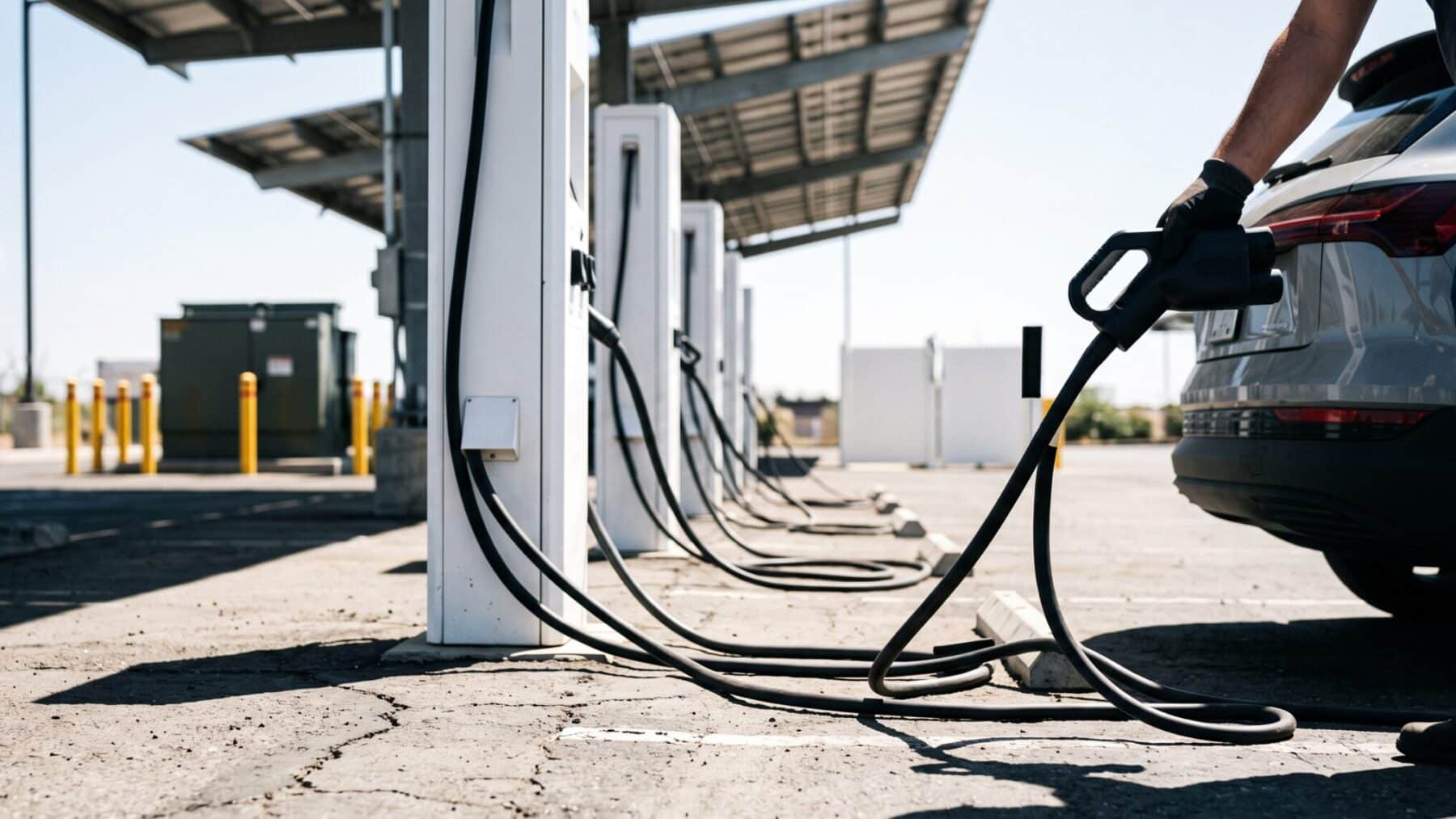
A driver pulls off the interstate, slides up to a gleaming fast charger, and drives away twenty minutes later with a nearly full battery.
The transaction looks simple. Behind it, the charging company has just taken a financial hit most drivers never see. The utility did not bill for the energy alone. It billed for the peak power the charger pulled from the grid in that single busiest fifteen-minute window of the month, and that one window can cost more than all the kilowatt-hours combined.
So what is it about fast chargers that makes them such a perfect demand-charge trap?
Why the power bill works against a fast charger the moment it gets busy
Most Americans pay for electricity by the kilowatt-hour, the way they pay for gasoline by the gallon. Commercial customers pay differently. Utilities also charge them a separate line item every month based on the single highest spike in power draw, measured in kilowatts, regardless of how briefly that spike lasted. That charge exists because the utility has to build enough grid capacity to serve every customer at their worst moment simultaneously.
A DC fast charger is a demand-charge machine by design. It draws 50 to 350 kilowatts at full power, immediately, for the entire duration of a session. A highway corridor station with eight or twelve 150-kilowatt stalls produces a peak power event that industrial billing structures were built to capture.
So the billing math breaks. At a low-traffic site, the charger may sit idle for 28 days, then serve a dozen cars on day 29. The utility still charges the peak demand from that single busy afternoon across the full monthly bill, even though the station delivered very little energy overall. Demand charges represent 23 to 85 percent of a DC fast charger’s operating costs, depending on utilization rate and local rate structure.
What the real numbers look like across the charging network today
As of late June 2026, there are over 82,000 EV charging station locations across the United States, with more than 253,000 charging ports, according to the Department of Energy’s Alternative Fuels Data Center. DC fast charging commonly costs $18,000 to $350,000 or more per charger to procure and install, depending on power output and site complexity. Those capital costs are sunk before a single session is delivered.
What kills the operating margin is the monthly demand charge that no upfront investment can eliminate. At a 150-kilowatt station, the cost per charging session drops from roughly $399 to $5.73 as utilization rises, a difference driven almost entirely by how demand charges are spread across sessions. An underused station in a low-traffic corridor can lose money on every car it serves.
That squeeze shows up directly in what drivers pay. Public DC fast charging costs $0.35 to $0.60 per kilowatt-hour without a membership, against a national residential average of around $0.177 per kilowatt-hour. Much of that markup is the operator passing demand charges onto drivers through higher per-kilowatt-hour rates. The same energy simply costs two to three times more away from home.
The evidence behind the cost squeeze and where it is most acute
The DOE’s Alternative Fuels Data Center and federal research into EV charging station economics have documented the demand-charge problem across multiple years of deployment data. Utility interconnection delays of 12 to 36 months add further pressure before a station earns its first dollar.
Across the country, utilities are replacing the traditional per-kilowatt demand charge on commercial EV rates with subscription tiers, capacity reservations and overage penalties. The label on the line item changes; the cost driver does not. In Massachusetts, some utilities offer commercial EV programs designed to reduce demand-related costs for qualifying customers, an example of discounting rather than eliminating the underlying charge.
The rate environment is making the baseline worse. As GCN has reported, a record $9.2 billion in rate-hike requests landed in a single second quarter, and regulators have approved 58 cents of every dollar utilities asked for over the past two years. That upward pressure on commercial electricity costs lands directly on charging operators.
One large Nevada utility has taken a different approach to its commercial EV charging tariff: it phases out demand charges for qualifying commercial EV customers over a ten-year transition period that ends in April 2029, giving operators a window of reduced demand costs. That reprieve is shaping where operators deploy fast chargers right now.
Where the model holds and where operators are being forced to adapt
High-traffic urban sites are navigating the demand-charge problem more successfully than rural highway corridors. Station-specific pricing has replaced network-wide pricing at major charging networks, letting operators in low-demand-charge territories charge less while still turning a margin.
Membership models and time-of-use pricing are the two tools operators are leaning on hardest. Mid-morning and late-evening sessions commonly run 10 to 20 cents per kilowatt-hour cheaper than the after-work peak at the same stall. That is not charity: spreading sessions across the day lowers the single monthly peak power reading and cuts the demand charge the operator owes the utility.
Smaller independent networks without sophisticated peak-management tools are the clearest losers in the current market.
What the demand-charge squeeze means for the buildout ahead
Public fast-charger density is not simply a function of capital. It is a function of where utility rate structures make a viable business possible. States that reform commercial EV demand charges, or that offer dedicated EV charging tariffs, are drawing investment faster than those that leave the industrial billing model in place.
Vehicle-to-grid and demand-response programs could eventually let charger operators earn revenue by curtailing load during grid stress events, partially offsetting demand charges rather than simply suffering them. That transition is still early, but the market incentive is now strong enough that it is moving from pilot programs toward commercial contracts in a handful of utility territories.
The operators who survive will be those who treat demand-charge management as their primary operating discipline, not an afterthought. The ones who cannot will keep losing money on every fast session until utilization rises enough to dilute the peak, or until the utility changes the rate. Neither outcome is guaranteed to arrive before the economics force a reckoning.
