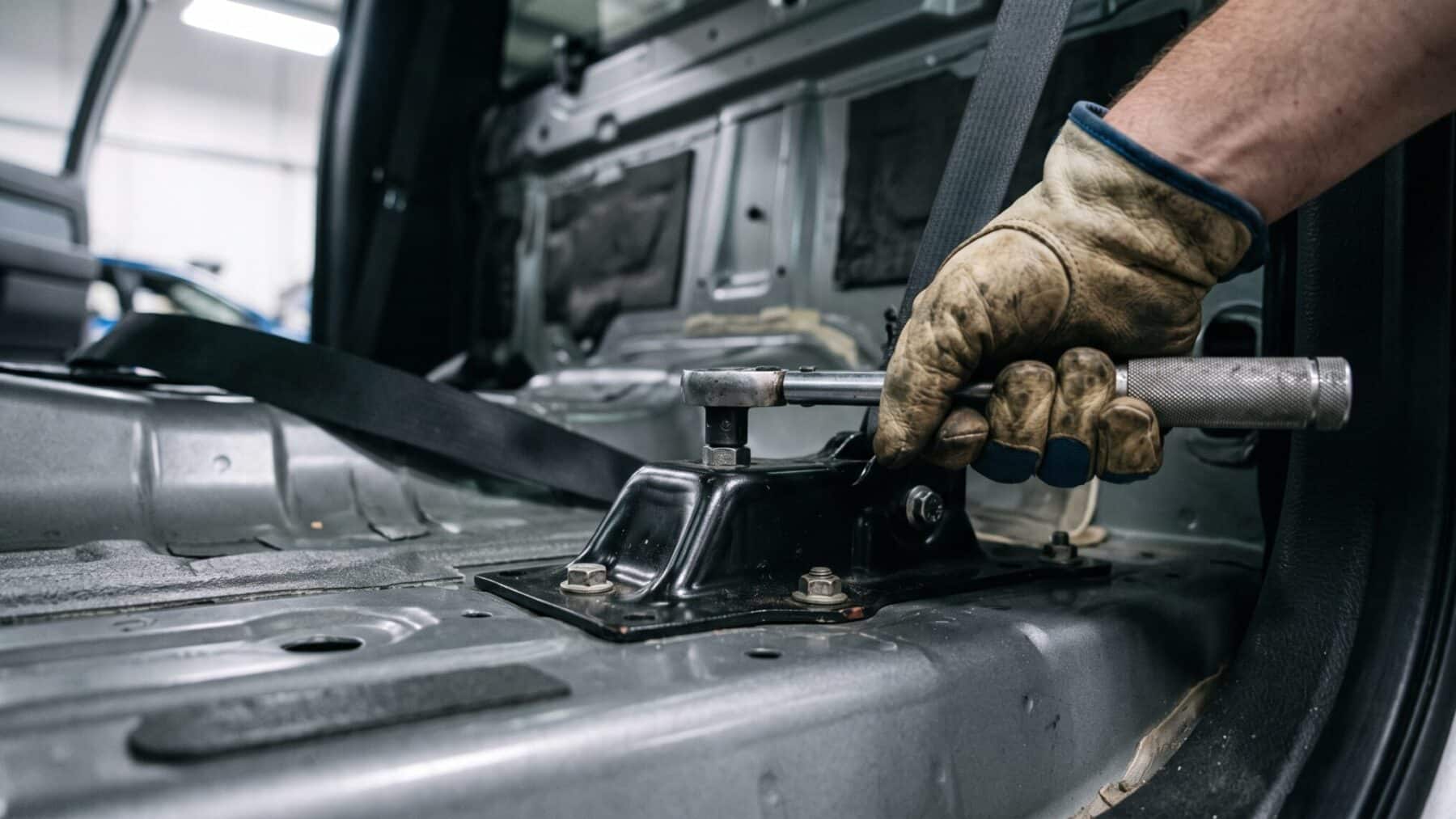
Picture the back seat of a full-size pickup: the belt clips in with a satisfying click and nothing looks wrong.
No warning light glows on the dash. Nothing rattles. But for more than a million of these trucks, the anchor holding that buckle to the floor may not have been properly secured to the body at the factory, and there is no way for anyone inside the cab to tell.
So what, exactly, breaks when that final link is missing?
Why an improperly secured anchor defeats the whole belt system
A seat belt does not work alone. The webbing you pull across your chest is only one part of a chain that runs from the shoulder anchor on the pillar, across your body, into the buckle, and down through the buckle anchor to a bolt threaded into the vehicle’s body structure itself. Every link in that chain has to hold for the system to manage crash forces the way engineers designed it.
When the buckle anchor is not fastened to the body, that final link is missing. An improperly fastened anchor may reduce a seat belt’s ability to manage force and restrain an occupant, increasing the risk of injury during certain driving conditions or a crash. The belt does not snap or fray. It simply cannot resist the load, and the passenger moves forward anyway.
The automaker’s own filing states there may be no visible warning before a crash, an affected seat belt could appear normal during everyday driving even though its anchor may not be properly secured. That combination of invisibility and consequence is what pushed this from a service bulletin into a full federal recall.
What 1.27 million trucks actually look like on a factory floor
Chrysler filed a Part 573 report with NHTSA on July 30, 2026, covering 1,271,294 Ram 1500 pickups in the United States because second-row buckle anchors may not have been properly attached to the body structure during assembly. The recall covers 2019 through 2026 model year Ram 1500 trucks.
The recalled trucks were produced between Feb. 17, 2018, and April 27, 2026, a build window spanning more than eight years and eight model years. The suspect positions are the seat directly behind the driver and the middle of the back bench.
The global scope of the campaign covers 156,138 vehicles in Canada, 15,088 in Mexico, and another 74,000 in other export markets, bringing the global total to just over 1.5 million affected trucks, making it one of the largest safety actions the Ram brand has issued in recent years.
The assembly error that hid in plain sight for years
The issue traces back to a factory assembly error rather than a faulty part, meaning no new or redesigned component is involved in the fix. The bolt that should fasten the anchor bracket to the body was either under-torqued or missed entirely on the assembly line, and Chrysler estimates that about 0.1 percent of the recalled vehicles actually have the defect, according to NHTSA.
According to the company’s chronology, Transport Canada notified FCA Canada on January 20, 2026, regarding a customer concern involving a second-row seat belt buckle anchor that may not have been fastened to the body structure of a 2025 Ram 1500. From February 2026 to July 2026, FCA US’s Technical Safety and Regulatory Compliance group met with FCA US engineering and manufacturing to review the issue, understand the failure mode, and to determine the suspect population, nearly six months of internal investigation before a public recall was filed.
No injuries or fatalities have been confirmed as linked to the defect in the NHTSA filing. This recall sits alongside a string of recent safety actions from the same manufacturer: nearly 849,000 Chrysler, Dodge, Jeep and Ram vehicles were recalled in August 2026 over a rearview camera software issue, underlining broader federal scrutiny of the brand’s processes.
How a torque wrench fixes what years of assembly missed
Because this is a workmanship fix, the remedy already exists: a technician with a torque wrench. Dealers will inspect the second-row center and driver-side buckle anchors and properly attach them to the body structure if necessary, free of charge. No new parts are required, and no supplier backorder applies.
Chrysler plans to mail owner notification letters starting Aug. 18. Owners can check whether their vehicle is affected by contacting Stellantis customer care at 1-800-853-1403. Vehicle identification numbers included in the recall are searchable at NHTSA.gov under campaign number 26V495. The repair carries no cost to the owner, and most visits will amount to a short dealer appointment.
A similar assembly-process failure drove a recall of more than half a million Camry Hybrids over a production defect: a different component, the same root cause.
What owners of these trucks should do right now
Not every truck in the recall population will necessarily need the fix, some may have been assembled correctly, but all 1.27 million U.S.-market trucks fall within the affected build range and need to be inspected. Skipping the appointment because the belt clicks in normally is exactly the reasoning the recall notice warns against: the defect is invisible under normal use.
Pull up the VIN from the dashboard or door jamb, enter it on the federal recall portal at NHTSA.gov, and book the dealer inspection if the truck appears on the list. Owners do not need to wait for the mailed letter.
The broader lesson is that an assembly line running millions of units over nearly a decade will occasionally miss a step. Federal regulators have found ways to catch these gaps faster than before, but the window between first production and first recall still measured more than eight years here. For any family riding in the back of one of America’s most popular pickup trucks, the fix is already waiting at the nearest dealership.
