Picture a full-size pickup rolling down an interstate for more than 600 miles.
The fuel gauge barely moves. The gas engine is running, but the wheels never feel it. Every bit of thrust comes from two electric motors drawing power from a large battery pack. The engine under the hood is doing something else entirely. So what, exactly, is it doing?
How the gas engine becomes a generator and never touches the road
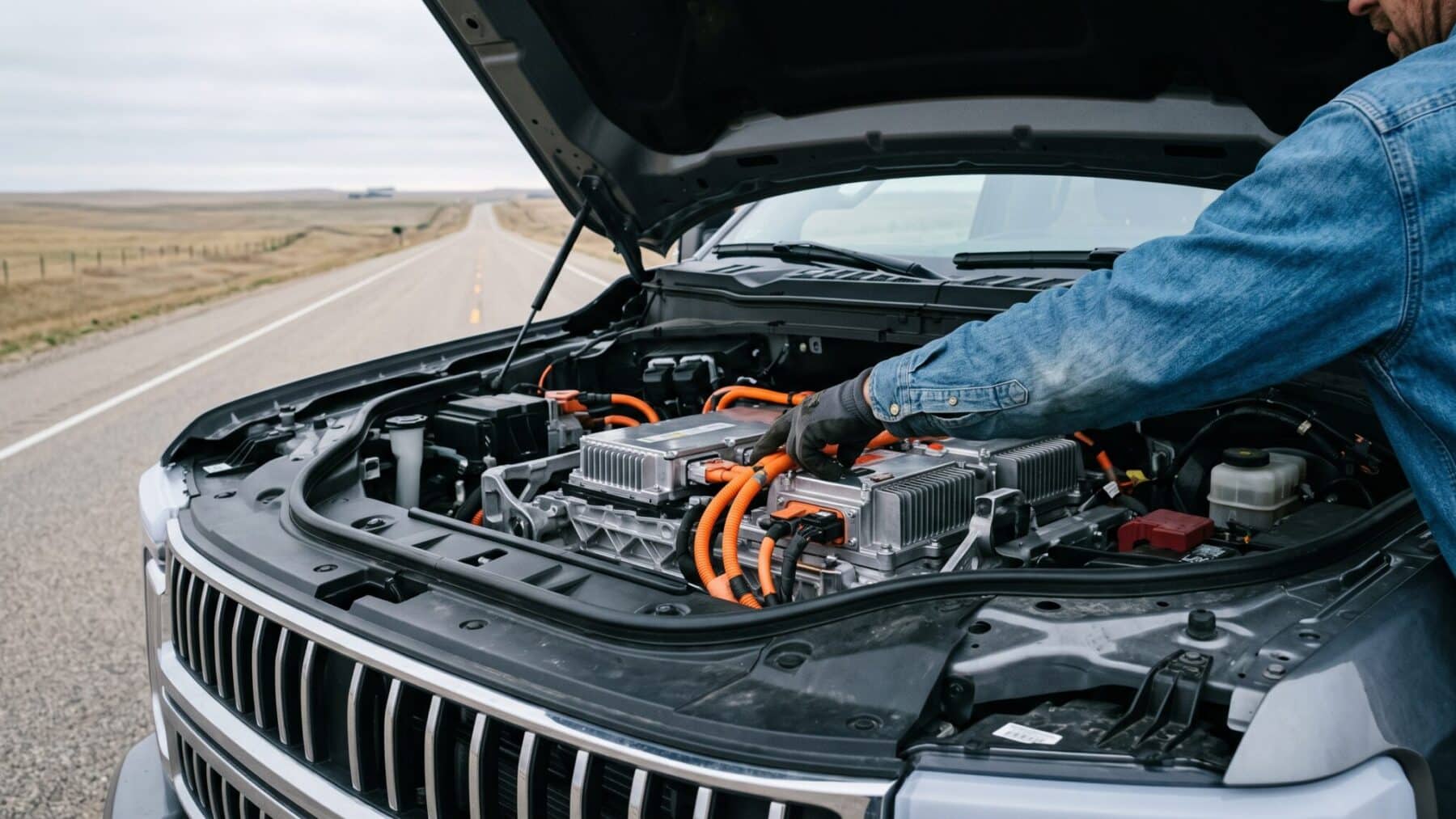
In a conventional hybrid pickup, the gas engine and the electric motor share the job of turning the wheels. Sometimes one leads, sometimes both pitch in, and complex software decides which at any given moment. The Ram 1500 Ramcharger works nothing like that. Its Pentastar V-6 is mechanically disconnected from the drivetrain. It spins a 130-kilowatt generator, and the generator feeds electricity to the battery or directly to the motors.
The wheels are always, exclusively, driven by electricity.
That separation changes everything about how the engine behaves. Because it never has to match road speed, it can run at whatever RPM produces electricity most efficiently, regardless of whether the truck is crawling through a parking lot or cruising at 75 miles per hour. A conventional engine has to rev and lug in response to the driver’s right foot. This one just hums along at its ideal load point.
The battery handles everything on its own for around 145 miles of pure electric driving. The engine only starts when the pack drops below a set threshold, or when the driver calls for more power than the battery can deliver alone. Electricity does the work, and the gas engine is the backup power station strapped to the frame.
What 647 horsepower and 690 miles look like in the real world
The Ramcharger pairs twin electric motors producing a combined 647 horsepower and 610 lb-ft of torque. Those are the confirmed production figures, revised slightly from the original 2023 reveal, and the powertrain pushes the truck from zero to 60 miles per hour in 4.5 seconds. That is quicker than most sports sedans, delivered in a vehicle that can haul a full bed of cargo.
The targeted overall driving range sits at 690 miles, with approximately 145 miles of all-electric driving from its 92-kilowatt-hour battery, supplemented by the V-6 running as a range extender. The longest-range conventional gas-powered full-size pickups top out at roughly 600 miles on a full tank. The Ramcharger targets beating that without an oversized fuel tank or a diesel engine.
The truck is targeted to tow up to 14,000 pounds and haul 2,625 pounds of payload , and includes an available 7.2-kilowatt onboard power panel, enough to run a job site or keep a household going during an outage. As hybrid vehicles grabbed a record 16 percent of new US car sales in the latest quarter, the Ramcharger lands at an interesting inflection point: a truck that uses a gas engine but behaves, on the road, entirely like an EV.
Where the numbers behind the Ramcharger’s design came from
Stellantis has called the Ramcharger the world’s first range-extended full-size electric pickup truck, a claim the company has repeated from its original 2023 reveal through its most recent communications. Those claims come directly from company leadership, and the specifications appear in official Stellantis North America product materials tied to the Ram brand’s electrified lineup.
The 92-kilowatt-hour battery is a substantial piece of hardware, with a usable capacity of roughly 70 kilowatt-hours. The average mass-market electric car in the US carries a pack of roughly 60 to 75 kilowatt-hours. A pack in that range is what gives the Ramcharger its ability to cover approximately 145 miles before the engine ever needs to start.
Ram’s stated engineering intent is that the powertrain be designed so that most owners who charge at home would start the V-6 only a handful of times a month. Buyers who plug in every night may never start the V-6 on a typical week of driving, and that is the promise the architecture is built around.
Where the range-extender system has real limits
The most obvious limit is that 145 miles of battery-only range still requires regular charging to stay in that zone. A driver who never plugs in will run the truck almost entirely on gasoline, functioning like a slightly unusual conventional hybrid. The efficiency gains shrink fast if the battery is always depleted, and the full 690-mile figure assumes the pack starts full.
Towing also compresses electric range sharply. Heavy loads pull far more energy per mile, and the 145-mile figure is almost certainly calculated at moderate highway speed with no trailer attached. Real-world towing at maximum capacity could cut the battery-only leg by half or more, which means the V-6 generator runs sooner on working days.
The architecture adds weight too. A 92-kilowatt-hour battery, two electric motors, and a separate V-6 generator sit on a purpose-built body-on-frame platform , adding considerable mass to a vehicle already built for heavy-duty use. As hybrids captured a record 22 percent of California’s new-car market in the first half of this year, buyers are clearly willing to accept electrified complexity, but they will expect the numbers to match reality at the worksite.
What the Ramcharger signals for the next generation of pickup buyers
The range-extender layout answers the most common objection to buying a battery-electric truck: range anxiety on a long haul or a job that runs all day. The Ramcharger bets that most buyers will take the V-6’s reassurance over a pure electric leap, as long as they never have to think about it on the road.
For buyers who charge at home, the math is genuinely compelling: a week of short commutes runs on electricity, and the occasional long haul flips seamlessly to generator mode. The transition is invisible. There is no gear change, no engine lurch, no dashboard drama when the V-6 starts spinning.
What remains open is how real-world ownership costs stack up over time. The electric motors require little attention, and the V-6, running at a steady load rather than constant acceleration cycles, may prove more durable than the same engine in a conventional truck. The industry will be watching, because if the Ramcharger’s numbers hold up in the field, the range-extender format becomes the template every rival has to answer.
