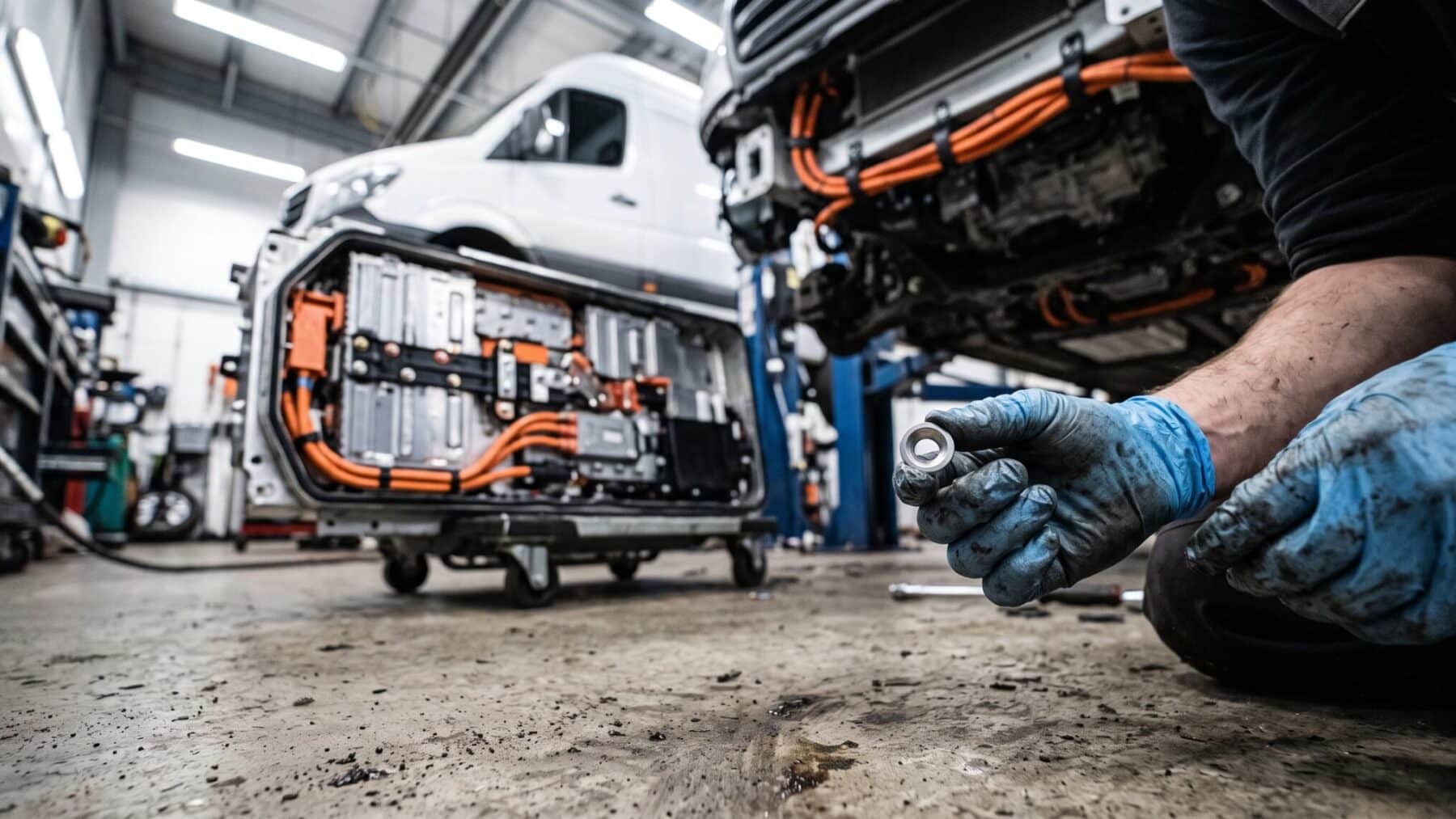
A white van idles in a depot, running silently, carrying no exhaust pipe.
Its fleet manager paid a premium for exactly that kind of certainty. A single metal ring, smaller than a coat button, sits where it should not be absent. And at a supplier’s busbar assembly operation, that ring was simply never installed.
The recalled vehicles are 98 all-electric cargo vans built within a one-month window in late 2025. The question every fleet buyer should be asking is how something so small can carry such serious consequences.
How a missing washer turns a quiet battery into an arcing risk
One or more bolts securing the power busbars inside the battery module may have been installed without a conical washer. That sounds minor until you follow the chain reaction. A busbar is the copper conductor that moves high-voltage current between cells and the rest of the drivetrain, and the bolt’s job is to clamp it tight enough that electrons flow without resistance.
Without the washer, insufficient clamping force develops, electrical resistance rises, and the risk of arcing begins. Arcing at high voltage is not a slow, gentle problem. It generates heat fast, inside a confined pack full of energy-dense cells.
The supplier apparently failed to detect the absence of washers during busbar assembly. That is the whole mechanism: not a design flaw, not a software bug, but a quality-control gap small enough to miss and large enough to matter when the van is running a full delivery route at highway speed.
The van at the center of this: America’s top-selling electric fleet workhorse
The best-selling electric van in America by volume is the vehicle being recalled for batteries that may catch fire. That context matters. The E-Transit is not a niche product sold in small numbers to early adopters. It is the van thousands of operators chose specifically because they trusted the transition to electric would be reliable and cost-controlled.
Affected vehicles are select 2026 models produced between October 14, 2025, and November 13, 2025. The Kansas City Assembly Plant in Claycomo, Missouri, is where Ford builds the E-Transit and the internal combustion Transit, one of the busiest commercial-vehicle assembly facilities in the country. That makes the missed washer a sharp reminder that volume and quality control do not always move in the same direction.
Fleet operators running mixed routes depend on consistent, uninterrupted propulsion. A sudden power cut mid-route is not just an inconvenience. It is a safety event, a missed delivery, and a dispatching headache rolled into one.
What the official record says and what federal safety regulators confirmed
Ford issued a recall covering 98 all-electric 2026 E-Transit full-size vans. The NHTSA recall number is 26S05. A later, separate campaign numbered 26C10 also covers certain 2026 E-Transit vehicles for the same underlying battery busbar issue. Owner notification letters for the 26S05 campaign were mailed on February 13, 2026, and fleet managers can verify affected VINs directly through NHTSA’s public recall database.
If electrical resistance or arcing occurs, a warning message will appear in the instrument cluster, after which the vehicle can safely coast to a stop while maintaining steering and brake function. The 12-volt auxiliary battery keeps both systems alive even if the high-voltage pack loses drive output entirely.
Ford is not aware of any reports of accident or injury. Dealers were notified on February 4 to inspect each busbar fastener, and missing washers trigger a full busbar replacement with correct hardware. The repair is free.
Where the catch bites hardest: fleets that run these vans around the clock
A single passenger-car recall is disruptive. A fleet recall bites differently. Depot operators scheduling shifts around van availability now have to route affected units to dealerships during working hours, absorbing downtime costs that no recall letter reimburses.
The economics of electric fleet vans are still genuinely strong: off-peak charging can cut electricity costs significantly versus peak rates. But those savings assume the van is moving, not sitting in a dealer bay awaiting a busbar inspection. As fleet EV volume trends have shown, even strong underlying demand does not insulate operators from the real cost of downtime.
Add a fire-risk recall to recurring complaints about range and cold-weather charging, and the picture for operators who bought on the promise of lower running costs grows noticeably more complicated.
What fleet operators should do now and what this recall leaves open
Owners of affected vehicles should have been contacted by mail, but fleet managers can also call the NHTSA Safety Hotline at 888-327-4236 or visit nhtsa.gov. Checking the VIN against the recall database takes under two minutes and is the single fastest action any fleet manager can take today.
There is no charge for parts or labor. That is the floor of what is owed here, and it meets it. But the broader question for fleet buyers is whether pre-delivery inspection for high-voltage commercial vehicles needs to be more rigorous than the standard passenger-car process, given what is at stake when a van goes down mid-shift.
The commercial EV transition is real and accelerating, and the fundamental cost argument for electrifying high-mileage routes remains solid. Every operator buying into that argument still deserves to know exactly what they are getting, right down to the washers inside the battery pack, before the van rolls out of the depot. A recall this narrow in scope still carries a lesson that is anything but small, echoing the broader pattern of features sold on promise and complicated by fine print in practice.
