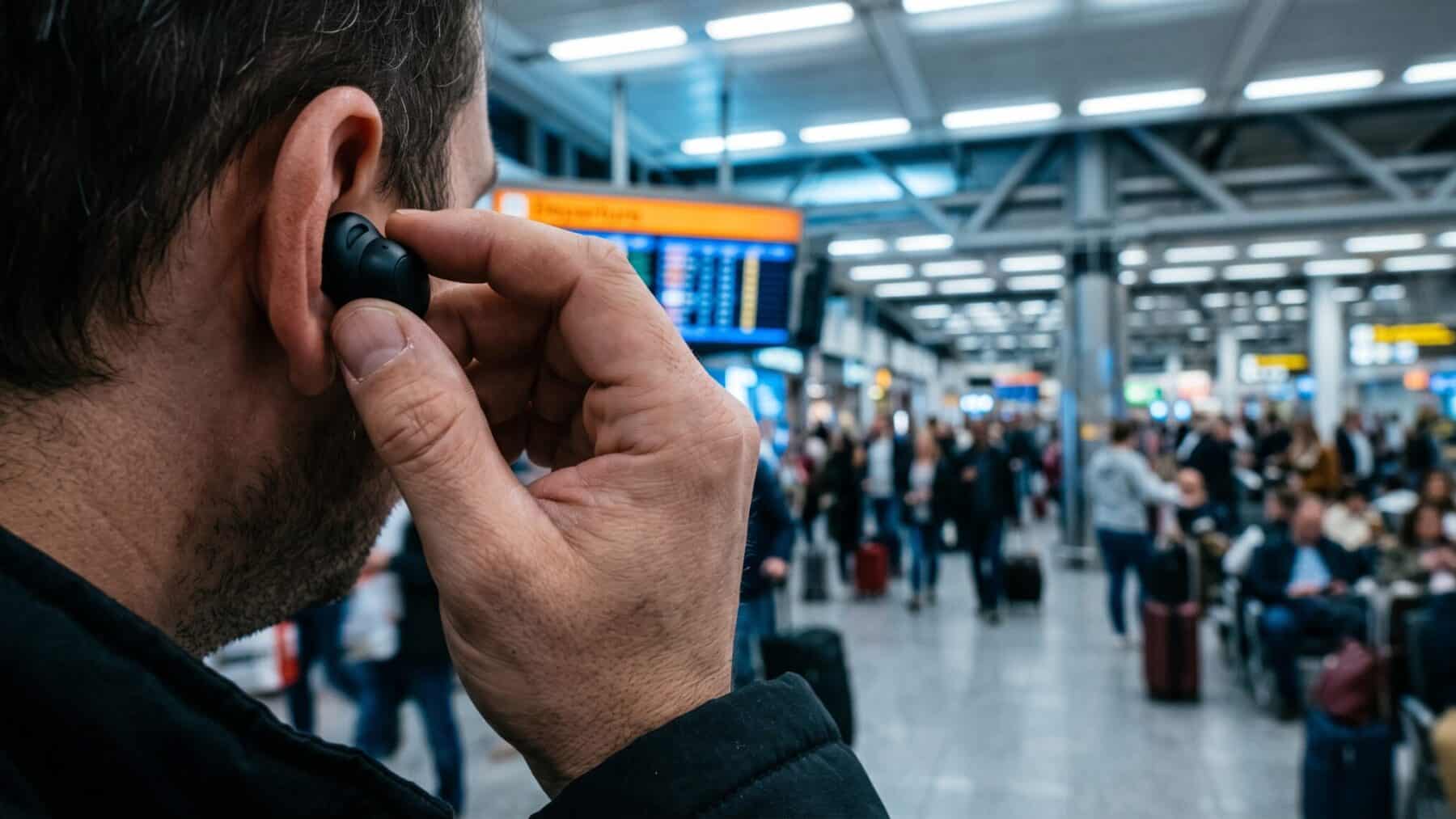
Two strangers stand at a market stall in a foreign city.
One speaks, the other listens through a small wireless earbud. The package promised 98 percent accuracy. What arrives instead is a garbled guess at every third phrase.
The music from a nearby speaker has confused the microphone. So has the vendor’s regional accent.
The question independent tests keep raising is not whether these devices work at all. It is where they stop working, and exactly how wide the gap is between the sticker claim and the street.
Why the pipeline breaks down the moment the room gets loud
Real-time translation earbuds chain three separate processes together: speech recognition captures what was said, a neural engine converts it, and a text-to-speech layer reads the result back. Each step introduces a point of failure, and noise hits the very first link hardest. The microphone bears the cost of every competing sound wave before a single word has been processed.
Fast or overlapping speech causes recognition errors that cascade through the entire pipeline, and models trained on standard accents lose accuracy with regional dialects. A restaurant, a transit hub, or a crowded street market stacks three problems at once: ambient noise, fast native-speaker cadence, and dialect variation. All three hit simultaneously, and the compounding effect across all three failure points is considerably worse than any single one alone.
Most earbuds still depend on cloud connectivity because translation happens on remote servers. Add a weak cellular signal at an overseas airport and the latency alone can make a conversation feel broken before accuracy even enters the picture.
What the box says versus what independent testers actually measured
The shelves, physical and digital, are full of confident numbers. Page after page of near-identical products claim 98 percent or higher translation accuracy, with some asserting figures as high as 99.8 percent confirmed. The marketing language is nearly uniform across the price range, from budget models to $299 premium hardware.
Independent reviewers have found real-world accuracy in roughly the 82 to 95 percent range for common conversational topics, falling further for technical or culturally specific content. But those numbers still assume relatively controlled conditions. Push into genuinely loud environments and the floor drops further still.
Top models can deliver 93 to 97 percent word-level accuracy when speech is clear and connectivity is stable, but field tests across transit hubs and street markets have recorded drops of 22 to 39 percentage points versus quiet-room benchmarks, a pattern documented across multiple independent reviews. That lower range is precisely where most international travelers reach for the device, making the gap widest at the moment of greatest need.
The research behind the numbers, and how large the market has grown
The global translation device market has grown rapidly, from $1.48 billion in 2025 toward a projected $1.89 billion by the end of 2026, driven by a new wave of AI-powered hardware, according to market-research analysts, though estimates vary widely across forecasters. That pace of growth means millions of devices are shipping to buyers who have only the manufacturer’s claim to go on.
Independent product reviewers and translation-industry researchers have consistently found that even the best earbuds in structured tests fall meaningfully short of claimed 98 percent accuracy figures. Many newer, unfamiliar brands make nearly identical marketing claims, and some review pages simply restate the manufacturer’s own accuracy figure as independently confirmed rather than providing genuine independent testing. Americans already spending on stacking subscription services may not immediately notice that some translation apps also carry ongoing fees on top of hardware costs.
There is often a significant gap between marketing accuracy figures and real user experience, largely because benchmarks use clean, standardized audio. Real production audio carries background noise, international accents, and the compression a cellular network applies to a voice call. The gap is structural, not accidental.
Where the device holds up and where it quietly falls apart
None of this means the devices are useless. The technology has matured enough to be more than a novelty, and for a traveler asking for directions or ordering food in a calm café, the experience can be genuinely smooth.
But the use cases where performance holds are not the ones the marketing imagery shows. Cheaper models fall apart through weak accuracy, clunky apps, or audio quality that makes them uncomfortable after twenty minutes. Even premium models carry a structural limitation that rarely appears in the headline specs: most modes require a device at each end of the conversation, and the majority of earbuds cannot translate live phone calls.
That last constraint cuts out a large share of real-world communication. A quick exchange with a taxi dispatcher, a call to a foreign supplier, a conversation at a hotel desk, all may fall outside what a given device can handle. The 78 percent of Americans who believe children should learn a second language might note that even the best hardware is not a substitute for actual fluency.
What a buyer can realistically expect and what remains genuinely open
The most practical adjustment is not avoiding the devices, it is testing them before relying on them. Buyers should pair the earbuds, confirm the app works, and run a full practice conversation before a trip rather than opening the box at the destination. That single habit catches the most common failure modes: connectivity gaps, pairing problems, and language pairs that perform worse than the average.
If a review states the manufacturer’s accuracy claim and then confirms that exact same number as independently verified, that is not independent verification, look for reviews that specify the noise conditions of the test, which gives a far more useful signal than the headline number on the box. Verifying a brand’s track record before purchase is the most reliable filter available.
The honest trajectory of the category is still upward. Recent advances in transformer-based deep learning have dramatically improved performance compared to just a few years ago.
And the pressure from independent benchmarking is real: manufacturers who publish verifiable test conditions are already separating themselves from those that do not.
