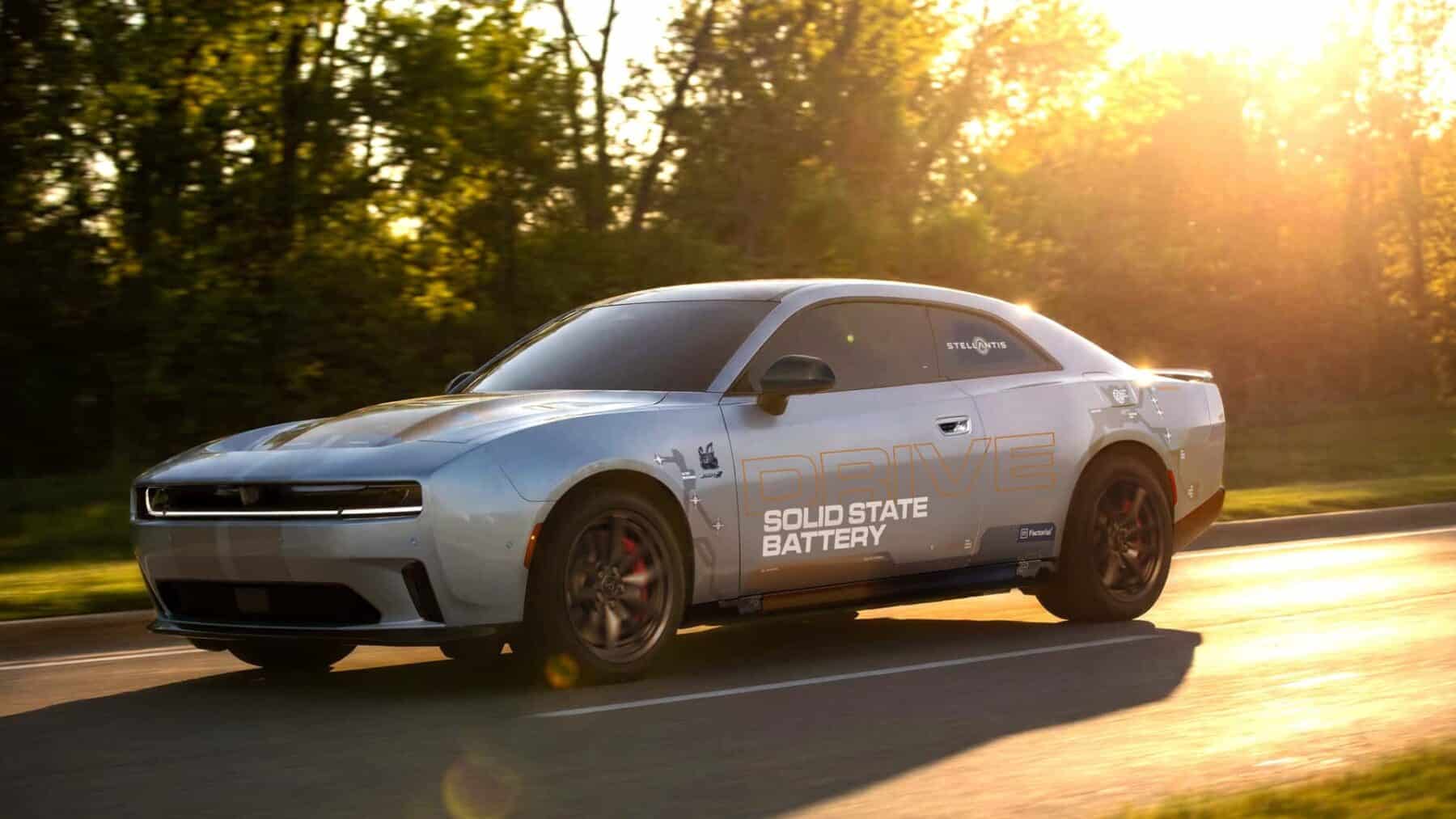
Picture a parking lot on an ordinary Tuesday, cars rolling past, and one of them is quietly carrying technology that most engineers expected to live in a lab for years yet.
The hood is down. The pack is bolted in. Nothing on the outside says anything is different.
Inside, though, the cell chemistry is unlike anything currently for sale at any dealership in the country.
So what physical change inside the cell actually produces a gap that large over the packs in every EV on the road today?
Why removing the liquid from a battery cell changes so much at once
Every lithium-ion battery in every EV on sale today uses a liquid electrolyte to shuttle ions between the two electrodes during charging and discharging. That liquid is the reason packs need heavy cooling systems, the reason a punctured cell can catch fire, and the reason energy density hits a ceiling.
Replace that liquid with a solid material and the electrode chemistry can change too. A lithium-metal anode, which holds far more energy per gram than the graphite used in today’s cells, becomes practical. That single substitution is what unlocks the density numbers this road test put on the record.
The cells in this test reach 375 watt-hours per kilogram, against roughly 250 to 270 for the premium lithium-ion packs in today’s EVs. That density lets a car travel farther on the same weight, or hold its range on a smaller, lighter pack. It is the arithmetic the entire industry has been chasing for a decade.
What the car actually carries and what the cells proved before the keys turned
The milestone announced in June marks the first integration of solid-state cells into a Stellantis vehicle, described by the partners as a breakthrough step toward automotive-grade application. The platform chosen is the electric Dodge Charger Daytona, a high-visibility choice that puts the technology inside a silhouette Americans already know.
In 2025, Stellantis and Factorial demonstrated FEST cells with an energy density of 375 Wh/kg, ultra-fast charging from 15% to 90% in just 18 minutes, and robust reliability from −30 °C to 45 °C. That temperature floor matters enormously for buyers in Minnesota or Montana, where cold weather most aggressively shrinks lithium-ion range.
The FEST cells were integrated into the existing pack through a patented mechanical design. The pack architecture itself did not need to be designed from scratch. That is a significant signal: future production rollout could proceed on existing platforms rather than requiring entirely new vehicle architectures.
The hard evidence behind the figure and how many charge cycles it survived
The validated 77-amp-hour FEST cells demonstrated 375 watt-hours per kilogram with more than 600 cycles progressing toward automotive qualification, which the partners called a milestone for large-format lithium-metal solid-state batteries. Six hundred cycles covers well over a decade of typical American driving if a driver charges from low to full roughly once a week.
Apply that density advantage to a mid-range car rated today at 300 miles and the direction is clear: a meaningfully longer range, on a pack that weighs less, not more. The scale of that gain will depend on pack size, vehicle weight, and how much of the cell-level density survives integration, precisely what road testing is now measuring.
The 18-minute charge window compounds that advantage. A driver could add the equivalent of a full tank in the time it takes to order and eat a fast-food meal. The partnership is anchored by a $75 million investment Stellantis made in Factorial Energy in 2021, a commitment that preceded the validated results and the road-test vehicle by several years.
Where the technology still has ground to prove and what road testing is designed to find
A laboratory bench is a controlled environment. Real roads are not. Most battery promises fall apart in the step between bench and car, where cold starts, fast-charge heat, vibration and years of wear replace clean test conditions.
By putting the cells into a car and beginning on-road validation, the automaker is now testing whether 375 Wh/kg survives those conditions rather than only asserting it. That is a meaningfully different kind of claim than a press release about future intentions.
The broader market context makes the uncertainty consequential. The automaker is placing a loud technology bet at a moment when the economics of electric vehicles have punished anyone who got ahead of demand, with tens of billions in EV write-downs booked across the industry. For buyers already in the market, the 8-year federal battery warranty clock on any EV purchased now started the day the first owner drove away, a detail that matters more as solid-state competition redefines what a good battery looks like.
What a successful road-test program would mean for the market’s next competitive turn
If testing continues to deliver positive results, future electric vehicles could offer longer range, faster charging and improved efficiency. The road-testing program now underway is itself the demonstration phase; what follows is production tooling and, eventually, a showroom date.
The compatibility of FEST cell technology with lithium-ion manufacturing processes gives the partners a critical path to scale. A chemistry that slots into existing lines rather than demanding new ones compresses the timeline from milestone to market considerably.
The competitive pressure is already visible. Every major battery supplier and several automakers have announced solid-state programs at various stages, from pilot lines to demonstration fleets, and the pace of those announcements has accelerated in the past two years. And for anyone watching the fast-charging infrastructure shift already reshaping where Americans plug in, a battery that hits 90 percent in 18 minutes would render much of today’s slow-charger anxiety moot before the decade is out.
The Charger Daytona on public roads settles nothing final. What it does start is the phase that decides whether the numbers verified in a laboratory ever reach a buyer’s driveway, and that phase, for the first time, is happening on actual asphalt.
