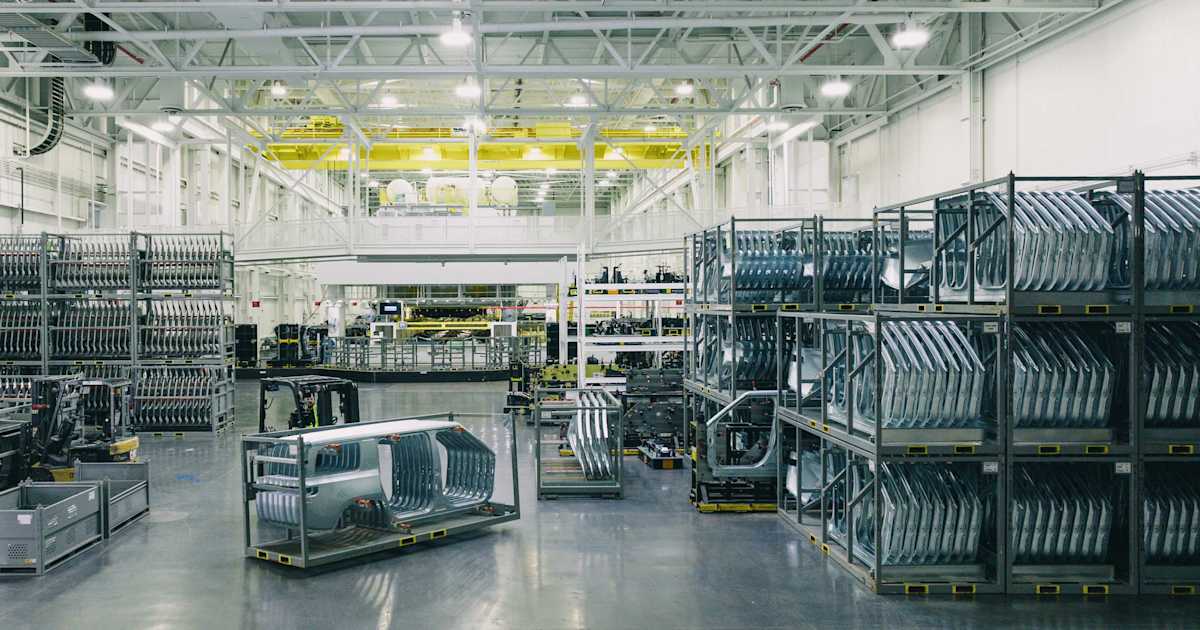
The line at a central Illinois plant ran quiet for months while new tooling was bolted into place.
Then in April the first employee-delivery units rolled off as a live quality check, and by June buyers were taking delivery.
A domestic EV maker was attempting to crack the single biggest passenger-vehicle segment in the country, and suddenly it had a real answer on the road.
The question was not whether the vehicle existed. It was whether the price could compete.
The answer depends entirely on which trim you choose and when it actually goes on sale.
How a four-trim price ladder is designed to pull buyers down from the premium shelf
The compact crossover has one defining commercial logic: volume comes from the middle, not the top. Rivian’s answer is a deliberate staircase. Open with a high-spec performance model to generate coverage and credibility, then follow with progressively cheaper trims that bring more buyers inside the tent every few months.
The Performance trim debuted with a Launch Package starting at $57,990, delivering 656 horsepower and 609 lb-ft of torque in a dual-motor AWD configuration. It runs 0 to 60 miles per hour in as little as 3.6 seconds, with an EPA-estimated range of up to 330 miles.
The real commercial bet sits lower. A Premium trim arrives in late 2026 at $53,990, a Standard RWD Long Range trim opens in early 2027 at $48,490, and an additional Standard version follows in Summer 2027 at $44,990. Each step is timed to keep the brand in the news and the order book open while the factory ramps its second shift.
What the Normal, Illinois plant actually produces and how fast it can scale
The assembly facility in Normal, Illinois is the only place currently building this vehicle. Rivian announced the first public customer deliveries of the R2 on June 9, 2026, after employees had already started taking delivery in April as vehicles rolled off the production line ahead of the wider rollout.
Production started on one shift, with meaningful R2 volume not expected until the back half of the year. A second shift is planned for later in the year, the standard industrial path to doubling output without building a new building.
The ceiling is substantial. Rivian’s newly expanded Normal plant has the capacity to produce 215,000 units annually, including up to 155,000 R2s. That would make the R2 one of the higher-volume electric vehicles built entirely inside the United States.
The reservation numbers and the production figures that put hard data on demand
Demand signal came early and fast. Over 68,000 reservations for the R2 were placed in the 24 hours following its announcement, suggesting genuine market appetite rather than the narrow enthusiast pool that typically greets a halo-product launch.
In the full year 2025, the year before the R2 entered production, Rivian built 42,284 vehicles and delivered 42,247, an almost perfectly matched ratio that showed the factory could clear its output. Rivian subsequently raised its 2026 total delivery guidance to a range of 65,000 to 70,000 vehicles, with the company and analysts estimating roughly 20,000 to 25,000 of those as R2 units in the launch year alone.
The financial picture is more complicated. Rivian has guided to losses running into the billions for the year, while first-quarter 2026 revenue grew year-over-year. Automakers navigating tariff pressure have turned to aggressive EV rebates to defend their positions, and the R2’s staggered pricing gives Rivian flexibility a single-price launch would not.
Where the staircase has gaps and what the segment leader still holds over it
The headline number Rivian’s marketing leans on hardest is not yet on sale. The $44,990 Standard variant does not arrive until Summer 2027, so every buyer who sees that figure in an ad today will be offered a vehicle costing roughly $13,000 more. That gap is the single biggest friction point between the brand’s promise and its current catalog.
The segment’s dominant model currently starts at around $44,000. Even the eventual Standard trim will arrive above that floor. As hybrids claim a record share of new-vehicle sales, every dollar of sticker price is under scrutiny, and that spread is the difference between a second car and a household’s primary vehicle.
The R2 also carries a sensor-rich architecture with advanced connectivity and an array of cameras and radars designed to support advanced driver-assistance features. That suite raises real questions about long-term software costs once included subscriptions expire.
What the R2’s staggered rollout means for the mid-size EV segment going forward
The staircase model Rivian is running keeps the brand relevant across a 12-to-18-month window instead of burning all its coverage in a single day. Each trim arrival is effectively a fresh product announcement, which is a meaningful advantage for a company that cannot yet match the dealer-network scale of legacy rivals.
For the segment as a whole, a well-resourced domestic competitor planning up to 155,000 R2 units annually at Normal alone forces every other mid-size EV maker to respond on pricing, range or features. The R2 lineup has a native NACS charge port with access to the Supercharger network, giving it adapter-free access to tens of thousands of Supercharger stalls and removing one of the most common objections first-time EV buyers raise.
The broader market backdrop is not easy. Rivian faces a difficult environment for new electric car sales, and the lowest trim is still more than a year away from production. Even so, the factory is running, the order book is open, and the price ladder has four rungs still to land. Whether the $44,990 Standard arrives on its stated Summer 2027 timeline will be the most-watched number in the mid-size electric SUV segment for the next 18 months.
