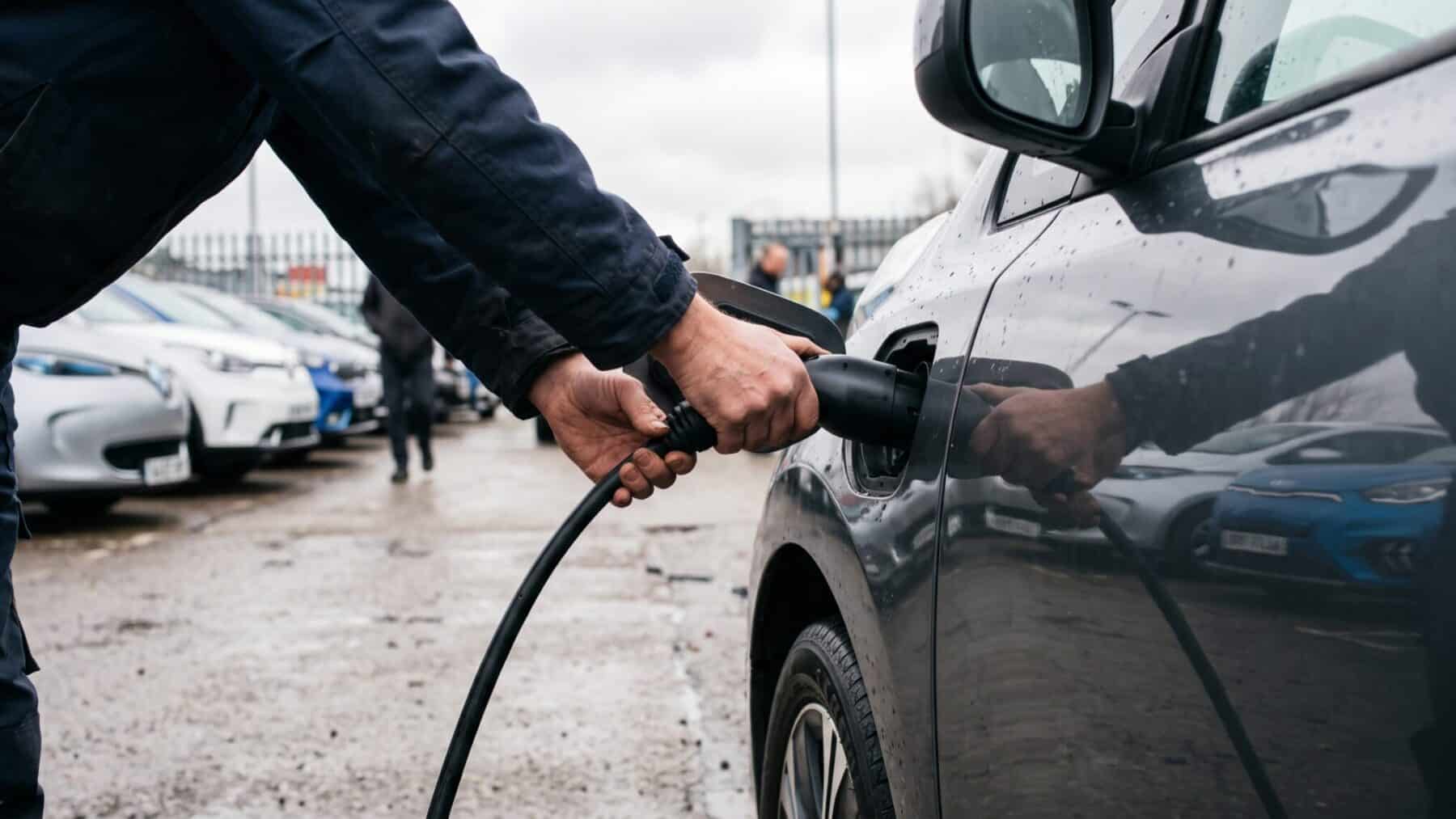
Pull off at almost any major interstate interchange today and the scene is different from two years ago.
A row of fast-charge stalls sits where a diesel pump used to dominate. The cables are thick, the screens are lit, and the spaces are often full. Something structural shifted in American infrastructure this year.
And the question worth asking is exactly how it happened so fast.
How a charger delivers power, and why bigger stations change the math
DC fast charging works by converting grid alternating current into direct current inside the station’s power cabinet rather than inside the car, which is what Level 2 home chargers require the vehicle’s onboard system to do. Pushing that conversion off the car and onto a purpose-built cabinet lets the station deliver far more kilowatts in minutes rather than hours.
That architecture has a compounding advantage: a single large cabinet can be wired to serve multiple charging posts, so operators who invest in one high-capacity unit can light up six, eight or even twelve stalls from it. Instead of adding more locations, operators have been packing more chargers into each site.
That shift means each new station that opens is doing more work than a station built even two years ago. In Q1 2025, 721 stations delivered 3,331 ports; in Q1 2026, just 617 stations delivered 3,387 ports. Fewer ribbon-cuttings, more plugs per ceremony.
What the network looks like on the ground right now
The US has passed 250,000 public EV charging ports, according to data from the Department of Energy’s Alternative Fuels Data Center. The AFDC now lists 250,406 individual charging hookups across 80,543 station locations. The total comprises more than 180,000 Level 2 ports, over 73,000 DC fast chargers, and a smaller number of Level 1 connections.
The 200,000-port milestone was reached in March 2026, meaning the network added roughly 50,000 ports in just a few months. That pace was not achievable three years ago, when supply chains for power cabinets were stretched and permitted sites were scarce. Fifty thousand new plugs in one season is roughly equivalent to half of all the public charging ports that existed across the entire United States in 2021.
The ports are not evenly spread. DC fast charging represents just under 30 percent of all ports despite being most critical to long-distance travel, and California accounts for a disproportionate share of total station locations nationwide. Drivers weighing a cross-country trip feel those gaps acutely.
The hard numbers behind the build-out surge
Over 3,000 new DC fast-charging plugs were installed in America in the first quarter, according to data published by Paren’s Q1 2026 report, an EV charging data platform that monitors over 95 percent of the country’s DC fast-charging infrastructure. Networks installed 3,387 new DC ports and opened 617 new stations from January through March.
Chargers rated at 250 kW or higher now make up 67 percent of all US DC fast-charging ports, while sub-150 kW units have dropped to just 21 percent of new installations. High-power charging is no longer the premium tier. It is the baseline.
That shift matters for drivers planning EV purchases this fall: the charger they pull up to on a road trip is far more likely to fill the battery at top speed than it was even a year ago. Utilization is stable, signaling that demand continues to absorb new capacity without saturation.
Where the network still falls short
The US average reliability score reached 93.5 in Q1 2026, with most states now falling in the 90 to 95 percent range, a meaningful improvement from Q1 2025, when the range was broader, at approximately 85 to 92 percent for most states. That improvement is real. But it still means that on any given day between five and ten chargers in every hundred are unavailable, and a driver who pulls off a highway to find a dark screen faces a very different experience than the aggregate statistics suggest.
Public Level 2 charging satisfaction has declined according to multiple surveys, with respondents citing payment processing friction and ease of initiation as the sharpest problems. The gains are concentrated in fast charging, while slower chargers in parking garages and hotel lots have not kept pace.
The federal infrastructure program that committed five billion dollars to public charging has had a slower rollout than projected. According to Paren, only 497 new DCFC ports at 99 locations were installed using federal program funding in 2025, roughly three percent of total deployments that year. The private market, by contrast, added tens of thousands of ports in the same window.
What the milestone means for drivers deciding now
A network that crosses 250,000 ports changes the calculus for anyone still on the fence about going electric. A lack of electric vehicle charging options is one of the biggest factors keeping Americans from going electric, but that may be more of a perception problem. Removing that barrier, even partially, moves the needle on adoption in a way that no vehicle specification can match.
The timing also intersects with a used EV market hitting its own records, meaning first-time electric buyers are entering a world where charging is meaningfully better than what earlier adopters faced. Those buyers are less likely to encounter the dead charger, the incompatible plug or the 45-minute wait that shaped early EV skepticism.
Even so, the geographic gaps, the Level 2 frustrations and the slow federal rollout are real friction points that 250,000 ports does not automatically dissolve. The next stretch of the build-out will determine whether the network truly serves everyone or only the drivers who already live near it.
