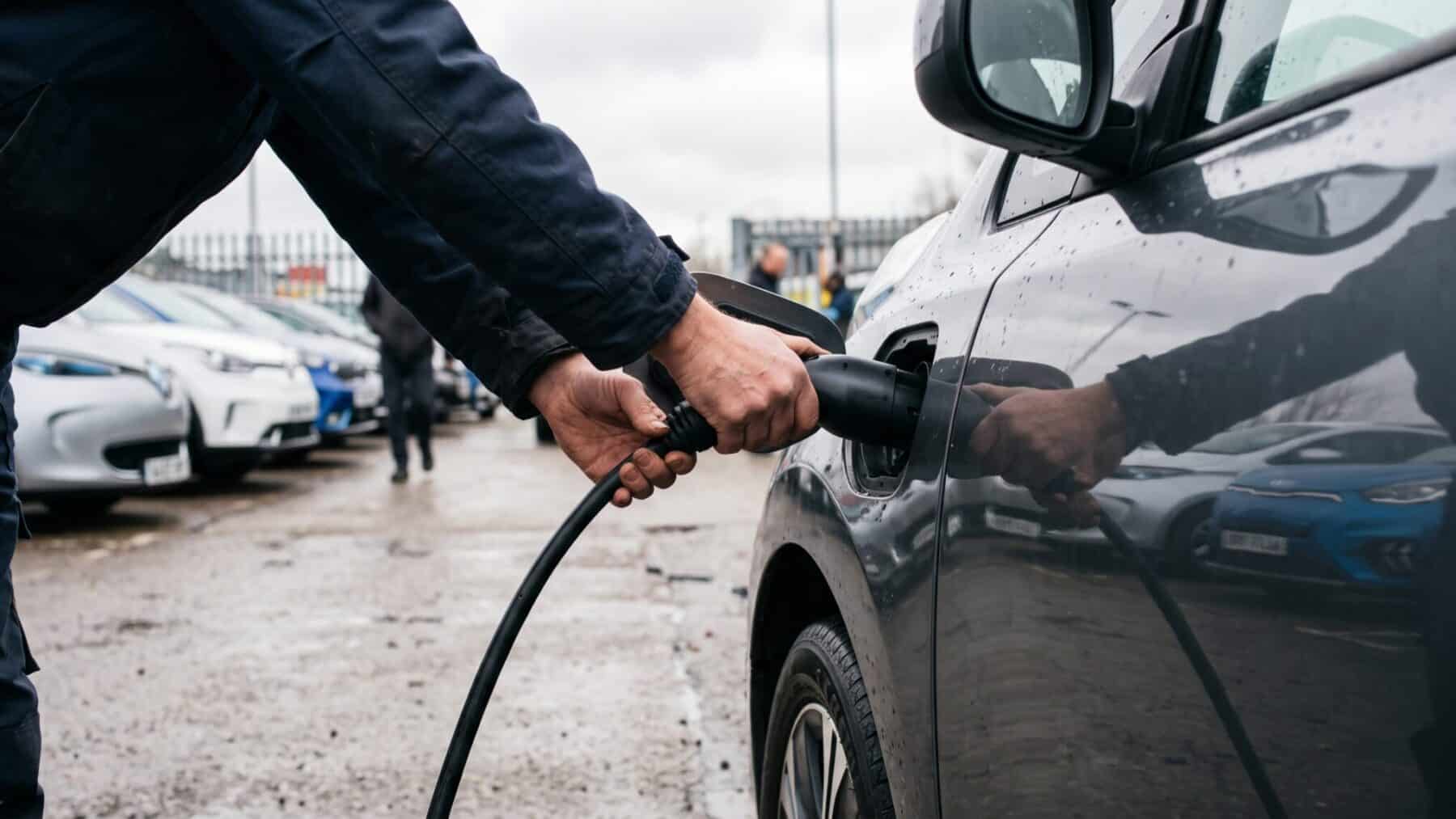
A car sits on a dealer lot, stickered below $37,000, its previous owner’s miles already on the clock.
It charges on the same cable as a new one. It carries the same battery warranty clock, though often less time left on it.
More Americans are buying one of these than at any point in history.
New electric vehicles are having a rough year. The secondhand ones are not. So what flipped the market, and how does a used EV actually move from one driveway to the next?
How a used electric car finds its second owner faster than ever before
The pipeline starts when a lease ends. Three- to four-year leases written during the EV boom of the early part of this decade are now maturing in large numbers, releasing tens of thousands of low-mileage, late-model electric cars into the wholesale market at once. Those cars flow through auction lanes, get inspected, re-titled and land on used-car lots within weeks.
The second feed is straight trade-ins. As new EV buyers upgrade to longer-range models, their first-generation vehicles enter dealer inventory. Electric cars depreciate faster than gasoline ones, a pattern that has drawn criticism but now works directly in a used buyer’s favor, compressing the price gap between new and secondhand far below what gasoline car shoppers typically see.
Once on the lot, used EVs sell quickly for a simple mechanical reason: no oil changes and far fewer brake jobs, thanks to regenerative braking, and no transmission fluid. Shoppers running the numbers on five years of ownership find the lower sticker erases the premium quickly, particularly when gas prices are climbing.
What the used-EV market looks like on the ground today
Walk a used-car lot right now and the electric section is no longer a lonely corner. 128,000 secondhand EVs found homes in the second quarter of this year, a new record, up 29 percent over the same period a year earlier, according to data from Cox Automotive, the world’s largest automotive services and technology provider.
The momentum had been building all year. A total of 93,500 used EVs were sold in the first quarter of 2026, up 12 percent year over year. Each consecutive quarter has set a higher floor, making the Q2 record look less like a spike and more like the new direction of the market.
The average price of a used EV sits right around $37,000. For buyers comparing that against a new EV sticker running roughly $56,000, nearly $20,000 higher, the math is not complicated.
The data behind the record and where it comes from
According to Kelley Blue Book estimates from Cox Automotive’s Q2 2026 report, 247,226 new EVs were sold in the second quarter, up 14.7 percent from the revised first-quarter total. The used market’s 128,000 units therefore represented more than half that new-car volume, a ratio that would have seemed implausible just three years ago.
The end of the federal EV tax credit on September 30, 2025 quickly depressed new EV sales, but rising gas prices in 2026 gave the broader EV market a second wind. The used segment, carrying no tax-credit requirement, absorbed the demand that new-car lots lost. Buyers who could no longer access a $7,500 federal subsidy found the used market already waiting with prices that required no federal help to pencil out.
Q2 new-EV volume was down 20.5 percent from the same period a year ago. That divergence, used EVs up 29 percent while new EVs fell by one in five, is the sharpest quarterly split the American electric-vehicle segment has recorded in recent years. The expansion of public fast-charging at everyday retail locations is part of the infrastructure answer that makes a used EV viable for owners who cannot charge at home.
Where the used EV record runs into real limits
Battery warranty clocks start ticking on the day the original owner drove off the lot. A five-year-old EV may carry a manufacturer warranty that promises eight years of battery coverage, but only three of those years remain transferable to the next owner.
Depreciation, the same force that makes used EVs affordable, also signals something the market has not fully priced. New EVs still depreciate quickly relative to gasoline cars, a pattern analysts attribute partly to fast technology cycles: a two-year-old EV may have a slower onboard computer, a smaller charging port standard, or fewer over-the-air update capabilities than the current model year.
Range anxiety also shifts shape in the used market. A battery that delivered 280 miles when new may test at around 272 miles after three years, which is still plenty for most daily drivers but matters on a road trip.
Third-party battery inspections, still uncommon at most independent lots, are the single most effective tool a shopper has. The hidden costs of charging economics that catch fleet operators off guard apply a similar lesson to any used-EV buyer who has not mapped out their local charging options.
What a used-EV record at 128,000 means for buyers shopping this fall
The supply trend is firmly positive. More affordable new EV models are launching in the second half of this year, and accelerated charging infrastructure deployment is expected to push quarterly used sales higher still. Each new car sold today is a future used car, and the pipeline of off-lease electric vehicles will only widen as the next wave of three-year leases matures.
Battery durability data support the optimism. The average EV retains 97 percent of its range after three years and 95 percent after five, according to Recurrent’s 2026 EV Market and Trends Report, meaning today’s used EV holds up far better than most shoppers expect.
For American car shoppers, the record quarter reframes a market that has spent two years generating mostly bad headlines. New-EV sales may be soft and tax credits may have expired, but 128,000 families drove home in an electric vehicle last quarter without any federal help, and they paid less for the privilege than any prior generation of EV buyers.
