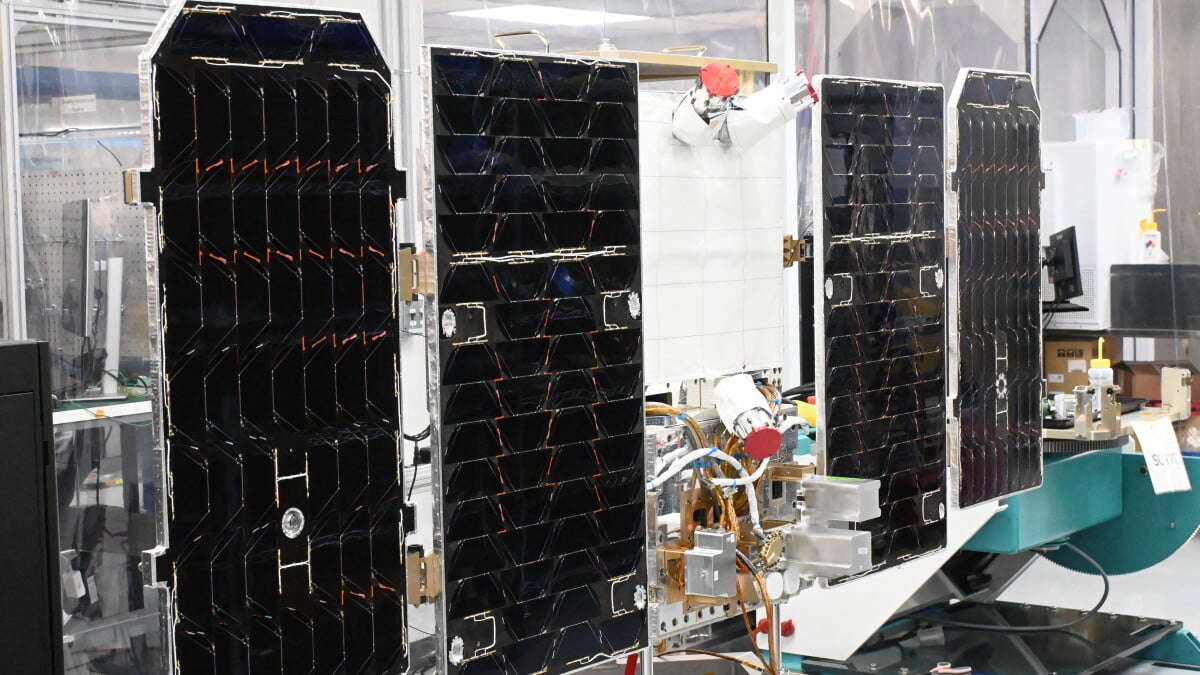
Google put four Tensor Processing Units (TPUs) into orbit on October 1, sending a prototype satellite for Project Suncatcher on SpaceX’s Transporter-18 rideshare mission. In a post on the Google blog, the company confirmed contact with the satellite and said it was operating as expected.
The experimental satellite, called MVP, carries four Trillium-generation TPUs, the same processor family used for AI workloads in terrestrial cloud infrastructure. The flight marks the first time Google’s TPUs have operated in space.
What the satellite carries
The refrigerator-sized satellite carries four TPUs, offering the computing power of a standard Google Cloud TPU v6e-4 slice. Solar panels are rated at around 1 kilowatt. The TPUs operate in short bursts of roughly 15 minutes at a time, during which the satellite runs Gemini models to benchmark real-world performance in orbital conditions.
Travis Beals, Google’s senior director of Paradigms of Intelligence, is leading the project publicly. Google and Planet Labs built the prototype together; SpaceX’s Transporter-18 mission carried it as one of 130 payloads on a dedicated small-satellite rideshare flight from Vandenberg Space Force Base in California.
SpaceX’s deployment schedule lists the satellite as Project Suncatcher M1, deployed roughly 61 minutes after liftoff.
Google’s announcement describes the prototype as the first step in a long-term research moonshot exploring whether space could one day host scalable machine learning infrastructure. The company published full mission details in a post on the Google blog signed by Travis Beals, senior director of Paradigms of Intelligence at Google Research.
The engineering challenges being tested
The prototype spacecraft carries four TPUs and will operate in Earth orbit for a year, if all goes to plan. During that time, Google will monitor how the chips are affected by space radiation and how effectively the heat they generate is dissipated.
Cooling relies on a combination of heat pipes and radiators rather than airflow. The TPUs run compute for approximately 15 minutes at a time before thermal shutdown forces a cooldown.
Cooling is regarded as one of the major challenges for operators of orbital data centers, as there is no airflow in space to carry away heat.
Google ran AI workloads on Trillium TPUs inside a proton beam at the University of California, Davis’ Crocker Nuclear Laboratory and reported the chips performed well, having received a dose of radiation greater than what they would be expected to encounter over a five-year space mission. The team conducted vibration testing by shaking the satellite on all three axes to mimic the frequencies of a rocket launch.
Satellites in dawn-dusk sun-synchronous orbits enjoy near-constant sunlight, potentially generating up to eight times more solar power than equivalent panels on the ground. That potential power density is central to why Google views orbit as a plausible long-term home for AI infrastructure, even as terrestrial demand for compute continues to surge.
That pressure is underscored by the race to build new facilities, with Texas now leading the United States in data center capacity under construction.
What comes next
Google has committed to a 2027 launch of two TPU-equipped satellites with Planet Labs to test laser links in orbit. Google’s research blog sketches the eventual design as clusters of 81 satellites flying in formation within a one-kilometer radius, connected by free-space laser links.
Google compares the pointing precision required for those inter-satellite laser links to hitting a coin-sized target from miles away while both endpoints are moving.
Google has published a pre-print paper on Project Suncatcher laying out its vision for a scalable compute system for machine learning in space, using fleets of satellites equipped with solar arrays, inter-satellite links using free-space optics, and Google Tensor Processing Unit accelerator chips.
The satellite is designed to operate for one year and will deorbit within approximately six years. The mission fits into an accelerating push by technology companies to extend computing infrastructure beyond the ground. SpaceX successfully launched Starship into orbit for the first time on Flight 14 on September 28, deploying 26 Starlink V3 satellites in a separate milestone for commercial space infrastructure.
Broader context
Google is testing whether its AI accelerators and cooling hardware can work in orbit, an early technical hurdle for its proposed satellite-based computing system. The flight alone does not prove that orbital AI compute can compete economically with terrestrial data centers.
The prototype puts Google’s proposed orbital AI infrastructure through its first in-space hardware test. The results will bear on whether the chips, communications links and economics behind its satellite-compute concept can move beyond research.
The company has not announced a timeline for any commercial service or indicated when, or whether, the program would move beyond the research phase.
