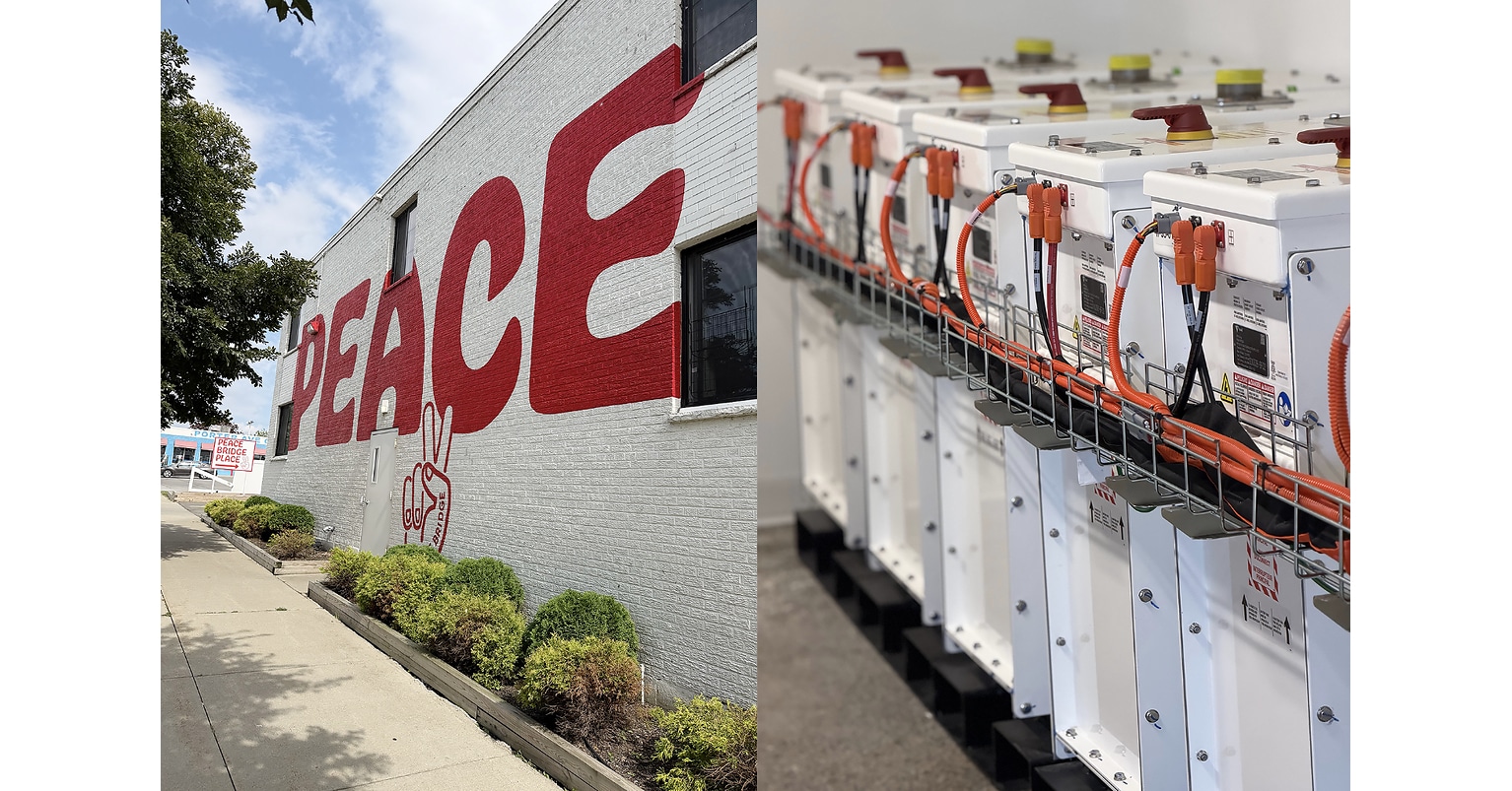
A battery energy storage system is now operating inside an occupied apartment building in Buffalo, New York, in what developers describe as one of the largest indoor residential installations of its kind in the United States.
The lithium-ion system, built by Buffalo-based Viridi Energy, is installed at Peace Bridge Place, a 105-unit affordable housing apartment building in Buffalo, New York.
The 3.75 megawatt-hour system stores excess electricity when it’s cheap and plentiful, then feeds the building during periods when the grid is strained and power gets expensive.
What was installed and where
Distributed across seven battery rooms, the 3.75-MWh system is integrated with Viridi’s proprietary Energy Management System (EMS), which optimizes the property’s electricity use while enabling it to respond to changing conditions on the local grid.
The system was deployed in partnership with Good Carbon Co., according to the companies’ announcement, and is a National Grid pilot focused on integrating flexible, grid-responsive technologies into its distribution network, with Viridi’s energy storage and energy management technology working in coordination with EnergyHub’s Edge Distributed Energy Resource Management System to enable the property to respond to National Grid signals during periods of peak electricity demand.
Viridi’s approach uses fail-safe battery architecture designed to isolate battery cells from one another. According to an Associated Press report on the project, Viridi spent six years and $10 million figuring out how to make a fireproof container for batteries, and half the cost was for batteries Viridi destroyed during testing. Viridi uses plates, pouches and spacing to isolate each battery cell, so that if one fails, the energy dissipates instead of spreading to the next battery, and no gas, smoke, heat or fire escapes the container, according to Viridi CEO Jon M. Williams.
The company says the installation is notable because it sits inside a building where people already live, rather than in a standalone structure or parking lot. Large batteries in apartment buildings are uncommon because of cost and fire concerns, the AP reported, and a battery this size inside an occupied apartment building tests whether fire codes and residents will accept lithium-ion storage where people live.
That configuration has drawn safety scrutiny in the battery storage industry as lithium-ion systems proliferate in dense urban settings. Jigar Shah, who led the Department of Energy’s Loan Programs Office during the Biden administration, said Viridi is the only company to consistently pass this “near impossible” test, and said the Peace Bridge Place system is a milestone in overcoming safety concerns.
Why batteries are moving indoors
Most large-scale battery projects in the United States still sit on open land next to solar or wind farms, similar to the long-duration storage project recently announced in Minnesota and the thermal battery plant planned in Kansas.
Bringing storage directly into an occupied residential building is a less common approach, aimed at buildings in dense cities where outdoor space for a separate enclosure may not exist.
An Associated Press report on the Buffalo project noted that the push to deploy batteries this way is tied to broader grid strategy, and that the manufacturer and state officials hope the project will show that larger batteries can safely operate where people live and work.
The report also noted that California’s electricity industry has embraced battery storage at scale, with more than two-thirds of California’s electricity coming from clean energy, with batteries getting a lot of credit for that, according to California Energy Commission Chair David Hochschild, who said that as electricity demand grows, batteries help ensure the grid is reliable, reduce pollution and contain costs.
That California context underscores how fast utility-scale and distributed battery deployment has accelerated nationally.
The U.S. Energy Information Administration has separately reported that by the end of 2025, the U.S. power system had operational battery storage capacity of 43.6 gigawatts (GW).
During the first six months of 2026, operators added another 8.3 GW of battery storage capacity, reaching nearly 52 GW of nameplate battery storage capacity.
Grid strain and winter energy costs
The Buffalo project arrives as federal forecasters warn that electricity costs, unlike some other home heating fuels, are headed higher this winter.
In its latest Winter Fuels Outlook, the EIA said it expects energy expenditures this winter to vary because of diverging trends in energy prices among fuels and regional variation in forecast temperatures.
Lower prices for natural gas and propane are driving decreases in expenditures for about half of households, while higher prices for electricity and heating oil are driving increased expenditures for households heating with those fuels.
Specifically, the agency expects the more than 40% of homes heating with electricity will experience a 4% increase in electricity bills on average this winter.
Grid operators and utilities have pointed to rising demand, including from data centers and electric vehicles, as a factor pushing up electricity costs even as natural gas prices fall.
GCN has previously reported how record grid peaks this summer have raised the stakes for managing new electric load, and how shared overnight charging habits created a new surge utilities say nobody priced for.
What comes next
Viridi has pursued other commercial installations where people live or work. In 2021, the Hauptman-Woodward Medical Research Institute in Buffalo implemented a 600 kWh/120 kW Viridi battery system.
The Buffalo installation is being watched by state officials and industry observers as a test case for whether battery storage can be safely integrated into existing residential buildings rather than built as separate standalone units. Shah thinks far more U.S. homes will use batteries for backup power by 2030, and the U.S. can meet much more electricity demand and avoid costly upgrades to the grid if batteries are strategically deployed, he added.
That scrutiny comes at a moment when both battery deployment and electricity demand are climbing simultaneously across the country.
