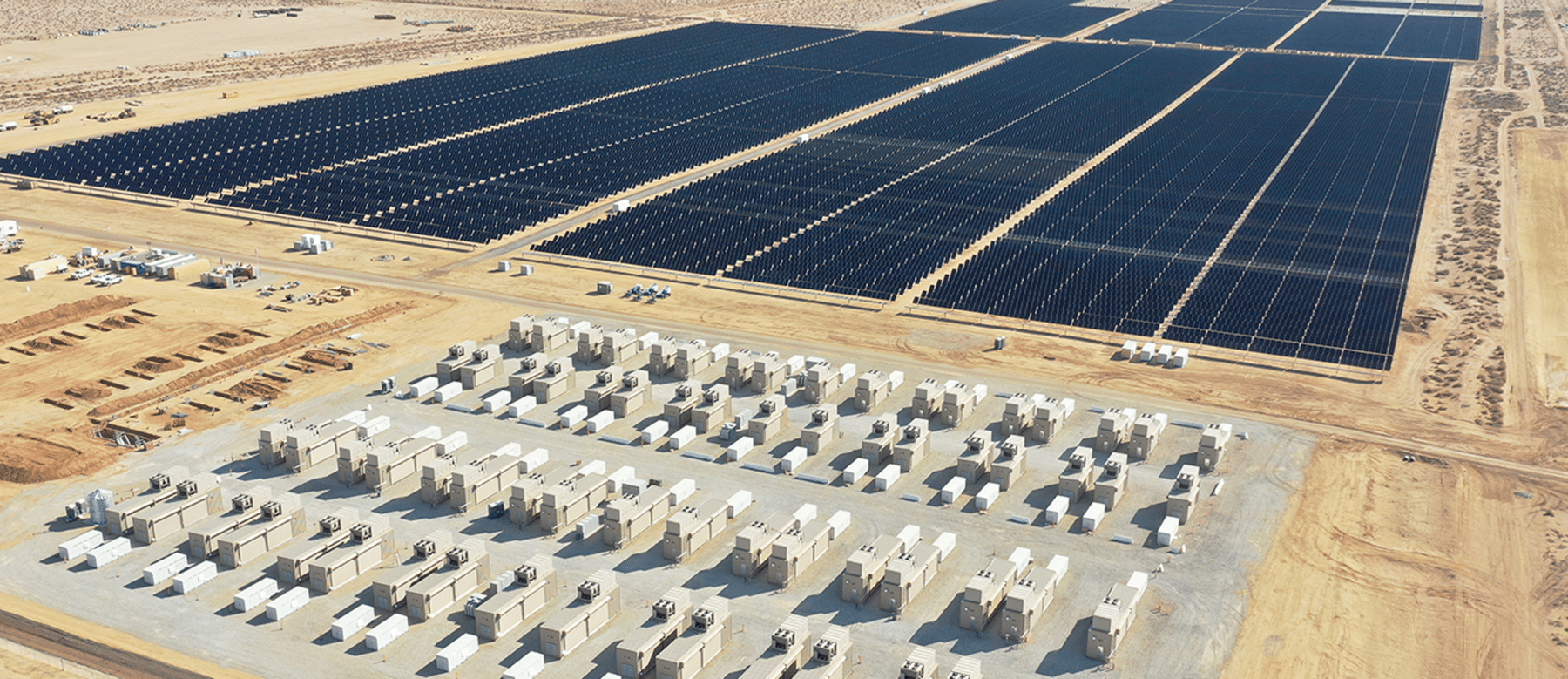
Out past the almond orchards of Kern County, rows of white steel boxes stretch toward the horizon next to acres of solar panels.
Workers walk the gravel rows checking cables between shifts.
By November, federal regulators expect this patch of California desert to hold more stored electricity than anywhere else in the country.
That is not a developer’s boast.
It comes straight from the agency that tracks every power plant in the nation.
So how did one stretch of farmland outpace every other battery site in America?
How one site pulled ahead of every other battery farm in the country
The mechanics are almost boring in their simplicity: build the same winning design twice, side by side, and let the math do the rest. The facility, called Bellefield, began operating in December 2025 with 500 MW of solar PV and 500 MW of battery storage, a four-hour storage window that shifts surplus midday solar into the evening demand peak , then set out to build an identical second phase right next to it.
That doubling is the whole trick.
Two matching halves of solar and storage, built on adjoining land with shared grid connections, add up to a single plant large enough to beat every other battery site in the nation on paper. According to the Energy Information Administration, plans for the Bellefield facility call for a doubling of the PV and storage capacity of the facility and for the new capacity to be operational by November this year. If those plans materialize, the facility will become the largest power storage facility in the United States .
None of that requires a new battery chemistry or a scientific breakthrough. It requires flat land, strong sun, a willing buyer for the power, and a grid operator ready to connect it, all four of which Kern County already had in place.
Inside the desert buildout chasing a national record
Picture two mirror image power plants standing a few hundred yards apart. Bellefield is a two-phase project, with each phase including 500 MW of solar and 500 MW of four-hour battery-based energy storage, for a total of 2,000 MW of installed capacity , enough to carry the solar farm’s daytime output deep into the evening peak.
When both halves are finished, the 2,000 MW project, 1,000 MW solar and 1,000 MW/4,000 MWh BESS, is expected to be the largest solar-plus-storage facility in the US , built almost entirely to serve the fast growing power needs of nearby data centers and large commercial buyers.
That scale reflects a wider shift already underway nationally. Electric cars and chargers draw real power too, but vehicle grid demand has slowed even as data centers pull in the opposite direction, pushing utilities toward exactly the pairing built at Bellefield.
Even the name, Bellefield 2, undersells what it is. It is less an expansion than a replica, stamped out next to the original to double capacity without reinventing anything.
What the federal numbers actually show
The record claim rests on monthly filings utilities and developers are required to send the Energy Information Administration, not on a press release. Those filings, compiled in the agency’s Preliminary Monthly Electric Generator Inventory, track every generator above one megawatt in the country by name, size, fuel type and in service date.
According to the agency’s analysis, Bellefield becomes the largest storage facility in the country if its expansion materializes on schedule. The current runner up, the Manatee Solar Energy Center in Florida, operational since 2021, has 75 MW of solar capacity and 409 MW of battery storage capacity , well under half of what Bellefield’s first phase alone carries.
A separate industry dataset hides a second, quieter record. The national average duration of installed battery energy storage systems increased from 2.8 hours to 3.5 hours year-over-year, driven by resource adequacy needs , a sign newer projects are built to run longer into the evening rather than just shave midday peaks.
Both trends point the same way. Developers are no longer bolting small batteries onto solar farms as an afterthought; storage is now the main event.
Where the record has limits
Even a record this size comes with caveats. The November date is a developer’s plan reported to regulators, not a certainty, and large battery projects have slipped before over equipment shipments, permitting or interconnection delays.
So the title could shift again quickly. Nationally, developers report plans to bring an additional 54 GW of battery storage capacity online over the next two and a half years, with 14 GW of that total targeted for the second half of 2026 alone , and any one of those projects could eventually surpass Bellefield once built at full scale.
Worse for any single record holder, construction elsewhere is not slowing. Other utilities are testing different storage strategies for the same demand growth, so the definition of largest keeps moving as fast as developers can pour concrete.
That instability is the point. A fast moving industry produces records that last months, not decades, and Bellefield’s claim is likely a marker on a curve rather than a final word.
What it means for the grid going forward
None of this changes anyone’s monthly bill overnight, but it signals where utilities expect future demand to come from. Projects at Bellefield’s scale exist specifically to serve data centers and large buyers whose power needs have outpaced nearly every other category of demand.
Because that demand keeps climbing, grid planners increasingly treat batteries as core infrastructure rather than a bonus feature bolted onto solar.
Even so, the real test arrives in November, when inspectors either confirm the second phase is live or report a delay. Either outcome will show up in the same federal dataset that first revealed Bellefield’s rise, keeping the record honest and public.
For now, the California desert holds a plant built twice over, each half identical to the last, racing a filing deadline toward a title that may not last the year.
