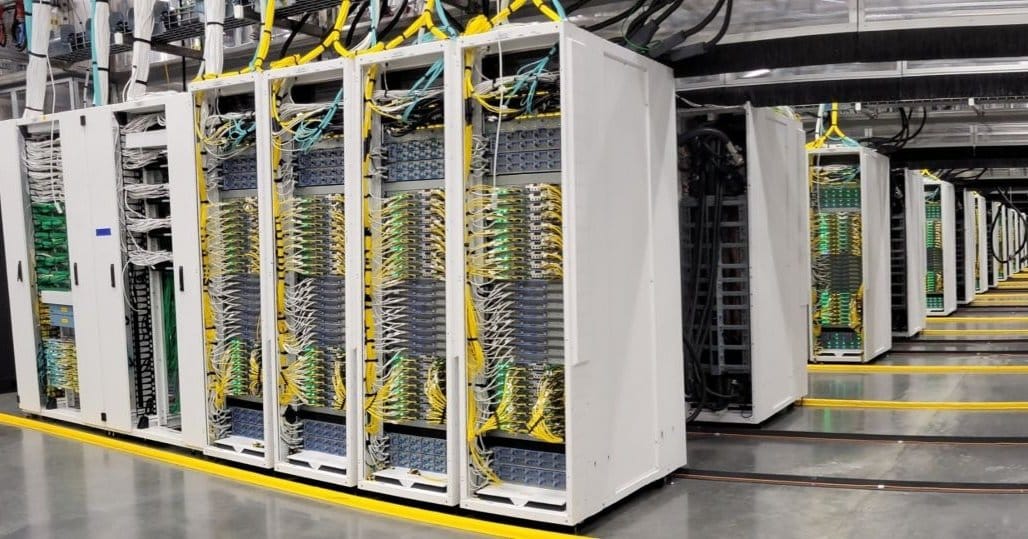
Picture a building longer than three football fields, packed floor to ceiling with glowing server racks, yet nowhere inside it is a diesel generator humming in reserve.
No fuel tanks sit outside the walls.
No battery room stands ready to catch a flicker in the power line.
Hundreds of thousands of processors inside draw more electricity than a small city, all of it pulled straight from the wires outside.
So what happens the instant that power wavers, even for a fraction of a second?
Why skipping backup power is even possible here
Most data centers treat the grid as something that will eventually fail them, so they stack layers of backup equipment behind every rack. A battery bank, known as an uninterruptible power supply, typically catches the load within milliseconds of an outage, bridging the gap before diesel generators can spin up and take over the electrical load.
Then, within seconds, generators take over for as long as the grid stays down.
The Atlanta facility throws that playbook out. Microsoft chose the site specifically because the local utility grid already behaves like a backup system on its own. Atlanta was chosen for its access to highly reliable utility power (99.99% uptime) at a lower cost, allowing Microsoft to forgo traditional backup infrastructure like on-site generators for the GPU fleet.
That single design call strips out three expensive layers at once. Fairwater achieves 4×9 availability at 3×9 cost, thanks to highly available grid power, and instead of relying on costly backup generators, Microsoft developed software and GPU-based energy controls that stabilize power use without waste, dynamically managing load, introducing supplementary workloads, and integrating on-site storage to maintain grid balance as AI workloads surge. And by securing that highly available grid power, the company can also forgo other traditional resiliency approaches for the GPU fleet, such as on-site generation, UPS systems, and dual-corded distribution . In plain terms, that extra sliver of reliability is what lets the whole backup layer disappear: a grid built to the standard utilities call “three nines” can be down for roughly nine hours a year, while a “four nines” grid is built to keep outages under about an hour a year.
Inside the building betting everything on the wires outside
The facility itself is the second in a family of sites Microsoft calls Fairwater, and Microsoft’s Atlanta Fairwater AI datacenter began operation in October 2025 , built on a QTS campus in Fayetteville, Georgia, just south of Atlanta. Each rack in Microsoft’s Fairwater data centres draws about 140kW of power, with entire rows consuming up to 1,360kW , numbers that dwarf a conventional server room by a wide margin.
Because so much heat pours off that many chips, the building also leans on a closed-loop liquid cooling system rather than open water towers. AI servers in the Fairwater datacenters are connected to a facility-wide cooling system designed for longevity, with a closed-loop approach that reuses the liquid continuously after the initial fill with no evaporation. The water used in the initial fill is equivalent to what 20 homes consume in a year and is only replaced if water chemistry indicates it is needed, and it is designed for 6-plus years.
Every processor inside also talks to every other processor across the whole building, which is why the structure rises two stories instead of spreading out flat. Satya Nadella has said Fairwater’s two-storey design and liquid cooling system lets Microsoft place racks in three dimensions and pack them with GPUs as densely as possible, minimising cable runs and improving latency and effective bandwidth . Shorter cables mean faster signals, which matters when thousands of chips must function as a single machine.
What the company has actually confirmed, and what is still estimated
Microsoft disclosed the broad strokes in a newsroom post on the architecture, describing the facility as connected to prior generations of AI supercomputers and the broader Azure global datacenter footprint to create what it calls the world’s first planet-scale AI superfactory. It has not, however, published an exact chip count or a megawatt figure for the Atlanta site itself.
Independent trackers have tried to fill that gap. Epoch AI fills the gap with modelled estimates of 304,279 GPUs and 636 MW in Atlanta , though Microsoft has published no official count or megawatt figure of its own. If accurate, that would make it one of the largest single computing sites ever built for artificial intelligence work.
The company has been more specific about water. The water used in Fairwater’s initial fill is equivalent to what 20 homes consume in a year and is only replaced if water chemistry indicates it is needed. That detail has been independently reported across multiple outlets covering the launch.
Where the grid-only bet still has limits
Dropping backup power is not free of risk, and Microsoft’s own materials acknowledge the tradeoff. Training runs across hundreds of thousands of chips can cause sudden swings in power draw.
Managing power at this scale creates challenges, as large training jobs can cause power oscillations affecting grid stability.
Because of that, the company has had to build software, not hardware, to smooth the problem out. Instead of relying on costly backup generators, Microsoft developed software and GPU-based energy controls that stabilize power use without waste. These systems dynamically manage load, introduce supplementary workloads, and integrate on-site storage to maintain grid balance as AI workloads surge.
Even so, the arrangement only works because Atlanta’s grid earns that trust in the first place. The data center features no on-site generation or uninterruptible power supply (UPS) systems, because the city of Atlanta boasts an incredibly reliable grid, which enabled the hyperscaler to forego on-site power. Move the same building to a weaker grid and the whole calculation falls apart.
What this means for how data centers get built next
This is not a one-off experiment. As Microsoft brings more Fairwater facilities online, it plans to connect them all on the same network as a distributed supercomputer , the kind of buildout already linking distant facilities into a single working system.
That pattern suggests grid quality itself is becoming a competitive asset for cities courting these projects, alongside land and tax breaks. A metro area with a dependable utility can now offer something concrete that saves a builder tens of millions of dollars in generators and battery rooms.
None of that erases the broader questions swirling around AI infrastructure, including how much new electricity demand these buildings place on the grids everyone else relies on too. That tension is already playing out in how fleets get monitored in real time.
But for now, the Atlanta building stands as proof that under the right conditions, the simplest backup plan is no backup plan at all, just a very good grid.
