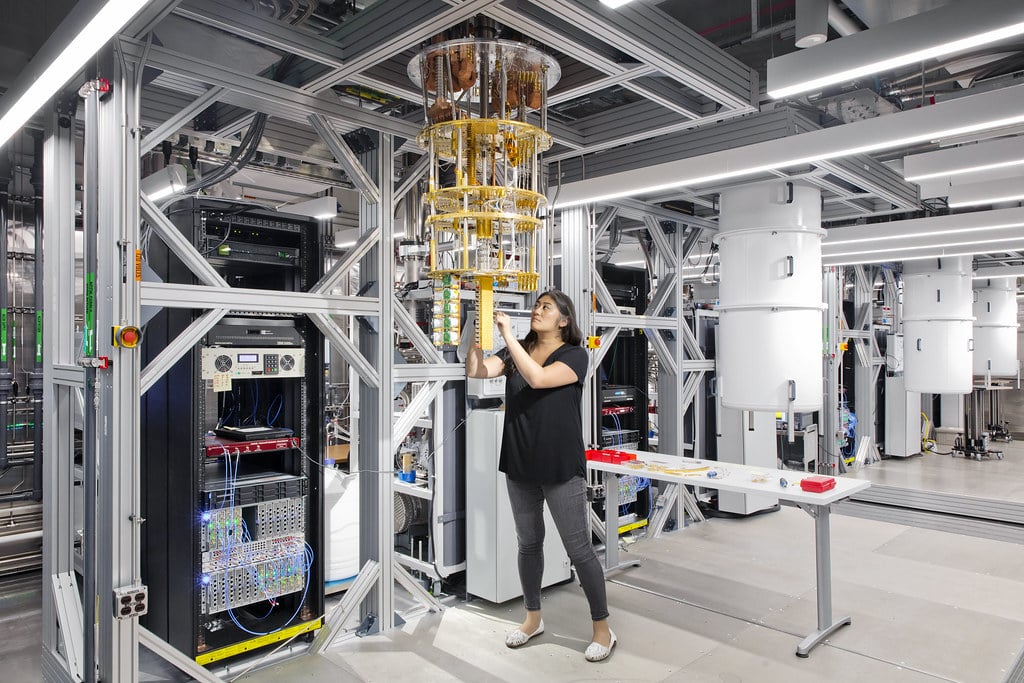
A chip the size of a dinner plate hangs inside a gold plated chandelier of wiring, cooled colder than deep space.
Every wire feeds a tiny loop of metal holding a single fragile calculation steady.
For years, engineers assumed protecting that calculation meant surrounding it with an entire city block of backup hardware.
That assumption quietly set the price of a working machine in the hundreds of millions of dollars.
A new wiring design just rewrote that math in public.
So how did the hardware needed for one trustworthy calculation shrink this fast?
Why one reliable qubit got so much cheaper to build
The hidden unit at the center of this story is the logical qubit, a single error free calculation built by stitching together many ordinary, error prone physical qubits. For years the working assumption was that doing this required hundreds or even thousands of physical qubits standing guard around just one logical one, with one of the most popular approaches, known as a surface code, requiring roughly 1,000 physical qubits to make up one logical qubit .
That overhead is the real reason quantum computers stay expensive, since each physical qubit needs its own wiring, cooling budget and control electronics. Multiply that by a thousand just to protect one unit of useful computation, and the hardware bill balloons fast.
A new error correcting code changes that ratio directly. Instead of the traditional surface code, which needs qubits arranged in a simple grid, IBM’s approach uses a family of codes with a few hundred physical qubits equipped with a low-depth syndrome measurement circuit, where hardware requirements are relatively mild, as each physical qubit is coupled by two-qubit gates with only six other qubits, and although the qubit connectivity graph is not locally embeddable into a 2D grid, it can be decomposed into two planar degree-3 subgraphs , shrinking the guard force protecting each logical qubit.
The result, described in the company’s own published research, is stark. Published research shows 12 logical qubits can be preserved for nearly 1 million syndrome cycles using 288 physical qubits in total, assuming the physical error rate of 0.1%, whereas the surface code would require nearly 3,000 physical qubits to achieve said performance .
Inside the chips doing the heavy lifting
Two separate chips carry this story from paper to hardware, released at different points on IBM’s roadmap. One is Nighthawk r2, a 120 qubit processor built for raw speed; it uses a new qubit-reset architecture that delivers up to 25 times the circuit throughput of IBM’s Heron systems, executing more than 100,000 circuits per second . The other is Loon, a smaller experimental chip built specifically to test the wiring that makes long range qubit connections possible for error correction.
Loon carries the cost story, since its defining feature is a set of long range couplers that let qubits talk to partners well beyond their immediate neighbors. That direct linking is critical for the complex interaction patterns error correcting codes require, and it is designed for IBM’s qLDPC codes, which reduce by up to 90% the number of physical qubits needed for each logical qubit compared with the traditional method .
Underneath this effort sits a third piece most coverage skips.
IBM also built a decoder that processes errors in less than 480 nanoseconds, within the margin required for real-time correction , timing the field considers essential for error correction to keep pace with a running machine. Without that speed, the cheaper qubit ratio would not hold up in practice.
The verified numbers behind the new price tag
None of this rests on a single claim. Industry trackers note a protected qubit built through error correction carries anywhere from tens to as high as thousands to one physical qubits per logical qubit, with surface codes needing far more hardware to hit the same error suppression as the new approach. Against that backdrop, the distance-12 BB code offers 10 times saving in the number of physical qubits compared with the surface code , a double digit multiple of improvement.
Independent engineering write-ups land on a similar figure from a different angle, describing codes that reduce by up to 90 percent the number of physical qubits needed for each logical qubit compared with the traditional method .
The company’s own public quantum roadmap ties the number to a bigger promise. The improved connectivity is described as needed for a scalable error correcting code, strengthening confidence toward a large-scale, fault-tolerant quantum computer, called Quantum Starling, targeted for completion by 2029 .
Chip economics elsewhere are shifting just as fast, the way a record chip sales year rewrote assumptions nobody expected to fall this soon.
Where the savings still run into real limits
A lower qubit ratio does not erase the cost of a quantum computer, it just moves the bill. IBM itself is committing more than $10 billion to quantum computing over the next five years , spanning research, manufacturing and infrastructure, a sign of how much expense remains even after the ratio improves.
That is because the 288 qubit figure describes memory, not computation. Holding logical qubits steady differs from running long sequences of logical operations across dozens of them at once, which is the real target for useful algorithms, and storing logical qubits cheaply is not the same as computing with them, since surface-code patches perform logic through a mature, well-understood choreography of merging and splitting, while a dense qLDPC block has no equally natural way to reach the qubits packed inside it .
Even so, the direction matters.
A ratio once assumed to sit in the thousands per logical qubit has been demonstrated on paper and is now being built into follow-up hardware designed around the same wiring principle, and that kind of compression rarely reverses once it shows up in a result rather than a projection.
What a cheaper logical qubit means for the next few years
None of this means a laptop sized quantum computer is arriving soon. The chips carrying this result are still lab prototypes, built to prove a wiring idea works before it gets folded into a production machine.
But the economics now point somewhere planners could not reach a few years ago. Fewer physical qubits per logical one means smaller refrigerators, shorter wiring runs, and fewer control channels for every unit of trustworthy computation a future machine delivers.
That is also why the company behind this result has set a public date for the next milestone, a large-scale, fault-tolerant quantum computer, called Quantum Starling, targeted for 2029 .
For now, the honest summary is modest and real at once. The physical qubit cost of one reliable qubit fell sharply against the old industry estimate, confirmed through published research and now being built into working silicon, and the field is treating that as the first hard evidence the economics of fault tolerant computing can actually bend.
