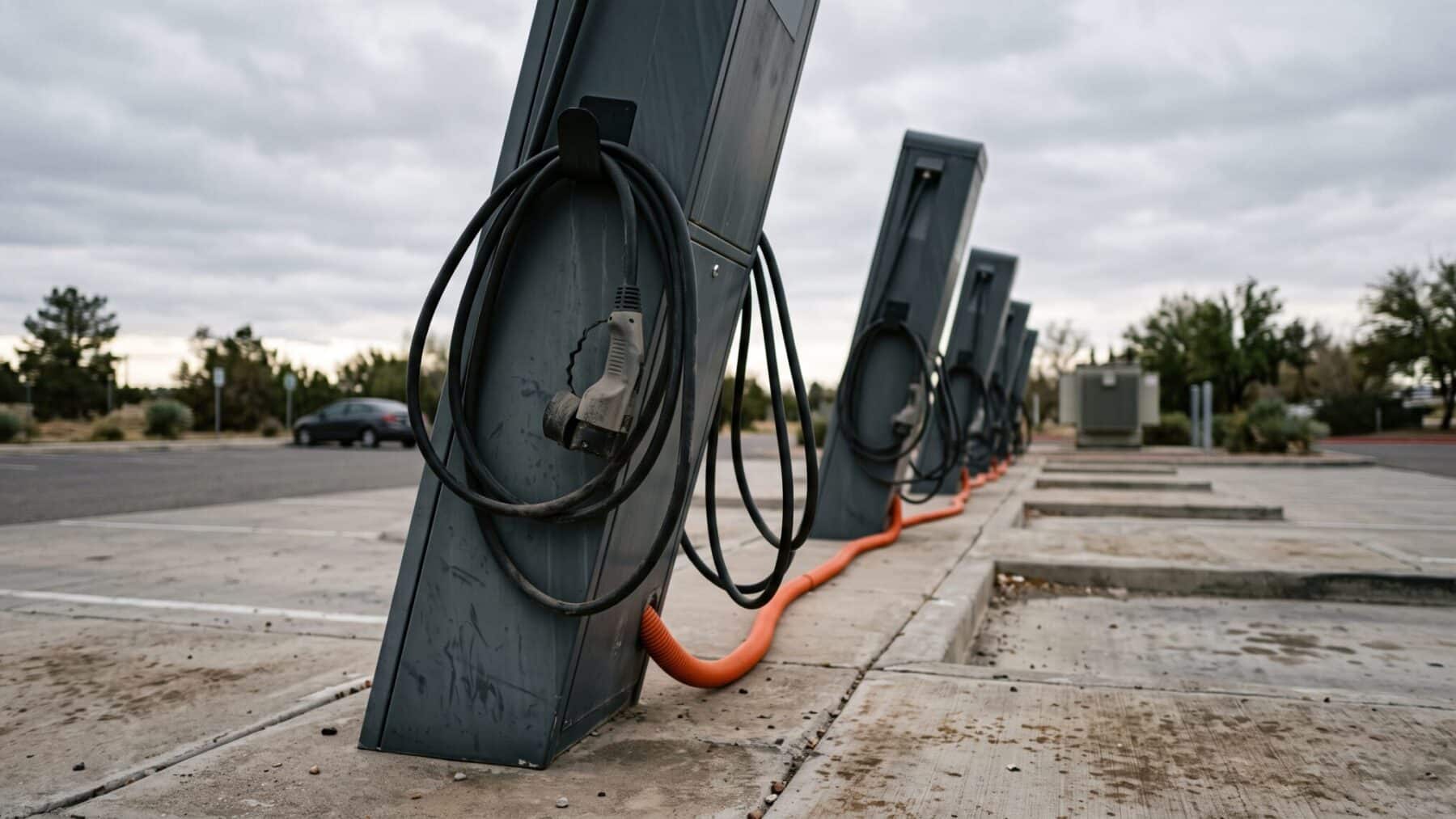
A single fast charger can sit mostly idle in a parking lot for weeks.
Yet it can still show up on a utility bill as if it ran at full blast all month.
That strange math is not a billing error.
It is how commercial electricity pricing treats any business that can suddenly pull a massive jolt of power.
Operators are now rethinking where they build and whether a site pencils out at all.
So what actually sets that bill, and why does one car plugging in matter so much?
Why one plugged-in car can set a station’s entire monthly bill
Utilities do not just charge commercial customers for the electricity they use. They also charge for the single highest burst of power that customer draws in any 15-minute window, a fee called a demand charge. For a fast charging station, that peak usually happens the moment a car plugs in and starts pulling maximum power.
So even if a charger sits empty for 29 days of the month, one car charging at full tilt on day 30 can set the demand baseline for the entire billing cycle. The utility then bills the station as though it drew that much power constantly, not just for the few minutes it actually happened.
That structure explains why demand charges now account for a disproportionate share of what it costs to run a DC fast charger. Joint Office of Energy and Transportation (DriveElectric.gov) data shows demand charges account for 23-85% of DC fast charger operating costs, dwarfing the price of the electricity itself.
And because the fee is tied to a brief spike rather than total energy sold, a near empty station pays almost the same demand penalty as one running nonstop.
The parking lot math that decides whether a charger makes money
Picture a 150-kilowatt fast charger installed at a rest stop that sees only a handful of cars a day. That single high-power session can set the demand baseline for the entire month, adding thousands of dollars to a monthly electricity bill even if the charger sits idle the rest of the time.
The gap between a busy station and a quiet one is not subtle. Figures from a federal rate-of-return analysis show cost per charge at a 150 kW station falling from $399 at low utilization to $5.73 at high utilization, a swing driven almost entirely by how that fixed demand fee gets spread across sessions.
Same charger, same rate, same equipment. The only variable is how many drivers show up.
Industry estimates suggest a DC fast charging port generally needs 15 to 25 percent utilization just to cover its costs, while strong corridor sites reaching 60% utilization can produce $3,000 to $5,000 per month per port. Below roughly 10 to 15 percent, the math usually runs backward, with empty plazas serving as a warning sign rather than a temporary phase.
What operators and regulators are finding in the billing data
The scale of this problem has started showing up in industry tracking of charging economics built on Joint Office of Energy and Transportation data. Cost modeling using a $20-per-kilowatt demand rate puts a 350-kilowatt charger’s monthly demand charges at roughly $7,000, a fixed cost that gets spread over very few sessions at low traffic.
That makes the unit economics deeply unfavorable for new stations in their early months, even before counting the electricity itself.
At the same time, overall charging demand keeps climbing. In May and June 2026, the US public DC fast-charging network set new monthly records of roughly 15.8 million and 16.1 million sessions respectively, with June’s year-over-year growth reaching 29%, according to data analytics firm Paren, which monitors more than 99% of US DC fast-charging infrastructure. In Q2 2026, the total number of DCFC sessions reached 46 million, up 15% from 40 million in Q1, Paren reported.
So the paradox cuts both ways: traffic is rising network-wide even as individual rural sites still struggle to clear the demand-charge threshold that determines profitability. That split mirrors a trend GCN has already tracked, where utilization outpaced new port growth last year, concentrating demand onto fewer, busier corridors while thinner sites fall further behind.
Where batteries and flexible grid deals are changing the equation
Because the penalty is tied to a brief power spike rather than steady draw, a battery parked next to the charger can blunt it. By charging slowly off-peak and discharging in short bursts to cover a car’s fast-charging demand, a buffer battery can shave the demand peak the utility bills.
Documented results back that up: industry guidance on battery peak shaving for EV charging sites reports that it can typically reduce demand-related costs by 20-60%, depending on site load and tariff structure, once storage absorbs the spike instead of the grid connection alone.
That dynamic is part of why utilities are experimenting with new connection models, including arrangements where chargers skip the upgrade queue in exchange for accepting limits on when they can draw full power.
Site selection has shifted as a direct result. Developers now weigh a location’s expected traffic as carefully as its electricity rate, because a station that cannot clear roughly 15 to 25 percent utilization risks losing money on every plug-in. That calculation increasingly favors interstate corridors and dense urban blocks over standalone rural plazas.
What this means for the next wave of charging stations
None of this makes fast charging a bad bet. It does mean the business now runs on two separate ledgers, one for the electricity sold to drivers and another, often larger, for the power company’s pricing structure around sudden demand.
Because utilities set these tariffs independently, the same charger can be profitable in one state and underwater in another purely based on local demand-charge rules. That has pushed developers to negotiate directly with utilities before breaking ground.
Battery buffering and traffic-driven site picking are becoming standard tools rather than upgrades, much the way large-scale storage has reshaped how the broader grid handles short bursts of demand.
For drivers, the upshot is mostly invisible: a fast charge still takes minutes and costs roughly the same at the plug. But behind that screen, the fight over a 15-minute power spike is now deciding which charging stations expand and which quietly disappear.
