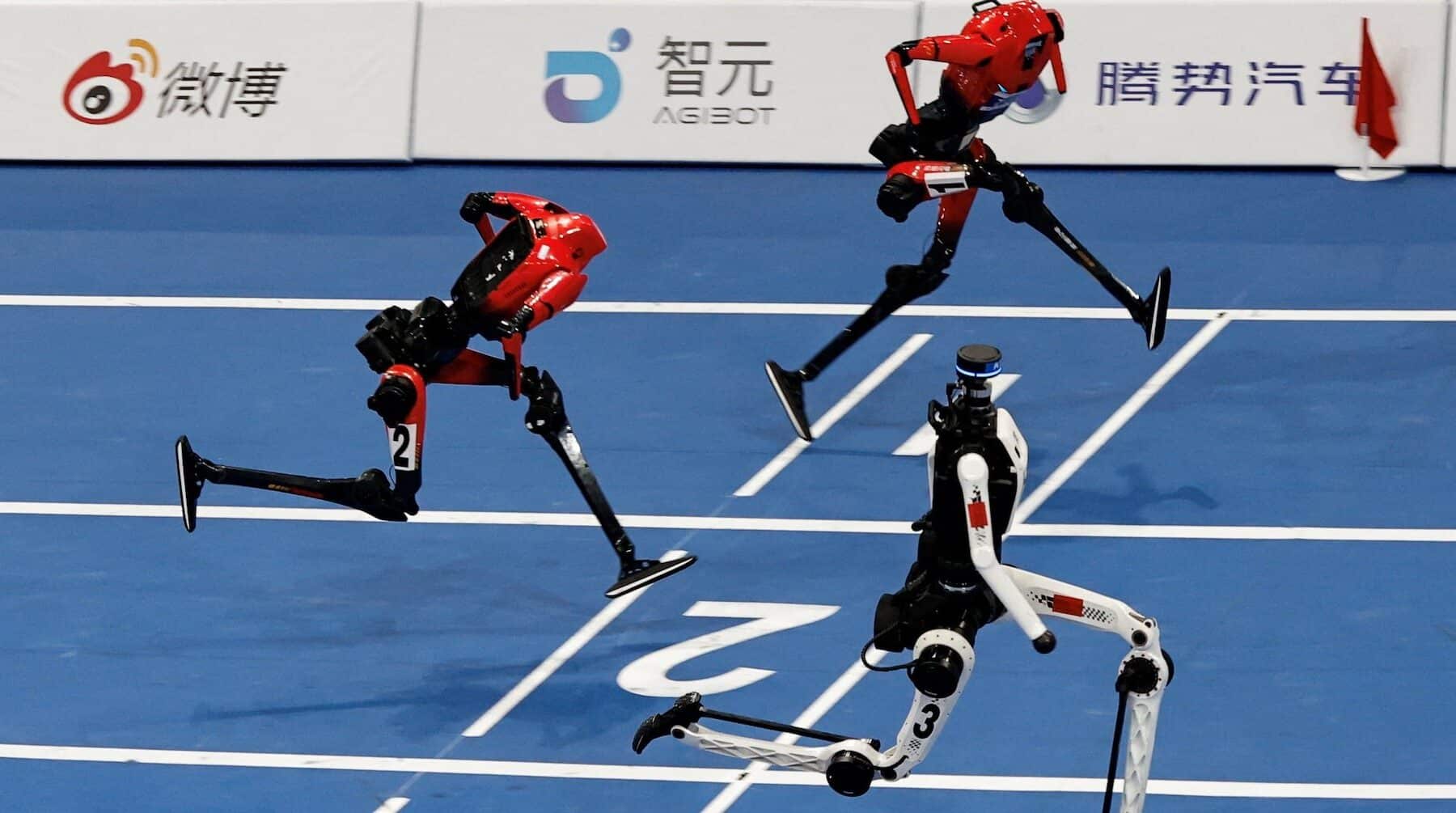
A finish line camera in Beijing caught something that had never happened on a track before.
A machine built from metal joints and circuit boards crossed it faster than any person ever has.
It did not stop cleanly, slamming into a padded wall and throwing sparks from its waist.
That collision at the finish is the part nobody expected to matter as much as the time on the clock.
How does a two legged machine outrun every human who has ever tried
Running fast on two legs is a balance problem before it is a speed problem, and that is where humanoid design has struggled for years. Every stride is really a controlled fall, with the robot’s control system recalculating its center of gravity dozens of times a second so it does not topple at pace.
The robot behind this run, called Tiangong Ultra, arrived at the games with three different running strategies trained in simulation beforehand, according to its lead engineer’s comments to Reuters. Each strategy is a trained motion-control system that continuously adjusts the robot’s joints and balance, letting it sprint upright without an operator directing every step. One strategy was considered more reliable, while the other two promised greater speed but had been tested less.
It also relies on satellite positioning and dual lidar to track its position and hold a line, rather than a human operator steering it step by step. That is part of what let it cut its own sprint time within days.
None of that solves stopping. The robot weighs about 75 kg and can exceed 17 metres per second at top speed, and future versions could become lighter, improve their braking ability and adopt a safer running posture, according to the robot’s lead engineer. A sprinting robot at this speed still cannot slow itself the way a human digs in a heel, which is exactly why the run ended in a crash, not a jog.
Inside the arena where the record actually fell
The setting was the National Speed Skating Oval, built for the Beijing Winter Olympics and repurposed this year as the track for the second World Humanoid Robot Games. More than 2,000 robots from 666 teams competed in 51 events including football, dancing and industrial-task contests.
The sprint drew the most attention of any single contest because the comparison to a human athlete was so direct. Tiangong Ultra ran 100 meters in 8.86 seconds at the World Humanoid Robot Games in Beijing on Tuesday, lowering the 9.39-second mark it set at the event’s opening, a time that had already beaten a human world record once.
Tiangong Ultra, developed by the Beijing Humanoid Robot Innovation Center, achieved the new time in the semifinal of the large-size robot division. Shaving half a second off an already record breaking time in under a week shows how fast the hardware was still being tuned between races.
What the clock actually proved, backed by the timing data
The time was more than seven-tenths of a second faster than the 9.58-second men’s human world record set by Jamaican sprinting great Usain Bolt in 2009. That gap, more than seven tenths of a second, is enormous by sprinting standards, where records usually fall by hundredths.
The center did not stop at one claim. The centre said its Tiangong machines had already beaten four human world records at this edition of the games: the 100 metres at 8.86 seconds against Bolt’s 9.58, the 400 metres at 38.15 seconds, the 1,500 metres at 2 minutes 21.64 seconds, and the high jump at 2.88 metres. The high jump gap was even more lopsided, a new mark 43 centimeters higher than the human record of 2.45 meters held by Cuban athlete Javier Sotomayor.
Even so, independent verification has limits. The result came from a single competition run rather than a standardized athletics meet, so it is best treated as a competition result rather than a certified benchmark.
Where the comparison to human athletes breaks down
A robot clocking a faster 100 meters than any person does not mean robots have become better athletes in any broader sense. The machine runs on a fixed power source and a controlled surface, conditions no human sprinter races under, and the fall at the finish line underlined that gap immediately.
Dennis Hong, a professor of mechanical and aerospace engineering at UCLA, said the run was “a significant milestone, not simply because the robot ran faster than a human, but because of what it takes to make a bipedal robot run at this speed.” Hong pointed out that the fall leads to more meaningful and difficult questions: whether robots can move and stop safely, recognize unexpected obstacles, recover from mistakes and continue working, the capabilities that ultimately make them more useful.
