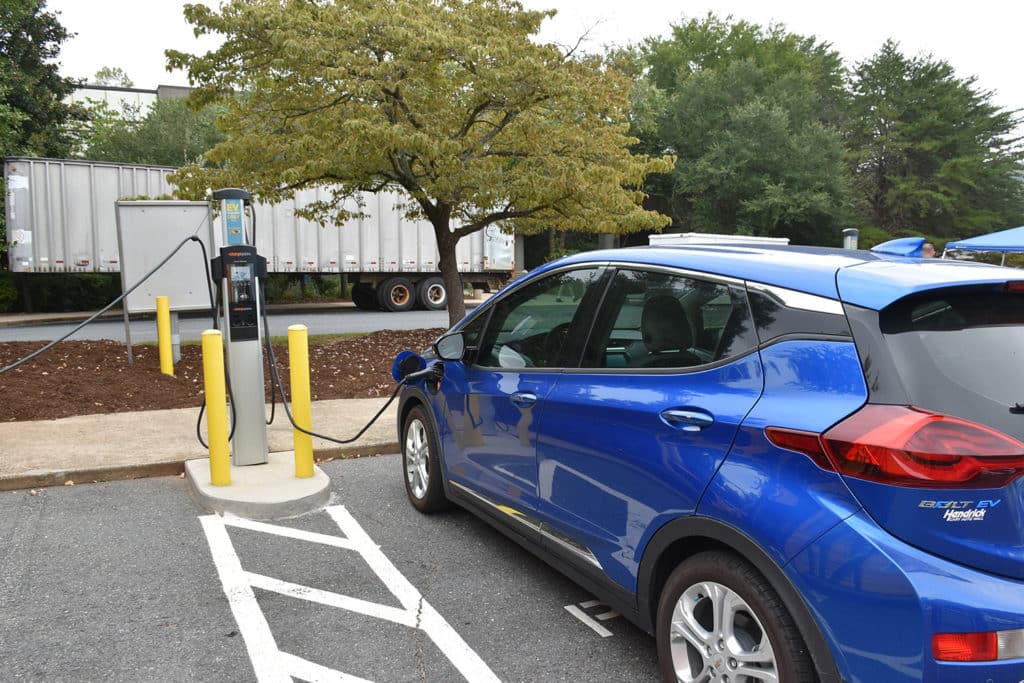
North Carolina’s Electric Cooperatives has launched a managed charging program that pays members up to $120 a year to shift electric vehicle charging into off-peak hours, using vehicle data rather than new hardware.
The program, called EVConnectNC, went live this week at two member cooperatives, with the software built by grid-edge technology provider WeaveGrid.
How the program works
EVConnectNC uses connected vehicle and charger data to help cooperatives understand charging patterns and encourage members to shift charging into lower-cost periods. North Carolina’s Electric Cooperatives and its member utilities run the program, with WeaveGrid providing the underlying software platform.
The program is already live with two North Carolina cooperatives, Roanoke Electric Cooperative and South River EMC with members enrolled and incentives being paid out today.
Members can earn up to $120 a year by charging at least 90% off-peak and using a minimum of 200 kWh per month. Eligible vehicles include Alfa Romeo, Dodge, Jeep, Lexus, Tesla, and Toyota.
Members with ChargePoint, Emporia, or Wallbox home chargers are also eligible and do not require a purchase of new charging equipment.
Unlike older managed charging programs that require a separate smart charger or second meter, EVConnectNC relies on vehicle telematics. The program utilizes EV telematics, which is an innovative method to remotely communicate with vehicles to monitor or manage their charging and collect consumption data without a smart charger or second meter.
Drivers keep control of charging times
Drivers retain full control of their vehicle and can charge whenever they need to, though charging outside the off-peak window may affect that month’s incentive.
Participants also gain access to charging insights and usage analytics through the program.
Because EV chargers and vehicles typically remain plugged in far longer than needed to reach a full charge, shifting that load to off-peak hours has little impact on the driver’s routine while helping manage costs for the broader membership.
That dynamic, long an obstacle for grid planners, is the same mismatch between plug-in time and charging time that has driven interest in other coordinated charging approaches, including record grid peaks this summer that raised the stakes for managing charging load broadly.
Why cooperatives are acting now
North Carolina’s Electric Cooperatives includes the family of organizations formed to support the state’s 26 community-based electric cooperatives, which collectively serve more than 2.8 million North Carolinians.
The push comes as the state’s EV adoption accelerates. North Carolina now has the second-highest number of EVs per capita in the country, trailing only New Hampshire.
Nikki Lynberg, Manager of Innovation and Business Development for North Carolina’s Electric Cooperatives, said the member-owned structure of cooperatives has long pushed them toward new approaches.
“As member-owned, not-for-profit utilities, electric cooperatives have a long history of embracing innovative solutions that deliver value to our members,” said Nikki Lynberg, Manager of Innovation and Business Development for North Carolina’s Electric Cooperatives.
The approach echoes other utility efforts to address rising EV-related load growth without costly new generation or wiring. Other utilities have similarly tried flat monthly credits or time-of-use rates tied to charging behavior, an approach that in states like New Jersey has already shifted from flat off-peak credits to variable, time-based rates.
A growing market for grid-edge software
WeaveGrid, the San Francisco-based company supplying the software for EVConnectNC, has built a business around helping utilities absorb EV charging load without straining local infrastructure.
“Cooperatives serve some of the fastest-growing EV markets in the country, representing more than 40 million Americans, a significant, largely untapped opportunity for managed charging programs going forward,” said Apoorv Bhargava, CEO and Co-Founder at WeaveGrid. “Working with North Carolina’s Electric Cooperatives shows that managed charging isn’t just a tool for large investor-owned utilities.”
The North Carolina rollout marks a notable expansion of managed charging beyond large investor-owned utilities into the cooperative sector, which serves rural and semi-rural customers where grid upgrades can be more expensive per household.
With incentives modest but no new equipment required, the program’s growth will depend on how many of the state’s 26 cooperatives eventually opt in beyond the two now live.
