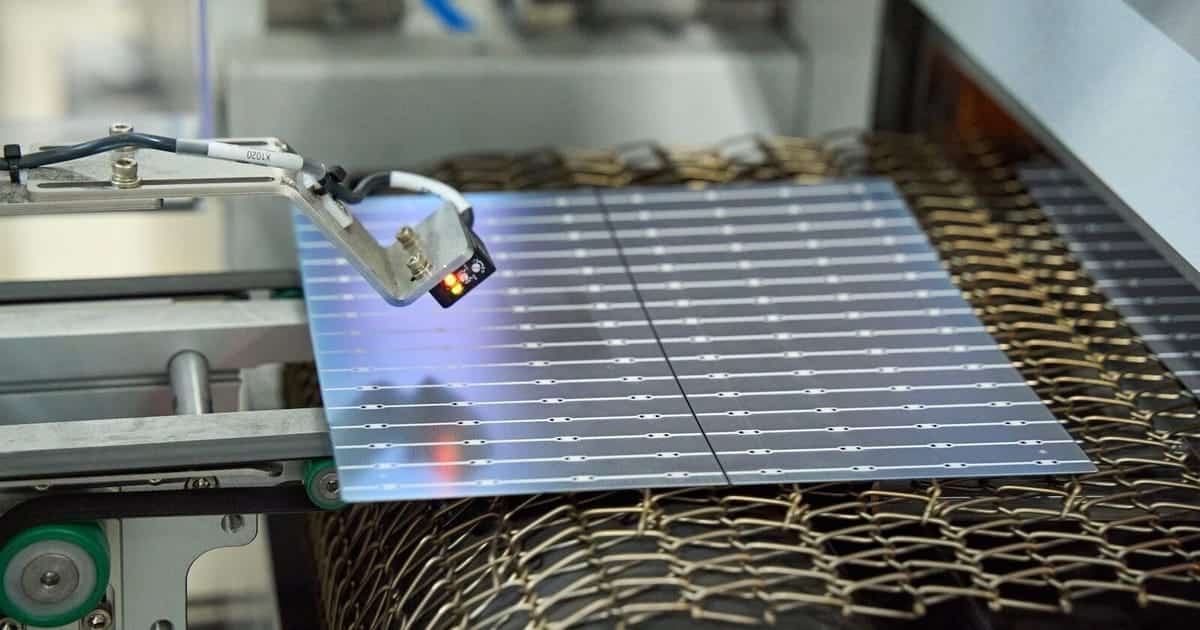
A pallet of raw silicon wafers sits just inside a factory door in the Southeast, still wrapped in foam.
Down the line, robotic arms are already stringing finished cells into panel frames.
The wafers came off a container ship weeks earlier.
Almost nothing between those two stations was made in America.
That gap just got a price tag attached to it.
So the question now is what happens to the factories stuck in the middle.
Why a price floor on raw silicon reshapes everything built on top of it
The mechanism is simple once you see it: the proclamation imposes additional Section 232 tariffs on covered imports, but its most significant feature is a new Minimum Import Price program. The proclamation combines two remedies: a minimum import price program and a 15% ad valorem tariff on polysilicon derivatives, with a company-specific onshoring incentive program.
Those floors extend into ingots and wafers, then into finished cells and modules. The minimum import price program sets price floors of $21/kg for polysilicon, $100/kg for ingots and wafers, $0.22/W for solar cells, and $0.38/W for solar modules, with materially inaccurate certifications triggering a permanent import ban.
Each step now carries its own enforced price.
That matters because the United States assembles far more panels than it makes raw material for. Industry trackers show US solar module capacity hit roughly 70 GW in 2026, but domestic cell production is only about 3.2 gigawatts, a mismatch that the tariff ripples downstream through.
Inside a supply chain built backward from how it should work
Picture the normal order of a factory floor: raw material first, then refinement, then assembly last. The US solar buildout did the opposite. Companies poured money into module assembly lines, the easiest and cheapest stage to stand up, while skipping the capital-intensive steps that come before it.
That is why a Georgia plant racing to fuse glass, wafers and cells under one roof stands out as rare rather than routine. Most assembly plants nationwide still buy wafers and cells from outside the country.
They just snap them into frames and glass under an American roof.
Commerce’s own trade case history backs this up. Regulators already found harm from solar imports from India, Indonesia and Laos, aimed at the same structural weak point. Even winners show the squeeze: a Texas manufacturer secured federal clearance to import 1.725 gigawatts of cells to maintain uninterrupted production while construction continues on its G2_Austin solar cell fabrication facility in Rockdale, Texas.
What the trade data and enforcement rules actually show
The order itself dates the problem precisely. On August 6, 2026, the president signed the polysilicon proclamation under Section 232 of the Trade Expansion Act of 1962, the same national security authority used for steel and aluminum tariffs in 2018 and semiconductors in January 2026. The Secretary of Commerce found that the quantities and circumstances of polysilicon imports threaten harm to U.S. national security, the basis cited for invoking that authority.
Enforcement carries real teeth. Materially inaccurate certifications trigger a permanent import ban, with repeat offenders barred from the market entirely. Regulators also moved early to close an obvious loophole, restricting imports from any importer found stockpiling polysilicon before the December 4, 2026 effective date.
That deadline was built to stop a pre-tariff hoarding rush.
National data confirms the squeeze was already building. Operational module manufacturing capacity reached 75.3 GW, with another 14.4 GW under construction, enough on paper to cover demand. But that figure says nothing about whether the cells inside those modules were made here.
Where the mismatch breaks down and who absorbs the cost
None of this plays out evenly. Manufacturers who already invested in wafer and cell capacity rather than assembly alone are positioned to benefit from the new floors, while companies that bet everything on final assembly now face higher input costs with nowhere else to source from. Analysts tracking the order note firms pursuing full vertical integration sit in a stronger position than peers still importing wafers wholesale.
Even so, the gap will not close overnight.
No additional solar module manufacturing capacity was added in Q1 2026, even as module manufacturing had grown tremendously in the last few years, suggesting the industry had already hit a pause. Analysts point to continued uncertainty around foreign entity rules, layering policy risk on top of the raw capacity gap.
What it means for panel prices and the factories racing to catch up
For homeowners and developers, the near-term effect is likely to show up in price, not availability. Module prices fell to $0.34 per watt in Q1 2026, compared to $0.43 per watt in Q1 2025, while commercial system prices increased by 4% year-over-year to $1.67 per watt.
That divergence is exactly what a mid-chain squeeze produces.
Panels assembled from pre-tariff inventory stay cheap for a while, but the wafers and cells behind the next batch now carry the new floor prices built into every watt. Even so, the response underway looks more like construction than retreat: U.S. solar module manufacturing capacity has grown from 8 gigawatts before federal manufacturing tax credits to 69.9 gigawatts as of June 2026, an increase of more than 750 percent.
The open question is whether wafer and cell plants scale at anything close to that pace. Until they do, the floor price set in August will keep doing the work factories further up the chain have not yet finished.
