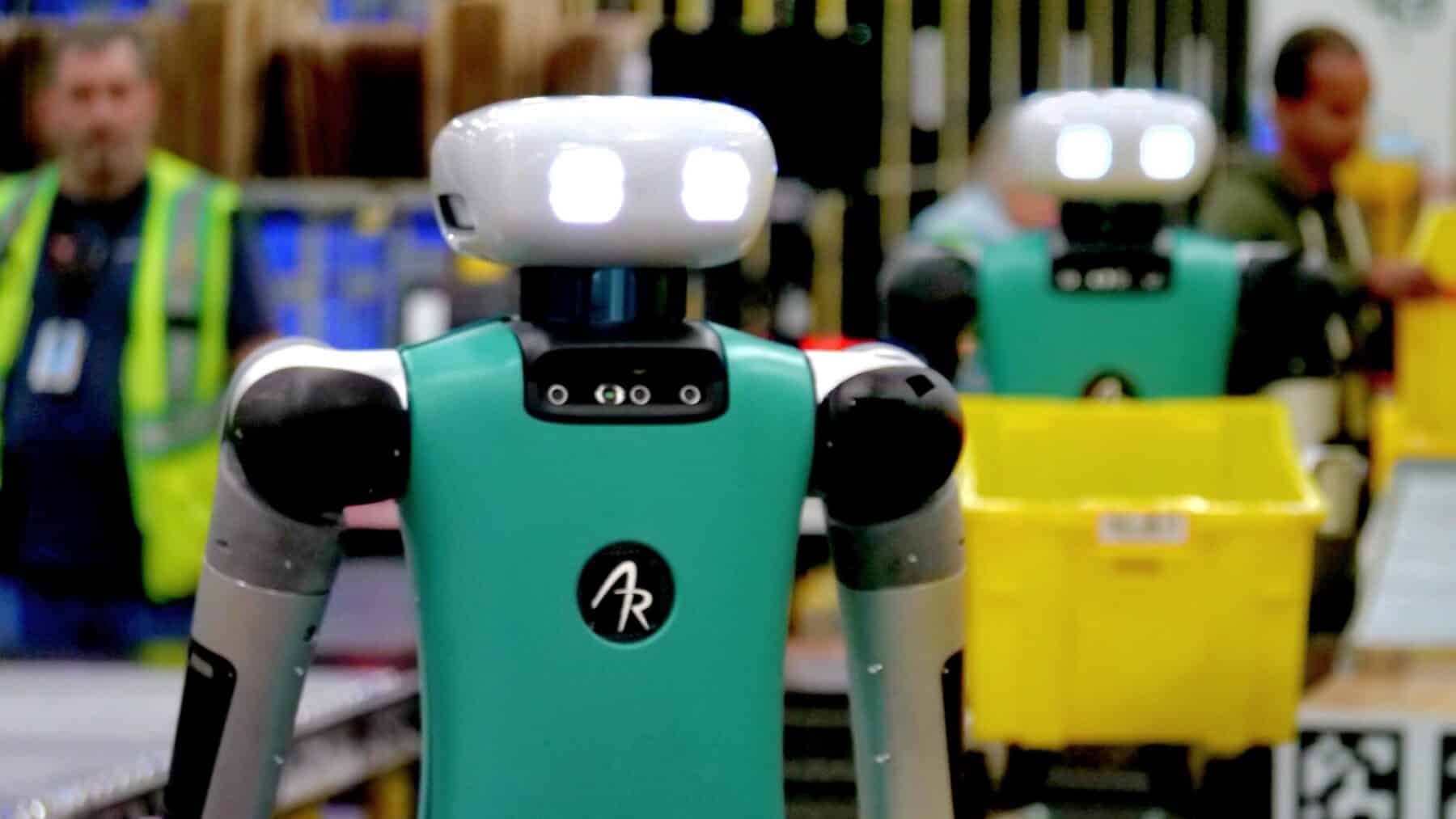
Agility Robotics began trading on the Nasdaq Stock Market on Thursday under the ticker symbol AGLT, becoming the first publicly listed company in the United States built entirely around humanoid robots.
The Oregon company completed its merger with special purpose acquisition company Churchill Capital Corp XI, a deal that provides about $465 million in gross proceeds before expenses. That includes about $164 million from Churchill XI’s trust account after redemptions, $201 million from a private investment in public equity (PIPE) led by Foxconn, and a $100 million funding round closed after the SPAC announcement.
Shares open above SPAC price
Agility’s stock opened at $11.26 per share, above the $10 per share price used in the SPAC deal.
Churchill XI shareholders approved the deal on Nov. 2, with more than 84% of votes cast in favor. The transaction closed on Nov. 4 , a day before shares began trading on Nasdaq.
Agility Robotics, which makes the Digit humanoid robot for warehouses and factories, began trading on the Nasdaq on Thursday after a $2.5 billion SPAC merger. Agility co-founder and chief robot officer Jonathan Hurst discussed the Nasdaq debut in an interview with GeekWire.
Agility had previewed the transaction in SEC filings in the weeks leading up to the vote. The company describes itself as the only U.S. publicly listed pure-play humanoid robotics company with proven, active commercial deployments.
Digit robot already working in warehouses
Agility’s flagship product is Digit, a two-legged robot designed to move totes and boxes in warehouses and factories without requiring a safety cage around it.
Amazon began testing the robot in 2023, initially using it to move empty totes, while GXO has also deployed the humanoid machine at warehouses.
AGCO plans to pilot Agility Robotics’ Digit humanoid robot at its Hesston, Kansas, facility in 2027 to support assembly and production operations, with the robots initially supporting parts sorting and stacking and the placement of totes for storage at the Hesston plant.
The capital raised through the SPAC merger is earmarked largely for production. Agility will use the capital to bring its latest Digit 5 robot to market and add manufacturing capacity.
The company has previously said it is building toward a factory, known as RoboFab, capable of turning out thousands of robots a year. The 70,000-square-foot manufacturing facility in Salem, Oregon, is designed for annual production capacity of up to 10,000 robots.
A crowded and unproven market
Humanoid robotics has drawn billions of dollars in investment from startups and established robotics firms betting that machines shaped like people can slot into existing workplaces built for human bodies, from warehouse aisles to factory floors.
Agility’s public listing sets it apart from privately held rivals and gives outside investors a direct way to bet on the category, though the company itself has cautioned that widespread deployment will take years. Several well-funded competitors, including Tesla and Figure AI, are also racing to bring humanoid robots to market, though they remain privately held or are developing the technology as part of broader corporate operations.
Agility’s approach echoes the automation push at Amazon, where machines like the Proteus mobile robot and the touch-sensitive Vulcan picker have been deployed across fulfillment centers, a trend GCN has previously covered as major technology companies expand automated and AI-driven infrastructure.
The move also follows a broader pattern of AI companies pursuing unconventional paths to scale quickly, a dynamic GCN examined in its coverage of a San Francisco AI lab’s rapid fundraising.
Whether humanoid robots prove durable, cost-effective replacements or supplements for warehouse labor remains an open question across the industry.
Agility’s public listing now puts that bet in front of stock market investors rather than only venture capital firms, giving the broader market a transparent gauge of how fast commercial humanoid robot deployments are actually growing.
