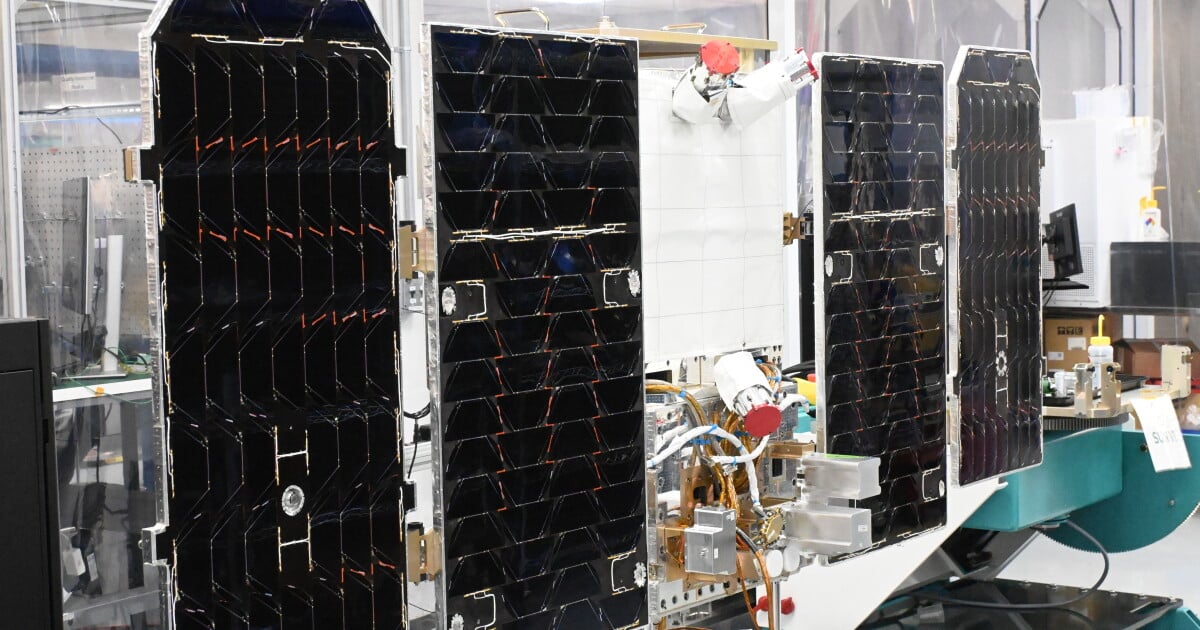
Google has launched a prototype satellite carrying four of its custom AI chips into orbit, an early step in a research effort called Project Suncatcher that explores running machine learning computation in space using solar power.
The satellite, built with Earth-imaging company Planet, lifted off October 1 aboard a SpaceX Falcon 9 from Vandenberg Space Force Base as part of the Transporter-18 rideshare mission.
What the prototype satellite carries
The prototype satellite has four specialty chips in it called Tensor Processing Units, or TPUs, that Google designed for machine learning and has already deployed in data centers on Earth.
According to Google’s blog post, the mission will gauge how the TPUs handle “the physical stress of spaceflight and the radiation and thermal extremes of space.”
A rocket trip into low Earth orbit lasts about 10 minutes, during which the spacecraft experiences intense vibration and sustained acceleration loads up to 10 times the force of gravity, or g-force.
Individual components, such as the TPU chips, can experience even greater forces up to 50 to 100 g.
The team conducted vibration testing by intensely shaking the satellite on all three axes to mimic the frequencies of a rocket launch. Separately, chips were tested in a proton beam facility to simulate space radiation while running AI workloads, as described in the same post.
A kilowatt of solar power and 15 minute bursts
The satellite will be in a sun-synchronous orbit where its solar panels will almost never be in the shade. That eliminates the need for carrying heavy batteries or backup power on the spacecraft , according to NPR member station reporting.
Travis Beals, senior director of the project, explained the underlying logic behind pursuing orbital solar power for computing.
“The sun puts out almost all of the power in our solar system. All of the other power sources that humanity has tapped into are just a tiny fraction of a percent,” said Travis Beals, senior director and lead of Project Suncatcher. “So in some sense, this project is about tapping into the best way to use solar power to run AI compute.”
The chips will run a version of the company’s Gemma AI model for 15 minutes at a time due to heat management constraints, using the open weight model to answer simple queries.
Because space lacks airflow for cooling, Google called cooling the chips “a crucial research challenge,” and outlined some of the approaches it’s working on, including using a combination of pipes and radiators to wick heat away from the chips.
Beal said the radiators are one of the heaviest components on the current mission, a drawback because heavier objects are more expensive to launch, and his team is working on ways to cool chips more efficiently.
A test flight, not a working data center
Google has been explicit that this is an early feasibility check rather than a functioning compute cluster.
Beals called the satellite launched “a very minimal test” to make sure the chips can run in space. A SpaceX rocket carried it into orbit, and Planet will get it up and running. Beal said Google will then fire up and test the TPUs. The goal is for the mission to be operational for a year.
Google first described the Project Suncatcher concept in a research blog post published in November 2025, outlining a vision for compact satellite constellations linked by laser based optical communication that could one day scale machine learning compute in orbit.
Next year, the company plans to put two more satellites into orbit to test their connection , building toward the larger constellation concept.
Why the project matters for AI infrastructure
The orbital experiment arrives as AI companies strain against power and land constraints for terrestrial data centers, a dynamic that has also pushed firms toward unconventional engineering fixes like the new liquid cooling design that cuts water use on the ground.
It also follows a broader pattern of major AI developers racing to secure specialized hardware, a trend visible in moves like Nvidia’s optical interposer chip prototype aimed at future AI servers.
Outside researchers have described the space-based compute concept as ambitious but technically grounded.
Brandon Lucia, a professor of electrical and computer engineering at Carnegie Mellon University, said the idea sounds “very sci-fi,” but much of the technology has been proven at a research level.
Google has not said when, or whether, the concept could move beyond prototype testing toward an operational orbital compute system.
