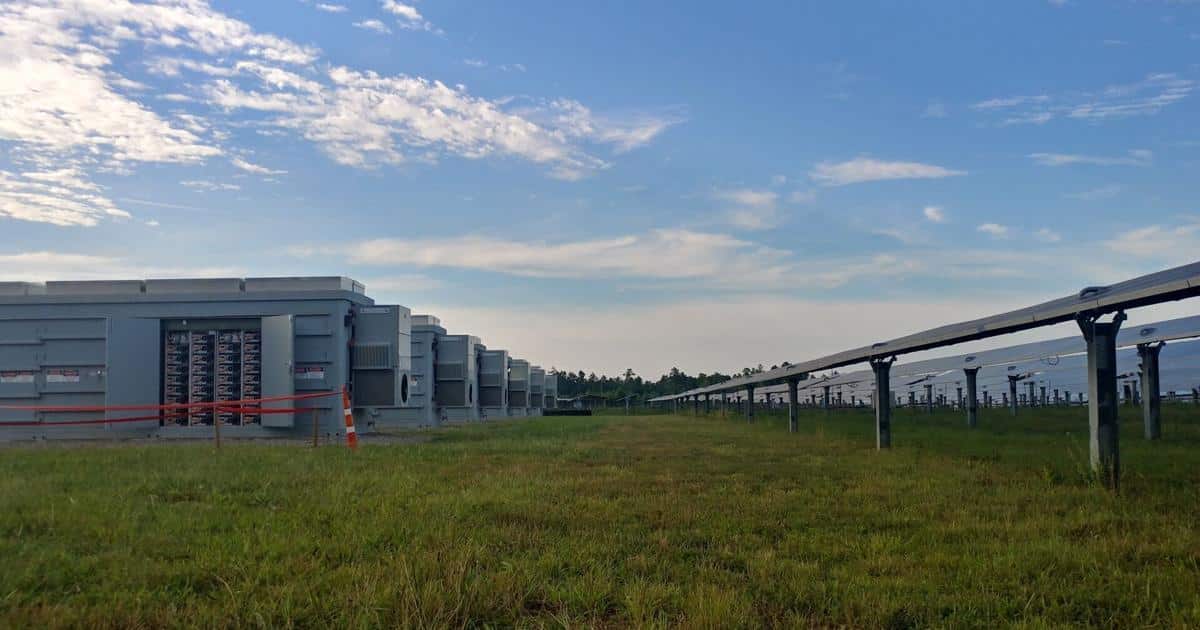
Developers plan to pair battery storage with more than 30 percent of new utility-scale solar capacity in both 2027 and 2028, nearly double the 16 percent share recorded so far this year, according to new federal data released by the U.S. Energy Information Administration.
What the data show
Utility-scale solar developers are increasingly co-locating battery storage with new solar photovoltaic capacity.
As of September 2026, over 16% of new utility-scale solar capacity added this year is co-located with operable battery storage, compared with 2% in 2017, according to data reported to the U.S. Energy Information Administration by operators.
That figure translates to roughly 41 gigawatts of co-located capacity so far this year, according to reporting on the EIA figures.
Reported plans for solar additions scheduled to come online in the last three months of this year show that the share with co-located battery storage could increase to 19% this year.
Longer-term plans indicate that this trend will continue, with the portion increasing to more than 30% in plans submitted for 2027 and 2028, EIA said on Oct. 30.
Why operators are bundling the two technologies
Although battery storage and solar units at the same plant often enter commercial service at different times, the EIA-860 and EIA-860M data collection program tracks these developments and provides a monthly summary that can be used to identify co-located technologies.
That separation lets analysts identify which projects were designed as combined facilities from the start.
The appeal for developers comes down to flexibility in volatile power markets. “When operators co-locate battery storage with solar, they can direct solar electricity output to the grid or to the battery, depending on the wholesale prices,” EIA’s report said.
“Wholesale prices in regions with large solar participation tend to fall when solar contributions are high and rise as they decrease.”
“Plants with both solar and battery storage can manage the combined output of their generating resources to maximize their value in a changing wholesale price environment,” EIA added.
Southwest states lead the shift
“As of September, 13% of the total U.S. utility-scale generating capacity is solar photovoltaic, and 18% of that is co-located with battery storage,” EIA said.
Four states stand out well above that national baseline. Southwest states have higher-than-average solar capacity shares relative to their total generating capacity and also have higher levels of co-located utility-scale solar and battery capacity.
The share of solar generation co-located with battery capacity in California, Arizona, New Mexico, and Nevada is more than double the national average.
Independent research backs up the scale of the buildout already underway. A September analysis from Lawrence Berkeley National Laboratory found that at the end of 2025, there were 436 co-located solar-plus-storage projects in the United States, with a total of 29 GW of solar capacity and close to 17 GW of storage capacity.
Why it matters for the grid
The shift toward pairing solar with storage is reshaping how grid operators manage daily supply swings, a pattern already visible in markets like Texas, where batteries discharged a record amount during a winter price spike.
The buildout comes as interconnection backlogs continue to weigh on the broader storage sector, with the national project queue still topping 2,000 gigawatts despite federal reforms aimed at speeding approvals.
Even so, EIA’s data suggest that for solar specifically, the pairing of generation and storage at a single site has become close to standard practice in the regions where solar is most prevalent, and is on track to become the norm nationwide within two years.
