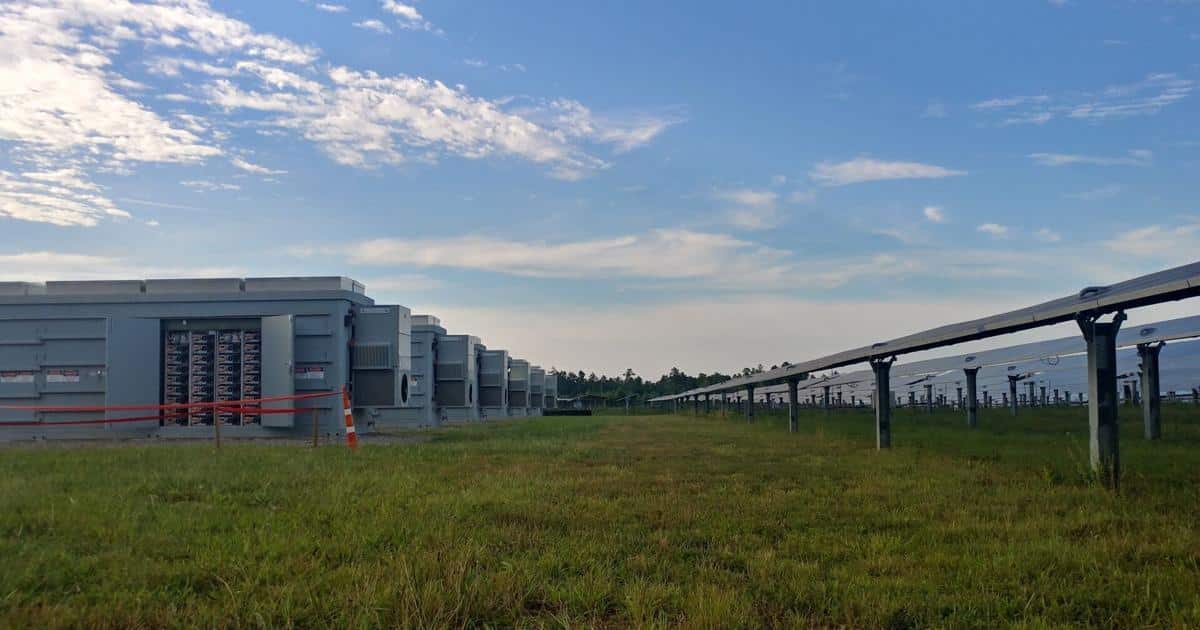
The queue of generation and storage projects awaiting permission to connect to the US electric grid remains above 2,000 gigawatts nationwide, according to Lawrence Berkeley National Laboratory’s annual Queued Up tracking.
Battery storage developers are still facing years of delay even as federal regulators push through a new round of structural reforms.
The backlog remains roughly equal to all operating US generating capacity combined. It has become a central bottleneck constraining how fast grid scale batteries can reach the power system.
The Federal Energy Regulatory Commission has spent roughly three years trying to clear the jam through Order No. 2023, its broadest overhaul of generator interconnection rules in decades.
A queue still bigger than new generation can clear
Total interconnection queue capacity stood at roughly 2,600 gigawatts (GW) at the end of 2023, falling to about 2,290 GW by the end of 2024. By the end of 2025, the total had fallen further to roughly 2,061 gigawatts, according to Berkeley Lab’s most recent Queued Up data.
Despite the recent decline, the backlog remains historic in scale. Active queue capacity is highest in the non-ISO West, followed by ERCOT, and capacity fell in 2025 in all regions except ERCOT and SPP, with most projects that enter the queue ultimately never getting built.
Battery storage projects make up a large and growing share of that backlog. The technology is widely regarded as one of the most flexible tools available for grid reliability, since it can be paired with solar or built standalone and dispatched within seconds, as seen in projects like Dominion Energy’s storage plan in Virginia.
But that flexibility has not spared batteries from the same multi-year wait that generation projects face.
FERC’s reform record so far
The Federal Energy Regulatory Commission on July 24, 2025, ordered the PJM Interconnection to make changes to its process for studying requests by generating developers to connect to the grid, after ruling that PJM’s existing compliance plan did not fully satisfy Order 2023.
That action marked one of the most direct federal interventions yet in the effort to unclog queues holding hundreds of gigawatts of battery storage projects.
The reforms have produced some measurable results. Of the 84 generation and storage projects totaling 14.3 GW of capacity that received interconnection agreements through PJM’s first transition cycle, 21 were battery energy storage resources, providing 1.9 GW of the cycle’s total capacity.
Order 2023 also changed how storage projects are studied in the first place. The rule established co-location standards allowing battery storage to share a single interconnection request with a co-located generation asset, removing a longstanding barrier for hybrid solar-plus-storage projects.
That shift is reshaping deals from Texas to the Southwest, regions driving much of the country’s new battery capacity, a trend also visible as solar farms increasingly pair batteries with new capacity nationwide.
Projects still spend years waiting
Even with the procedural changes, wait times in the nation’s largest grid operator remain long. PJM’s average interconnection timeline has stretched from under two years in 2008 to roughly eight years by 2025, despite the Order 2023 reforms that began taking effect in 2023.
That gap highlights the distance between the pace regulators are pushing for and the pace developers are actually experiencing.
The slow churn matters beyond individual project economics. Utilities are increasingly counting on battery storage to smooth demand spikes from data centers and electrified transportation, a dynamic already playing out in programs that shift EV charging load off peak in New York and similar pilots elsewhere.
If storage projects cannot get connected on schedule, utilities lose one of their fastest tools for managing that load growth.
FERC’s attention has also expanded to the load side of the equation. On June 18, 2026, FERC took action to facilitate access by large loads, such as AI data centers and manufacturers, to the electric grid, issuing show cause orders to PJM, MISO, SPP, CAISO, ISO-NE and NYISO.
At the center of the proceeding is a preliminary finding that existing tariffs for these six grid operators may not adequately address the challenges of integrating large, co-located loads onto the transmission system.
What comes next
Grid operators now face deadlines to either justify their respective tariffs as just and reasonable or file reforms in response to FERC’s show cause orders.
How those proceedings resolve will shape whether battery storage developers see queue wait times shrink or whether the backlog continues to outpace FERC’s reforms.
